FNU DNP practice hours: 500 hours across DNP850 to DNP853
FNU's post-master's DNP counts 500 practice hours, and they fall only within the four project courses, DNP850 to DNP853. Together with 500 hours from your master's, that makes the 1,000 FNU requires. FNU encourages you to spend that time at your own workplace, leading a rapid-cycle quality improvement project, and it describes no placement service for DNP sites.
No project site yet?
Tell us your DNP cohort and when you reach DNP850. A placement advisor will reply by email.
The four courses that carry the hours
The October 2025 program of study for the post-master's DNP lists six didactic courses, DNP800 to DNP805, and four project courses with clinical credit. Only the project courses count toward the 500 hours.
| Course | Title | Credits |
|---|---|---|
DNP850 | DNP Scholarly Project Preparation | 1, clinical |
DNP851 | DNP Scholarly Project Planning | 4, clinical |
DNP852 | DNP Scholarly Project Implementation | 4, clinical |
DNP853 | DNP Scholarly Project Dissemination | 3 (2 didactic, 1 clinical) |
That is 10 clinical credits in a 30-credit program. FNU does not publish how the 500 hours divide between the four courses, so your DNP clinical faculty and each syllabus are where to confirm what a course expects.
In the full-time sequence, DNP850 sits in term 3 alongside DNP804 and DNP805, and DNP851, DNP852 and DNP853 follow in terms 4, 5 and 6. The full-time program was labeled 18 months over six terms and the part-time one 27 months over nine.
Where FNU's hour figures disagree
FNU's sources do not line up perfectly on DNP hours, and it helps to know where before you plan a calendar.
| Source | What it says |
|---|---|
| Program of study, October 2025 | A minimum of 1,000 clinical hours: 500 from the MSN and 500 in the DNP |
| Catalog, DNP section | 500 contact hours, counted only within DNP850 to DNP853 |
| FNU clinical experience page | 500 clinical hours over 3 terms |
| Catalog, program overview | 8 credits (360 contact hours) of clinical practicum |
The 500-hour figure appears in the most places, and the program of study shows 10 clinical credits rather than 8. The three-term wording also sits oddly beside a program of study that spreads clinical credit over four terms. Ask your DNP clinical faculty which figure governs your cohort, and plan from the number they confirm.
The project the hours serve
DNP hours are not a rotation in the MSN sense. FNU describes them as time spent collaborating with your clinical site to lead and implement a rapid-cycle quality improvement project, guided by the specific needs of that practice.
The project uses the Institute for Healthcare Improvement (IHI) Model for Improvement. FNU describes small-scope projects that can be implemented within three months, applying the model over an eight-week period. Students partner with clinical site sponsors, Frontier faculty and faculty from the IHI Open School.
Because of that design, the site question for a DNP student is less about patient volume and more about whether an organization will let you lead a small change and measure the result. A willing leader at the site matters more than a busy clinic.
Your workplace is the expected site
FNU encourages DNP students to complete their clinical hours in their current workplaces, and the catalog pictures the project ideally taking place where you work as an APRN. Applicants are strongly encouraged to identify potential project sites and mentors early, and the catalog says DNP clinical faculty are closely involved in helping identify them.
FNU describes no placement service for DNP project sites; the model is your own practice. That makes the DNP very different from FNU's MSN tracks, where Clinical Advisors and the Community Map support the search.
Working where you are employed has practical effects. If your employer does not ask for an affiliation agreement, its own requirements replace FNU's compliance items. If you volunteer at a project site, you complete FNU's list through DNP850. Sites owned or run by a first-degree family member are not allowed. The employer site page covers keeping your job and student roles apart.
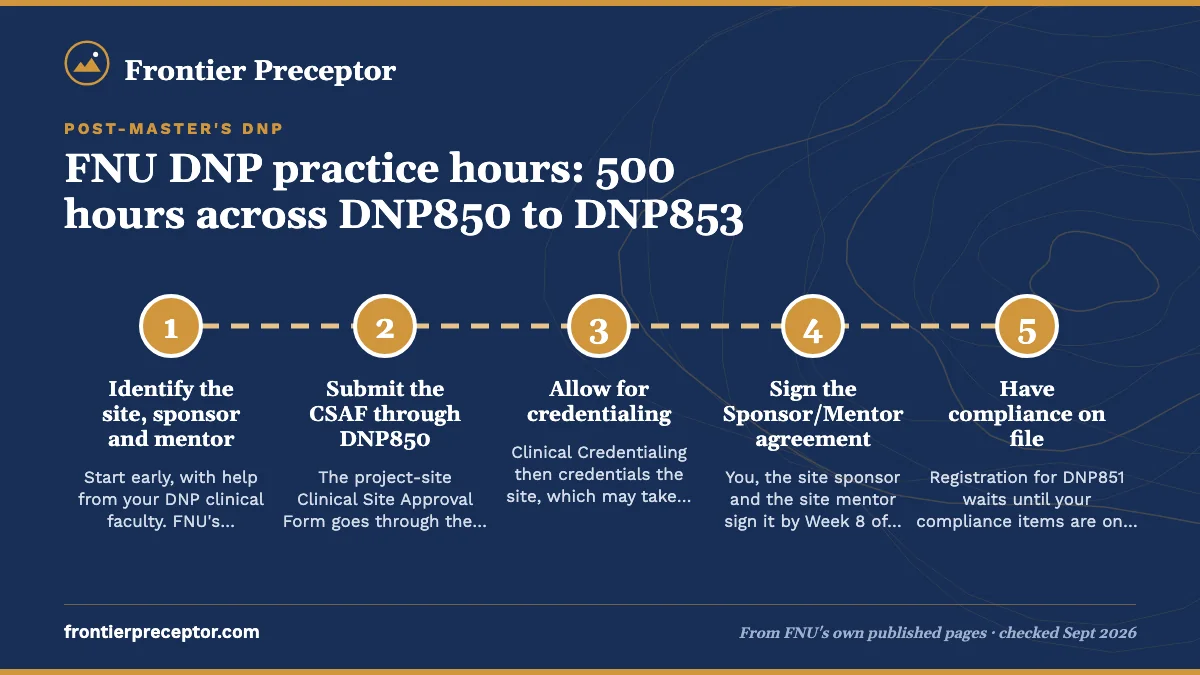
Sponsor, mentor and the steps before DNP851
Two people at the site anchor your project, and FNU sets different bars for each. The mentor must hold a master's degree or higher plus quality improvement or clinical expertise. The sponsor has no defined level of education.
- Identify the site, sponsor and mentorStart early, with help from your DNP clinical faculty. FNU's suggested first choice is your own workplace.
- Submit the CSAF through DNP850The project-site Clinical Site Approval Form goes through the
DNP850Canvas course, also referred to as DNP Prep 101. - Allow for credentialingClinical Credentialing then credentials the site, which may take several months.
- Sign the Sponsor/Mentor agreementYou, the site sponsor and the site mentor sign it by Week 8 of the term before
DNP851at the latest. - Have compliance on fileRegistration for
DNP851waits until your compliance items are on file.
Week 8 of the term before DNP851 is the fixed point in the DNP calendar: the Sponsor/Mentor agreement must be signed by then.
Companion DNP, international sites and New York
The Companion DNP, open to FNU MSN graduates, uses the same DNP850 to DNP853 project courses within 21 credits, plus nine credits completed in the FNU MSN. FNU does not state its hours separately, and it is missing from the October 2025 programs of study page though still listed on the tuition page, so confirm its status before planning around it.
Unlike MSN and PGC students, DNP students living outside the continental US may petition FNU's DNP program leadership for an international project site. New York's clinical restriction does not apply to DNP applicants, who are eligible for admission. DNP students come to campus once, for the three-day DNP Bound orientation.
The DNP program page covers admission and the program as a whole.
When the workplace route needs a backup
FNU builds the DNP practicum around your own workplace, and when that route works it is the natural choice. If your employer cannot host a project, or you are between roles, we look for an organization near you with a master's-prepared mentor willing to support a small quality improvement project. If a planned site falls through before the Sponsor/Mentor agreement is signed, tell us early so a new search has time to work.
We also gather with you the site, sponsor and mentor details the CSAF and Clinical Credentialing ask for, planned around the Week 8 deadline. FNU's DNP faculty and credentialing team decide whether a site works. Tell us your cohort and when you expect to reach DNP850.
Questions FNU students ask
Do my MSN clinical hours count toward the DNP's 1,000?
Yes, as FNU frames it. The post-master's DNP program of study sets a 1,000-hour minimum made up of 500 hours from your MSN and 500 within the DNP. The DNP hours count only inside DNP850 to DNP853. If documenting your master's hours could be difficult, ask FNU how they are verified before you enroll.
Can I do my FNU DNP project somewhere other than my job?
Yes. FNU encourages the workplace but does not require it, and DNP clinical faculty help students identify sites. A site where you volunteer means completing FNU's compliance items through DNP850, credentialing of the site, and a sponsor and mentor who sign the agreement by Week 8 of the term before DNP851. Sites run by a first-degree relative are excluded.
Who can be my DNP project mentor?
The catalog asks for a mentor with a master's degree or higher and quality improvement or clinical expertise. FNU's published wording does not say the mentor must be an APRN, but confirm with your DNP faculty before you ask someone. The sponsor, the other named person at the site, has no defined education requirement.
Do FNU DNP students need BLS certification?
It depends on your site. When you volunteer at a project site, you complete FNU's compliance list, which includes BLS, through DNP850. If you work at the site and it requires no affiliation agreement, you follow your employer's requirements instead of FNU's list. Check which case applies with Clinical Credentialing early in the program.
Related pages
Last checked 2026-09-23
We check these pages against FNU's own published sources. Your Clinical Advisor, your RCF and FNU's current guidelines have the final word.
Your site submitted before Clinical Bound.
Tell us your FNU track, your county and your Clinical Bound date. We look for a preceptor and site that fit FNU's rules for your track, and help you get the CSAF and credentialing details right.
- Matched to your track: CNM/CM, NP, or the right mix FNU allows
- Ready for the CSAF, the RCF and Clinical Credentialing
- In person near you, or telehealth within FNU's caps
Start your placement plan
A placement advisor replies with what an FNU-ready preceptor and site look like for you.