FNU WHNP clinicals: a women's health preceptor with the volume you need
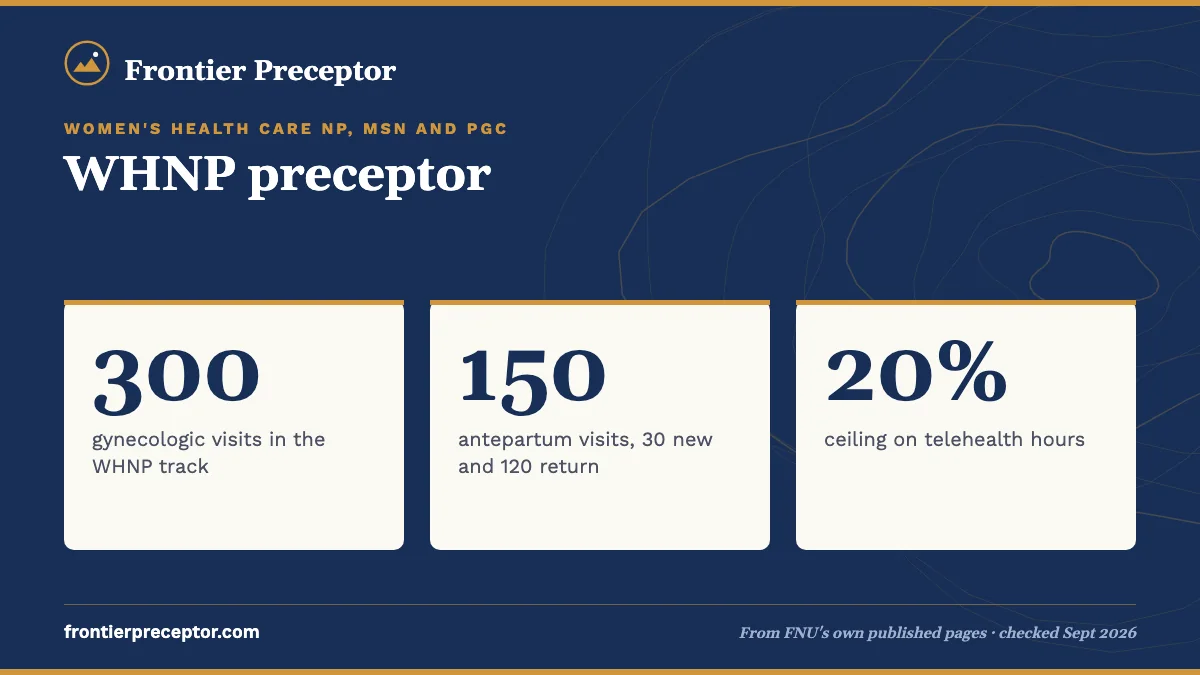
FNU's Women's Health Care NP track is built on volume: 300 gynecologic visits, 150 antepartum visits and 100 primary care visits inside 750 clinical hours. Your primary preceptor should be a WHNP, you locate and secure the sites yourself with FNU's help, and no registration for WH750 Clinical Bound happens until your RCF has accepted at least one site.
Get your placement plan
Tell us your FNU track and where you live. A placement advisor replies with what a FNU-ready preceptor and site look like for you.
Visit counts: why gynecologic volume drives your plan
For anyone whose clinical courses begin in 2025 or later, the WHNP requires a minimum of 750 hours spread over 19 clinical weeks. The visit list FNU publishes for WHNP students is short but heavy:
- 300 gynecologic care visits
- 30 new antepartum visits and 120 return antepartum visits
- 25 postpartum visits within 8 weeks of birth
- 25 perimenopausal or postmenopausal visits
- 100 primary care visits
Three hundred gynecologic visits is the figure most WHNP plans are built around, so a practice with a full gynecology schedule is worth more to you than one where gynecology is an occasional add-on. Ask about primary care as well: a women's health practice that refers primary care elsewhere may not be able to cover your 100 primary care visits.
Two counting rules matter. A visit you only observed does not count toward these numbers, and observation at a specialty site does not count toward your hours either.
WH750 to WH753: the clinical sequence
The clinical block is identical for MSN and PGC students. FNU does not publish clinical hours per course, but its catalog does set a weekly minimum for each practicum.
| Course | Credits | Content | Weekly minimum |
|---|---|---|---|
WH750 | 1 (lab) | Clinical Bound: Transition to Clinical, a five-day skills intensive with simulation | Not a practicum |
WH751 | 4 | WH Clinical Practicum I (course detail) | 20 hours |
WH752 | 6 | WHNP Clinical Practicum II | 28 hours |
WH753 | 5 | WHNP Clinical Practicum III | 24 hours |
WH717 | 1 | WHNP Final Comprehensive Review (didactic) | Not a practicum |
WHNP clinic time is capped at 10 hours in a day and 40 in a week. Your first site has to offer at least the WH751 weekly minimum, since that is one of the conditions your RCF checks before accepting a CSAF.
The preceptor a WHNP student needs
Per the catalog, your primary preceptor ought to be a Women's Health Nurse Practitioner. FNU also accepts CNMs, CMs, FNPs, MDs and DOs, and visits you complete under an MD or DO count toward your required visits, which makes an OB/GYN physician a workable second preceptor.
Each preceptor must also clear FNU's general bar: a US license with no encumbrances, a year or more of relevant experience in an advanced-practice or medical role, and, for nurses, graduate preparation in a nursing-related field. Relatives cannot precept you, and you cannot train at a practice owned or run by anyone in your family or household. The preceptor requirements page compares these rules with the other tracks.
Plan for three sites, not four. FNU's catalog allows WHNP students no more than three, while its website says four, so treat three as your limit unless your RCF tells you otherwise in writing.
Telehealth, fetal monitoring and New York
Telehealth can cover up to 20% of your program hours and no more than 30% of any single visit type. Licensure follows the patient: for each telehealth visit you need to satisfy the nursing rules of the state the patient lives in, as the telehealth page explains.
WHNP and midwifery students add current fetal heart monitoring education to the compliance items every track uploads to CastleBranch, alongside BLS, a background check, the FNU Student Health Verification Form and proof of health insurance. WHNP preceptors also complete a mid-course evaluation that FNP and PMHNP preceptors skip.
New York is closed to WHNP clinicals, for both MSN and PGC students. You may enroll while living there, but your clinicals happen in another state; the only New York option is a federal government facility. Read the New York page for the exact terms.
FNU's support, stated fairly
FNU asks you to take the lead, and it backs you with real resources. Track-specific Clinical Advisors walk you through the Community Map, a database of 20,000-plus active sites and preceptors that past Frontier students have used, and they help troubleshoot when a lead goes cold.
Your RCF approves the clinical plan, makes a pre-clinical visit to your primary site and a second visit around your halfway point, and grades your clinical work with input from your preceptor. Once a site is accepted, Clinical Credentialing puts an affiliation agreement in place and credentials your preceptor, which FNU warns can take several months.
What FNU cannot do is make a busy practice say yes. Its own pages say rotations can be competitive in certain regions, and a Community Map listing tells you a site or preceptor is known to FNU, not that the preceptor has room for you in your term.
Why WHNP students choose us
WHNP placements live or die on gynecologic and prenatal volume, and our search is built around it. We search for WHNP-led practices first, then for OB/GYN and women's health clinics that can fill gynecologic and prenatal volume, and we look at telehealth only inside FNU's caps and only where your course allows it. Each lead is checked against the three-site limit before we pass it on.
Once a WHNP or OB/GYN preceptor says yes, we help you ready the details your CSAF needs and the contacts Clinical Credentialing requests, and we remain reachable if that preceptor later pulls out. Every site is FNU's call through your RCF and Clinical Credentialing, and ours come to them sized for the WHNP visit counts. See how it works, or send your projected Clinical Bound term through the form below.
Questions FNU students ask
Can a CNM or an OB/GYN physician precept me in FNU's WHNP track?
Yes. FNU lists CNMs, CMs, FNPs, MDs and DOs as allowed WHNP preceptors, and a visit an MD or DO supervises is still credited toward your required counts. The catalog still says your primary preceptor should be a WHNP, so if your main preceptor would be someone else, discuss it with your RCF before you submit the CSAF.
What fetal heart monitoring education do FNU WHNP students need?
FNU requires WHNP and nurse-midwifery students to keep fetal heart monitoring education current as part of clinical compliance, uploaded through CastleBranch before Clinical Bound. The public catalog does not name a specific course or provider, so follow the instructions in the CB101 Canvas course or ask Clinical Credentialing which programs they accept.
What if my women's health site can't give me 300 gynecologic visits?
FNU expects you to use more than one site when a practice cannot provide enough volume, and the catalog warns that this can mean relocating for a time, even out of state. With a three-site limit in the catalog, look at each site's gynecology schedule before you commit, and keep your RCF informed as the count builds.
When do WHNP preceptors complete evaluations for FNU?
FNU's preceptor troubleshooting page says every preceptor completes the DDAT (Daily Developmental Assessment Tool) once per week. WHNP and midwifery students also send an MDAT midway through each course and an EDAT near the end, and preceptors are asked to complete each within a week. Preceptors fill these in through the Preceptor Login on FNU's portal.
Does the WHNP post-graduate certificate have the same clinical requirements as the MSN?
Yes. Both complete the same WH750 to WH753 block, the same 750-hour minimum for clinicals starting in 2025 or later, and the same visit counts. The difference is how quickly you arrive: full-time certificate students arrive at Clinical Bound in term 4, against term 6 for full-time MSN students, which leaves less time to secure a site.
Related pages
Last checked 2026-09-23
We check these pages against FNU's own published sources. Your Clinical Advisor, your RCF and FNU's current guidelines have the final word.
Your site submitted before Clinical Bound.
Tell us your FNU track, your county and your Clinical Bound date. We look for a preceptor and site that fit FNU's rules for your track, and help you get the CSAF and credentialing details right.
- Matched to your track: CNM/CM, NP, or the right mix FNU allows
- Ready for the CSAF, the RCF and Clinical Credentialing
- In person near you, or telehealth within FNU's caps
Start your placement plan
A placement advisor replies with what an FNU-ready preceptor and site look like for you.