FNU's Clinical Site Approval Form: what goes in, where it goes, why it stalls
The Clinical Site Approval Form (CSAF) is how you tell FNU that a preceptor at a specific site has agreed to take you. You file one per site through the Community Map, your RCF reviews it, and only after acceptance does Clinical Credentialing begin. Most CSAF delays trace back to something that could have been checked before the form went in.
Get your placement plan
Tell us your FNU track and where you live. A placement advisor replies with what a FNU-ready preceptor and site look like for you.
What the CSAF is, and when you file it
The CSAF is FNU's record that a named preceptor at a named site has committed to precept you. The FNU Catalog fixes the order: you complete the form once you "receive a commitment from a preceptor," not while you are still asking around. Every FNU program of study lists the milestone "Submit Clinical Site Approval Form (for each clinical site)" during the didactic terms, well ahead of Clinical Bound.
The words "for each clinical site" matter. If your hours will come from a clinic and a hospital, or from two practices, each one needs its own form and its own acceptance. Track limits cap the count: four sites for nurse-midwifery (FNU's website says typically two clinics and two hospitals), four for FNP and four for PMHNP. For WHNP the Catalog says three while the website says four, so confirm that one with your RCF.
DNP students file a CSAF too, for the project site, but through the DNP850 course (or DNP Prep 101) in Canvas rather than the Community Map.
Where the form goes after you submit it
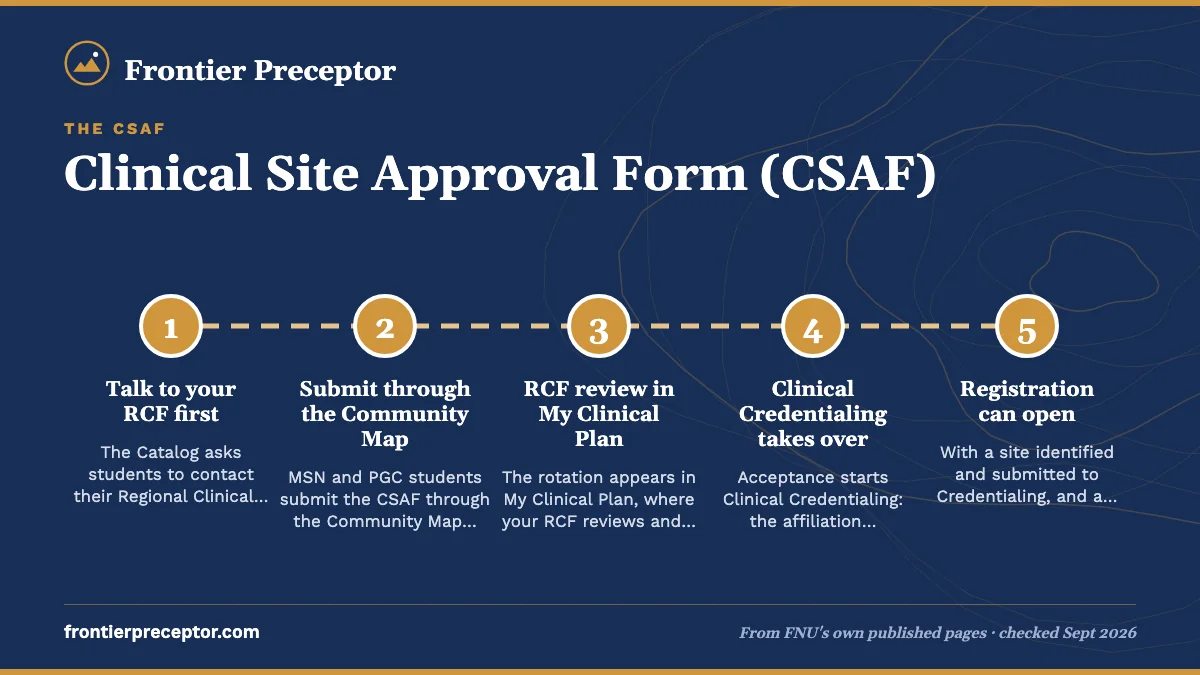
- Talk to your RCF firstThe Catalog asks students to contact their Regional Clinical Faculty member before submitting. A short conversation about the site can surface a problem before it becomes a declined form.
- Submit through the Community MapMSN and PGC students submit the CSAF through the Community Map. Step-by-step instructions are in CB101, the Clinical Bound 101 course in Canvas.
- RCF review in My Clinical PlanThe rotation appears in My Clinical Plan, where your RCF reviews and accepts it. Once one site is accepted, your RCF assigns your Clinical Bound date.
- Clinical Credentialing takes overAcceptance starts Clinical Credentialing: the affiliation agreement, insurance and preceptor credentialing. FNU emails your preceptor instructions for the Preceptor Login.
- Registration can openWith a site identified and submitted to Credentialing, and a complete clinical plan, you can be registered for Clinical Bound.
What to have ready before you open the form
FNU keeps the CSAF's fields behind its login, so this checklist works from what is public: the points your RCF and Clinical Credentialing check a site against. Settle these points with your preceptor first and filling in the form becomes a matter of copying answers across.
- The preceptor's full name, credential and contact details, since FNU contacts the preceptor directly once you submit them.
- Confirmation the preceptor meets FNU's baseline: a valid, unencumbered US license, one year of relevant advanced-practice or medical experience, and usually a master's degree or higher.
- The practice's name and address, and who there handles contracts, because Credentialing needs an affiliation agreement signed with the site.
- How many hours a week the site can give you, measured against FNU's practicum minimums of 20, 28 and 24 hours a week.
- The patient mix, compared with your track's required visit counts.
- That no family or ownership link connects you to the site or the preceptor.
- The state the site is in, and that you hold an RN license there or are compact-eligible.
If any answer is uncertain, resolve it with the preceptor before you submit. A form that goes back and forth eats into the same months credentialing needs.
Why CSAFs stall
- No firm commitment. A preceptor who said "maybe next year" has not committed, and the CSAF assumes they have.
- Preceptor fit. FNP students can spend up to 40% of hours with an MD, DO or PA; a PMHNP student's accepted CSAF must include a preceptor with psychiatric prescribing authority; the Catalog wants a midwifery student's primary preceptor to be a CNM or CM where possible.
- Too few hours. The Catalog says the site must offer the minimum weekly hours of your first clinical course.
- Family or ownership ties. FNU will not approve a site that a relative or household member owns or runs, a site you own part of, or a relative as your preceptor.
- Location. New York is closed to most FNU students, and Guam, Puerto Rico, the US Virgin Islands and US military bases outside the continental US will not be approved.
- Birth settings. A birth center needs CABC accreditation, and a home birth practice that attends twin or breech births is ineligible.
- State notice. FNU says some states require advance notice and approval before students do clinicals there.
The page on who can precept an FNU student sets out the preceptor rules by track in full.
Submitting a CSAF is not the same as having an approved site. Nothing is approved until your RCF accepts it and Credentialing clears the site and preceptor.
One accepted site gets you a date, not a finished plan
Your RCF can assign a Clinical Bound date as soon as one CSAF is accepted. That is a milestone, not the finish line. Before registration, the Catalog expects a complete clinical plan that covers all your visit types and hours, and without one a student may need to take an Academic Hiatus.
In practice that means thinking about your whole practicum when you file the first form. A midwifery student needs a hospital site that can provide at least eight births, because FNU requires a minimum of eight hospital births among the 40. An FNP student needs a patient mix from newborns to older adults. A PMHNP student needs enough medication management and therapy work. If your first site cannot cover everything, plan the second CSAF early and raise it with your RCF.
What stays behind FNU's login
The form itself, the Community Map and the CB101 instructions all sit behind your FNU login, and so does the Clinical Site Preparation Timeline FNU links from its admissions pages. We describe the CSAF from the Catalog and FNU's public pages, which can lag behind what the form asks today.
If something here does not match what you see, trust the login side. Your RCF is the person to ask whether a site is worth submitting, your Clinical Advisor can help if the search itself is stuck, and the program guidelines on Canvas or Banyan Tree decide course-level questions, such as whether your workplace can be a site.
The groundwork behind a complete CSAF
You submit the CSAF yourself, through the Community Map, and we handle the groundwork before it: finding a preceptor who fits your track and area, confirming their availability and weekly hours, and gathering with you the preceptor and site details the form and Clinical Credentialing will need, so your first submission is complete.
Your RCF decides on the CSAF and Credentialing clears the site, and a form with every answer settled gives both a clean start. Send us your track and location if you want that groundwork done with you.
Questions FNU students ask
Does the CSAF get uploaded to CastleBranch?
No. The FNU Catalog says clinical compliance documentation is completed through CastleBranch, with the CSAF as the exception. MSN and PGC students submit the CSAF through the Community Map, and the rotation is then tracked in My Clinical Plan. Items such as your RN license, BLS card, background check and health form are what go to CastleBranch.
Can I submit a CSAF for a preceptor who hasn't confirmed yet?
FNU's sequence starts with a commitment from the preceptor, and the form follows. Submitting a site that later declines uses up your RCF's review time and can hold up your plan. If a preceptor is interested but undecided, mention the lead to your RCF informally and keep searching until you have a clear yes, ideally in writing.
How long after RCF acceptance is a site credentialed?
There is no published turnaround. The Catalog says credentialing a site can run to several months, and certain states want advance notice of FNU students. Your Clinical Credentialing Coordinator can tell you where a particular site stands. Build that lead time into your plan instead of counting on a quick contract.
How does the CSAF work for FNU DNP students?
DNP students submit the CSAF for their project site through DNP850 or DNP Prep 101 in Canvas. Clinical Credentialing then credentials the site, which the Catalog says may take several months. A Sponsor/Mentor agreement between you, the site sponsor and the site mentor is also due by Week 8 of the term before DNP851. See DNP practice hours.
Can my RCF decline a CSAF?
Yes. The RCF's role is to evaluate the site and the preceptor, and the site has to meet your track's rules and offer enough weekly hours. If a site is declined, ask your RCF what would need to change. Some problems, such as hours or a second preceptor, can be fixed; a family link cannot. The site not approved page covers next steps.
Related pages
Last checked 2026-09-23
We check these pages against FNU's own published sources. Your Clinical Advisor, your RCF and FNU's current guidelines have the final word.
Your site submitted before Clinical Bound.
Tell us your FNU track, your county and your Clinical Bound date. We look for a preceptor and site that fit FNU's rules for your track, and help you get the CSAF and credentialing details right.
- Matched to your track: CNM/CM, NP, or the right mix FNU allows
- Ready for the CSAF, the RCF and Clinical Credentialing
- In person near you, or telehealth within FNU's caps
Start your placement plan
A placement advisor replies with what an FNU-ready preceptor and site look like for you.