Your RCF or Credentialing turned a site down
A declined site nearly always traces back to a published FNU rule: the preceptor's experience or credential, a family tie, your track's preceptor mix, the state, the contract, or telehealth over the cap. Find out which one, because each has a different fix and some sites can be saved.
Get your placement plan
Tell us your FNU track and where you live. A placement advisor replies with what a FNU-ready preceptor and site look like for you.
First, find out who said no and at which step
Two parts of FNU can stop a site. Your RCF reviews the Clinical Site Approval Form and decides whether to accept the site into your clinical plan. After that, Clinical Credentialing works on the affiliation agreement, insurance and preceptor credentialing, and a site can stall or fail there even after your RCF said yes.
Ask which rule the site missed and whether the problem lies with the preceptor, the site or the overall plan. A preceptor problem can sometimes be solved by another clinician at the same site; a site problem usually means looking elsewhere. Also ask whether the decision is final or simply waiting on a missing document, and write the answer down.
Reasons that sit with the preceptor
- Experience or license: FNU asks for a valid, unencumbered US license, one year of relevant experience in the advanced practice or medical role, and a master's or higher in a nursing-related field. CNM preceptors can be approved without a master's, though FNU prefers an MSN.
- Midwifery without a CNM or CM: the primary preceptor should ideally be a CNM or CM. Births, procedures and suturing must be supervised in the room, by a CNM, CM or NP credentialed by FNU, or by a board-certified MD or DO.
- WHNP without a WHNP lead: the primary preceptor should be a WHNP, with CNMs, CMs, FNPs, MDs and DOs in support.
- FNP plan too physician-heavy: MDs, DOs and NCCPA-certified PAs can cover up to 40% of FNP hours. A plan that leans on them beyond that needs an NP preceptor added.
- PMHNP without a prescriber: the accepted CSAF must include a preceptor with psychiatric prescribing authority, and therapists can cover no more than 135 hours.
The catalog lets the Clinical Director approve exceptions to preceptor qualifications together with the Department Chair and the Director of Clinical Credentialing. If your preceptor sits close to the line, ask your RCF whether that route is worth trying. Track-by-track detail is on FNU preceptor requirements.
Reasons that sit with the site
- Family or ownership ties: a practice that a relative or household member owns or runs is out, as is any site where you hold an ownership stake, and no family member can precept you.
- Too few weekly hours: your RCF checks that the site can offer the minimum weekly hours your first clinical course requires.
- Birth settings: birth centers must be CABC-accredited, home birth sites are reviewed by the Clinical Director and the Director of Clinical Credentialing, and home birth sites that offer twin or breech births are not eligible.
- Affiliation agreement not signed: FNU cannot place you until the site signs an affiliation agreement and shows it carries professional liability insurance with acceptable limits.
When the agreement is the sticking point, ask your Clinical Credentialing Coordinator exactly what the site objected to. What looks like a refusal can be a request stuck with the wrong office. Our Clinical Credentialing page explains what that team handles.
Reasons that come from where the site is
New York permits clinicals for just six New York-resident MSN nurse-midwifery students per academic year, and only in upstate, rural and underserved parts of the state. PGC midwifery students and all FNP, WHNP and PMHNP students cannot do clinicals there, and nobody living outside the state can go there for clinicals, though federal government facilities in New York are exempt. See our New York page.
US territories (Puerto Rico, Guam and the US Virgin Islands) and military bases beyond the continental US are treated as international and are not approved for MSN or PGC students. You also need an unencumbered RN license, or compact eligibility, where the site sits, unless it accepts any US license, as military and Indian Health Service sites may. Some states want advance notice before FNU students start.
Telehealth over the cap
A plan built on a telehealth practice can come back because it breaks the cap. Midwifery and WHNP students may count telehealth for up to 20% of program hours, FNP students up to 10% (and only while in the same office as the preceptor), and PMHNP students starting in 2025 or later up to 450 hours. For every telehealth patient, you must meet licensing requirements in the state where that patient lives.
The fix is to rebalance: keep the telehealth site as a minority share and add an in-person site for the rest, checking that your RN licensing covers the states your telehealth patients live in. Virtual clinical options sets out what telehealth can and cannot cover.
Reason and fix at a glance
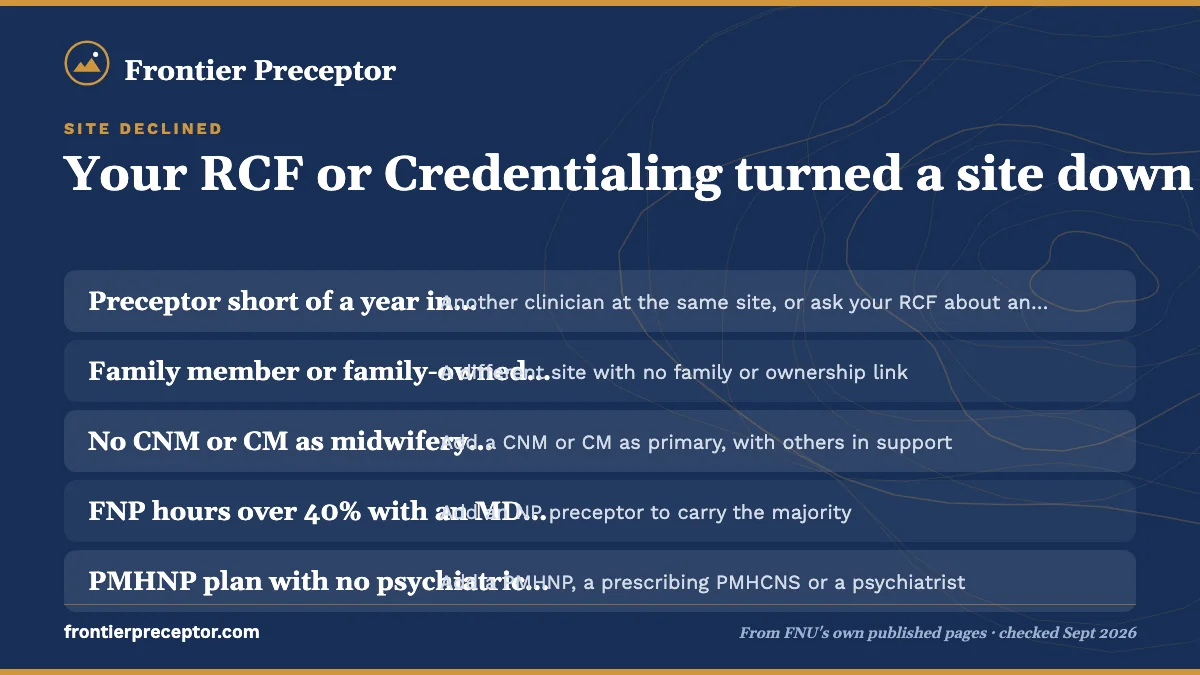
| Reason | Usual fix |
|---|---|
| Preceptor short of a year in the advanced practice role | Another clinician at the same site, or ask your RCF about an exception |
| Family member or family-owned site | A different site with no family or ownership link |
| No CNM or CM as midwifery primary | Add a CNM or CM as primary, with others in support |
| FNP hours over 40% with an MD, DO or PA | Add an NP preceptor to carry the majority |
| PMHNP plan with no psychiatric prescriber | Add a PMHNP, a prescribing PMHCNS or a psychiatrist |
| New York or a US territory | A site in another state where you hold or can get an RN license |
| Affiliation agreement not signed | Ask Credentialing what stalled; otherwise a site that will sign |
| Telehealth above the cap | Add an in-person site and shrink the telehealth share |
Finding the replacement
When a site cannot be saved, we can search for a replacement. We look for the next preceptor and site suited to your track, starting with in-person options close to home, and screen each against FNU's published rules, including every reason above, before you submit anything. If the declined site was otherwise a good fit, tell us exactly why it failed, so the next search can steer around that same problem.
We help prepare what goes on the CSAF and what Clinical Credentialing will need, so the next submission starts complete. Your RCF and Clinical Credentialing still decide, and the replacement reaches them already checked against the reason the first site fell short. Use the form below, or see how it works.
Questions FNU students ask
Can I appeal when my RCF declines a clinical site?
FNU's public materials do not describe a formal appeal for a declined site. They do describe an exception route for preceptor qualifications, decided by the Clinical Director with the Department Chair and the Director of Clinical Credentialing. Ask your RCF which rule was the problem and whether an exception is realistic.
Is a clinic where a relative works, but does not own or run, allowed?
FNU's wording covers three things: a site a family or household member owns or administers, a site you have an ownership stake in, and a relative acting as your preceptor. A relative on staff who neither runs the site nor precepts you is not named in that wording. Tell your RCF about the connection anyway and let them judge it.
Can a PA be my FNP preceptor at FNU?
Yes, within limits. MDs, DOs and PAs together may cover up to 40% of FNP practicum hours, and a PA must be NCCPA-certified. A PA-led site works best alongside an NP preceptor who carries the rest of your hours. Plan that split with your RCF from the start.
I live near the New York border. Can I do clinicals across it?
Not if you live outside New York. FNU says students who reside outside the state may not attend clinical experiences there. The one exception open to every FNU student is a federal government facility located in New York. Otherwise, look for sites on your side of the border.
Does a declined site affect my Clinical Bound date?
It can. Your RCF only assigns a Clinical Bound date after at least one site has been accepted, and you cannot be registered for Clinical Bound until a site is identified and submitted to Clinical Credentialing. A decline late in the process can therefore push your projected term back.
Related pages
Last checked 2026-09-23
We check these pages against FNU's own published sources. Your Clinical Advisor, your RCF and FNU's current guidelines have the final word.
Your site submitted before Clinical Bound.
Tell us your FNU track, your county and your Clinical Bound date. We look for a preceptor and site that fit FNU's rules for your track, and help you get the CSAF and credentialing details right.
- Matched to your track: CNM/CM, NP, or the right mix FNU allows
- Ready for the CSAF, the RCF and Clinical Credentialing
- In person near you, or telehealth within FNU's caps
Start your placement plan
A placement advisor replies with what an FNU-ready preceptor and site look like for you.