Tried the Community Map and your network, and still no preceptor
A search that stalls after the Community Map and your own contacts usually has a cause you can name: your region, your track's preceptor rules, or a list that shows past sites rather than open seats. Work through those in order before you widen the radius, and bring your Clinical Advisor and RCF in early.
Get your placement plan
Tell us your FNU track and where you live. A placement advisor replies with what a FNU-ready preceptor and site look like for you.
Why 20,000 listings can still produce no yes
The Community Map is large. FNU puts it at over 20,000 active clinical sites and preceptors, spread through all 50 states. The catalog is more exact about what it holds: a database of preceptors and sites that Frontier students have used before. A listing tells you a clinician once precepted, not that they have room in your Clinical Bound term.
FNU also says plainly that rotations can be competitive, especially in certain regions. A clinician who shows up near you may already have a student from another school, may have changed jobs, or may now work for an employer that no longer takes students. None of that is visible on the map.
Your own network has a different blind spot. Colleagues who think well of you can still be the wrong fit on paper, because FNU's preceptor rules differ by track. A warm yes from someone FNU cannot credential is not a lead, and it costs you weeks.
Check who actually counts for your track
Before widening the radius, make sure you are asking the right people. Every preceptor needs a clean, valid US license, at least a year working in an advanced practice or medical role, and a graduate degree in a nursing-related field, though a CNM can be approved without the master's. Each track then narrows or widens the pool.
- Nurse-midwifery: FNU wants a CNM or CM as the primary preceptor where possible. FNPs, WHNPs, MDs and DOs are also allowed, and you need a hospital setting for at least eight of your births.
- FNP: up to 40% of your hours may be with an MD, DO or NCCPA-certified PA, which reopens physician-led family practices you may have skipped.
- WHNP: the primary preceptor should be a WHNP, and CNMs, CMs, FNPs, MDs and DOs can fill in around them.
- PMHNP: your accepted CSAF must include a preceptor with psychiatric prescribing authority. Psychiatrists have no time limit, and master's-prepared licensed therapists can cover up to 135 hours.
The full rules per track are on who can precept an FNU student.
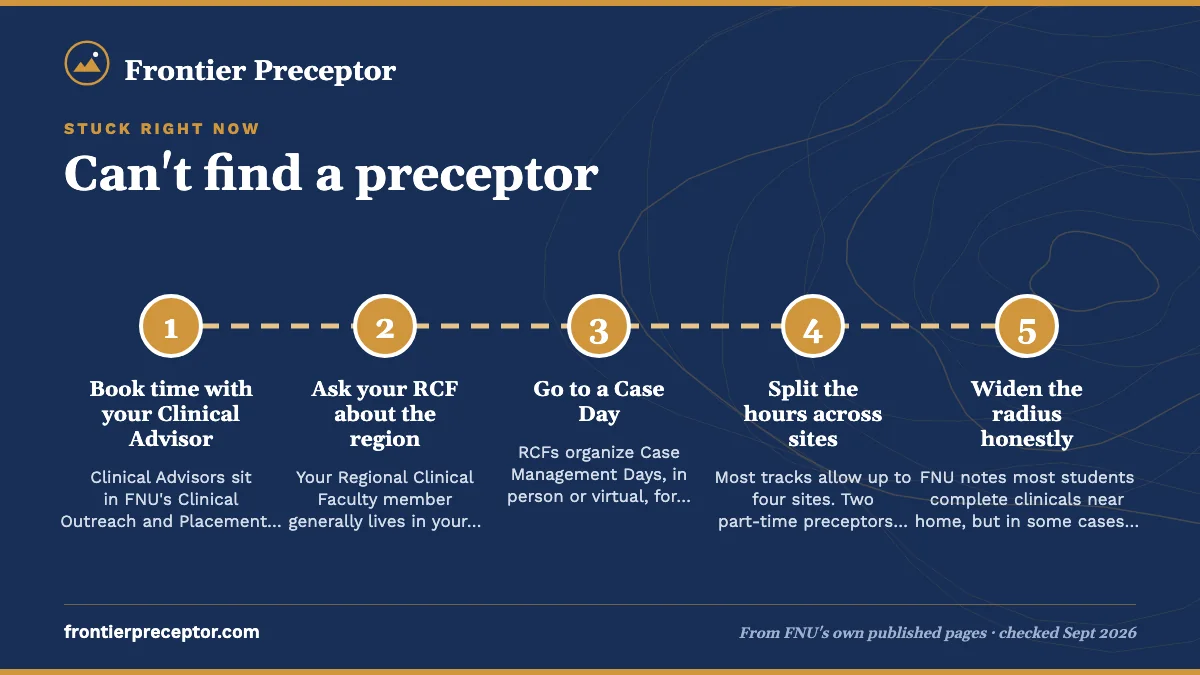
Five moves before you call it a dead end
- Book time with your Clinical AdvisorClinical Advisors sit in FNU's Clinical Outreach and Placement team, are assigned by track, and are there to troubleshoot challenging situations. Bring a list of everyone you contacted and what each said, so the pattern is visible.
- Ask your RCF about the regionYour Regional Clinical Faculty member generally lives in your part of the country and evaluates sites there. Ask which kinds of practices near you have hosted FNU students recently.
- Go to a Case DayRCFs organize Case Management Days, in person or virtual, for group learning and networking within the region. Students, alumni and preceptors attend, so it is one of the few places you meet local preceptors face to face.
- Split the hours across sitesMost tracks allow up to four sites. Two part-time preceptors are often easier to find than one who will take your whole practicum.
- Widen the radius honestlyFNU notes most students complete clinicals near home, but in some cases travel or a temporary move is needed. You need an RN license in any state where you do clinicals. New York is closed to NP and PGC students outside federal facilities, and the US territories are not approved.
If you hope to use your own workplace, check your course syllabus and program guidelines first; our page on clinical hours where you work explains the separation FNU expects.
Make the ask easier to say yes to
Many first contacts fail on uncertainty rather than unwillingness. A clinician who has never had an FNU student does not know what the paperwork involves, so tell them. FNU's Clinical Credentialing team handles the affiliation agreement with the site, exchanges certificates of insurance and credentials the preceptor, and FNU provides general and professional liability insurance for its clinical students.
Then name what precepting gives back. FNU pays an honorarium based on the program and the number of hours (no amount is published), and offers The Gift of Precepting, a six-contact-hour CE course, plus a 10% discount on non-matriculating FNU courses, DynaMed access set up through you, and documentation of precepting hours for recertification. Our page on asking a preceptor has wording that works.
Do not fill the gap with a relative. FNU rules out a family member as your preceptor, any site a relative or household member owns or runs, and any site you hold an ownership stake in.
When it makes sense to bring in a placement service
If your advisor, your RCF and your own outreach have run their course, this is exactly where we come in. A placement advisor takes over the legwork, searching for a preceptor and site matched to your FNU track, with in-person placement near home as the main route and telehealth added only where the course allows it, within FNU's caps.
Each lead is checked against FNU's published preceptor rules before you spend a CSAF on it, and we pull together the CSAF entries and what Clinical Credentialing will ask for alongside you. The final decision is your RCF's and Clinical Credentialing's, and the site you bring them has been built to meet their standards. If a preceptor later drops, the search restarts straight away. See how the service works or use the form below.
Questions FNU students ask
Will FNU assign me a preceptor if I cannot find one?
FNU's admissions page says students are responsible for securing their clinical site, and none of its current materials describe assigning one. What FNU gives you is support: Clinical Advisors who help with the search, the Community Map, your RCF, and a team that handles contracts and credentialing once a preceptor commits.
Can I do my FNU clinicals in a different state from where I live?
Yes. FNU has no rule tying clinicals to your home state, and the catalog notes that a site change can mean relocating, possibly out of state. Your RN license must be unencumbered, or you must be compact-eligible, in each state that hosts your clinicals. New York is restricted, and the US territories are not approved for MSN or PGC students.
Is it worth contacting clinicians who are not on the Community Map?
Yes. The map records sites and preceptors FNU students have used before, so it misses clinicians nobody has asked yet. Anyone who meets FNU's preceptor rules can be proposed on a CSAF. Clinicians can also add themselves using FNU's Preceptor Inquiry Form, which puts their details on the map.
How many sites can I use to complete my FNU hours?
Nurse-midwifery, FNP and PMHNP students can use up to four sites, and midwifery can go higher with RCF approval. For WHNP the catalog says three while the FNU website says four, so confirm the limit with your RCF before you build a plan that depends on a fourth site.
Does it matter how early I start looking?
Very much. FNU recommends finding preceptors early in the program, and credentialing a site can take several months after your RCF accepts the CSAF. If the search is still open close to Clinical Bound, see what is realistic when time is short.
Related pages
Last checked 2026-09-23
We check these pages against FNU's own published sources. Your Clinical Advisor, your RCF and FNU's current guidelines have the final word.
Your site submitted before Clinical Bound.
Tell us your FNU track, your county and your Clinical Bound date. We look for a preceptor and site that fit FNU's rules for your track, and help you get the CSAF and credentialing details right.
- Matched to your track: CNM/CM, NP, or the right mix FNU allows
- Ready for the CSAF, the RCF and Clinical Credentialing
- In person near you, or telehealth within FNU's caps
Start your placement plan
A placement advisor replies with what an FNU-ready preceptor and site look like for you.