Doing FNU clinical hours where you already work
Sometimes, and only on FNU's terms. MSN and PGC students have to check their course syllabus and program guidelines, their employer's own policy has to allow it, and they must keep a strict line between the job and the student role. DNP students are encouraged to use their workplace.
Need a site beyond your workplace?
Tell us your track and what your job already covers. A placement advisor will reply.
What FNU publishes for MSN and PGC students
The catalog doesn't give a flat yes or no. It tells students to check "their course syllabus and program guidelines" to see whether clinical hours can be done at a workplace, and adds that the facility's own employment policy has a say too (FNU Catalog, Summer 2026).
Those syllabi and guidelines sit in Canvas rather than on FNU's public pages, so that is where your track's answer lives. Read the guidelines for your clinical courses, then ask your Regional Clinical Faculty member (RCF) before you ask your manager. Raising it with the RCF first saves you from building a plan around a site that can't be used.
Where it is allowed, the condition is the same in every track: FNU requires "separation between their employment role and their student role." The rest of this page is about what that looks like on a real schedule.
Keeping your job and your student role apart
The catalog backs the separation rule with a hard line: practicing in an advanced-practice role without preceptor supervision, while not licensed for it, means "automatic dismissal." At your own workplace, colleagues may be used to you working on your own, which is exactly where that line can blur.
Settle these with your manager, preceptor and RCF before the first shift
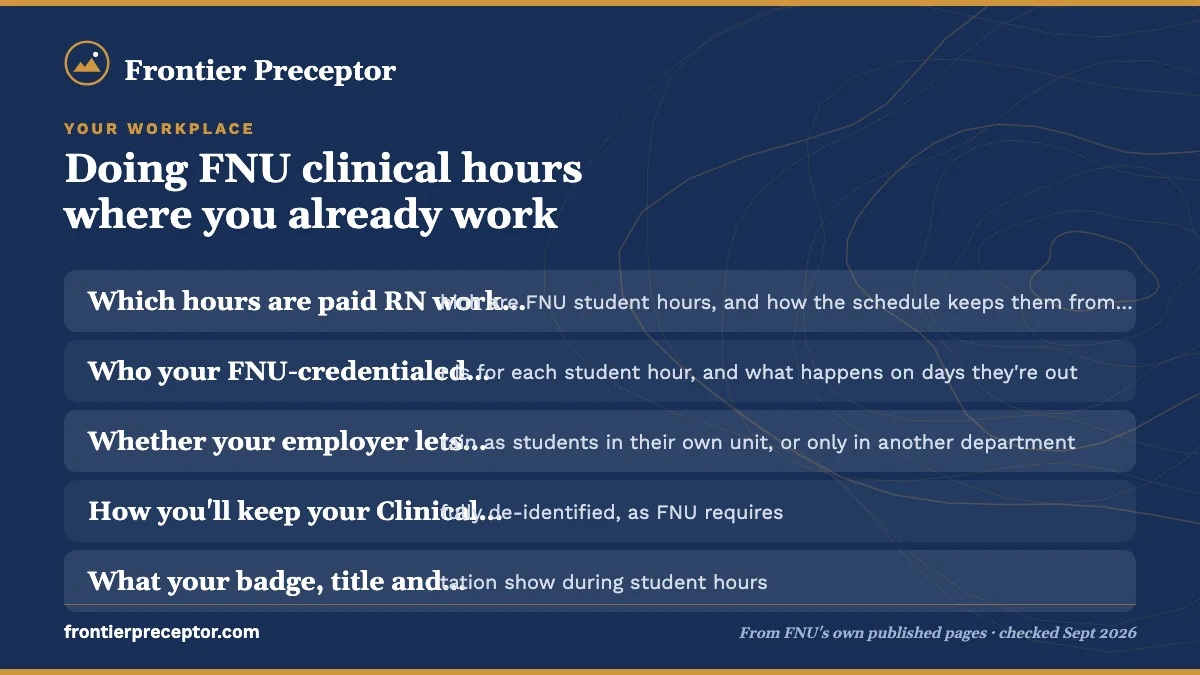
- Which hours are paid RN work and which are FNU student hours, and how the schedule keeps them from overlapping
- Who your FNU-credentialed preceptor is for each student hour, and what happens on days they're out
- Whether your employer lets staff train as students in their own unit, or only in another department
- How you'll keep your Clinical Log fully de-identified, as FNU requires
- What your badge, title and documentation show during student hours
During student hours, the catalog says you are not an employee of FNU or the clinical site and are not covered by workers' compensation. That is one more reason to keep the two roles on clearly separate time.
Your workplace still goes through full approval
Being on staff doesn't skip a step. You still submit a Clinical Site Approval Form through the Community Map, your RCF still has to accept it, and Clinical Credentialing still needs a signed affiliation agreement, proof of the site's professional liability insurance and a fully credentialed preceptor.
At a larger employer, the person who signs an affiliation agreement may not be your unit manager. Find out who does before you submit, and expect the agreement to run on its own clock; Clinical Credentialing explains why it takes months.
Your preceptor at work has to meet FNU's rules for your track too. A supervisor can precept you if they qualify under the preceptor requirements, but a family member can't, whoever employs them.
Don't count hours at your workplace until your RCF gives final release, even if your unit is ready to have you start.
Will one workplace cover your visit counts?
Often it won't on its own. Every MSN and PGC track needs 750 hours plus track-specific visits. FNP students need newborn, pediatric, adult, geriatric, gynecologic, antepartum, mental health and men's health visits. WHNP students need 300 gynecologic visits and antepartum, postpartum and primary care visits. PMHNP students need child, adult, geriatric, crisis and substance use visits, and midwifery students need 40 births with at least eight in a hospital.
A single unit may not span all of that. The catalog expects students to use more than one site when one can't supply the volume, within a cap of four sites in most tracks, and warns this may mean relocating, "possibly out of state." Treat your workplace as one piece of the clinical hours plan, not the whole of it.
Owning part of the practice changes the answer
If you hold an ownership stake in your workplace, it's out for MSN and PGC clinicals. The catalog bars sites "where they have a stake in ownership," along with sites owned or run by a family or household member, even when a non-relative there would precept you.
The same logic catches a family business you happen to work for. DNP students have a narrower rule: no site owned or run by a first-degree family member.
If you're unsure whether a partnership, a shared-ownership group or a family link counts, describe it plainly to your RCF before you submit a CSAF. Adjusting the plan at that stage is far easier than after Clinical Credentialing has started work on an agreement with the site.
DNP students: the workplace is the default
The DNP turns the question around. FNU encourages DNP students "to complete their clinical hours where they work," and the catalog describes projects done "ideally at the site of APRN employment." Your 500 DNP hours come from leading a rapid-cycle quality-improvement project at that site.
Your project site still needs a CSAF, submitted through the DNP850 Canvas course, before Clinical Credentialing reviews it. If your employer doesn't require an affiliation agreement, you follow its requirements instead of FNU's compliance list. You, a site sponsor and a site mentor sign a Sponsor/Mentor agreement no later than Week 8 of the term before DNP851. The mentor needs a master's degree or higher; the sponsor has no set education level. The DNP practice hours page has the course-by-course detail.
Building around a workplace plan
If your job covers part of your hours, we search for the site that fills the gaps: a pediatric practice for an FNP whose job is adults only, say, or a hospital birth site for a midwifery student who works in a birth center. Each CSAF's site and preceptor details get prepared with you as well, so the second site isn't a scramble. Tell us what your job already covers and we start from the gaps.
Whether your workplace qualifies is for your syllabus, your employer and your RCF to settle, and Clinical Credentialing approves every site. We test each plan against the separation and ownership rules first and flag any risk before you submit it.
Questions FNU students ask
Can my manager be my FNU preceptor?
Possibly, if they meet FNU's rules for your track: a valid, unencumbered US license, a year in an advanced-practice or medical role, the right credential for your track, and no family tie. Being supervised as a student by the person who also manages your job makes role separation harder, so talk it through with your RCF before you list them.
Do RN hours at my job count toward FNU clinical hours?
FNU clinical hours are student hours under an FNU-credentialed preceptor at a site cleared by Clinical Credentialing and your RCF, and the catalog requires strict separation between your employed role and your student role. Your regular RN shifts are employment. If your syllabus and employer allow clinicals at your workplace, schedule student hours as their own blocks and log only those.
Does FNU's liability insurance cover clinical hours at my own job?
FNU provides general and professional liability insurance for clinical students during the practicum, at sites cleared by Clinical Credentialing and the RCF. That coverage is tied to your student role. The catalog also says students aren't covered by workers' compensation during clinical. The clinical insurance page explains what FNU covers and what you carry yourself.
What if my employer doesn't allow students?
Then the workplace is out, whatever your program guidelines say, because the facility's own employment policy is part of FNU's test. Look at a different site nearby instead. Your Clinical Advisor and the Community Map can help you find alternatives, and you can use the form below to ask us to search for a preceptor who fits your track.
Can DNP students use a project site where they don't work?
Yes. Working at the site is encouraged, not required. The catalog asks DNP applicants to identify potential project sites and mentors early, and DNP clinical faculty help with that. At a site where you volunteer, you complete FNU's compliance items through DNP850, and Clinical Credentialing credentials the site, which can take several months.
Related pages
Last checked 2026-09-23
We check these pages against FNU's own published sources. Your Clinical Advisor, your RCF and FNU's current guidelines have the final word.
Your site submitted before Clinical Bound.
Tell us your FNU track, your county and your Clinical Bound date. We look for a preceptor and site that fit FNU's rules for your track, and help you get the CSAF and credentialing details right.
- Matched to your track: CNM/CM, NP, or the right mix FNU allows
- Ready for the CSAF, the RCF and Clinical Credentialing
- In person near you, or telehealth within FNU's caps
Start your placement plan
A placement advisor replies with what an FNU-ready preceptor and site look like for you.