How our placement help fits FNU's clinical process
FNU expects you to secure your own preceptor and clinical site, then approves each one through your Regional Clinical Faculty and Clinical Credentialing. We do the search and the preparation in the same order FNU works, so what reaches your RCF is complete. You submit, and FNU decides.
Get your placement plan
Tell us your FNU track and where you live. A placement advisor replies with what a FNU-ready preceptor and site look like for you.
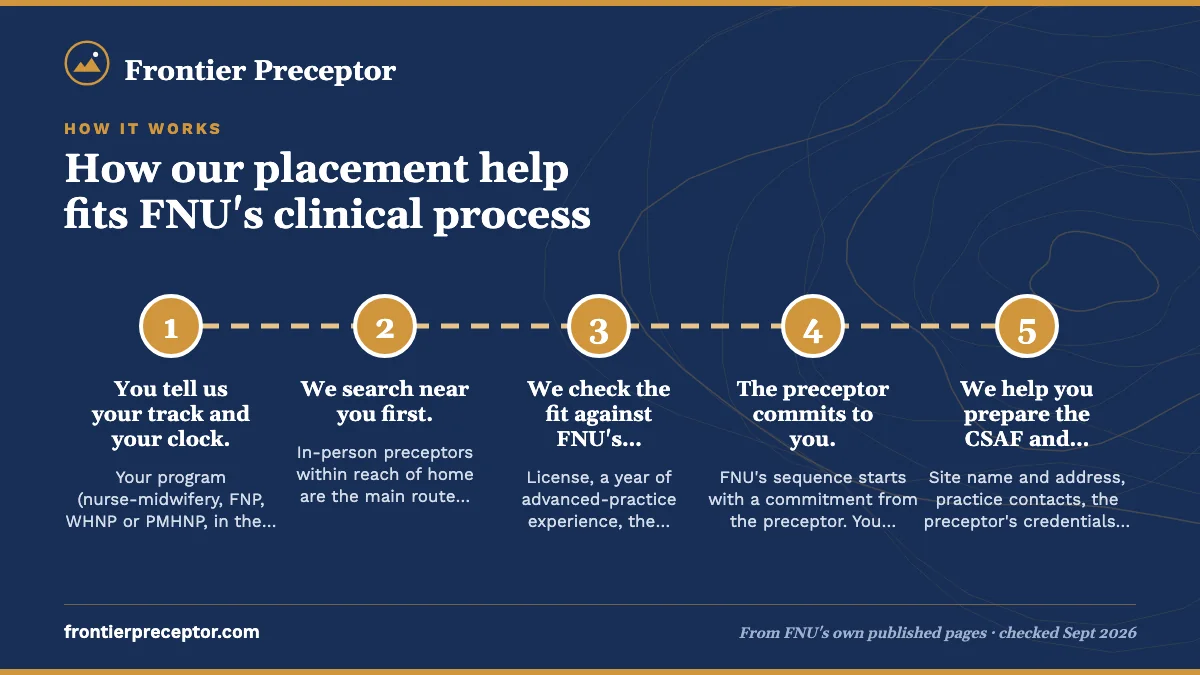
FNU's order, and where we sit in it
FNU's catalog sets out a fixed sequence. You find a preceptor and get a commitment. You then complete a Clinical Site Approval Form (CSAF) and submit it through the Community Map. Your RCF reviews and accepts it, and only then does Clinical Credentialing start its work on the site and the preceptor.
After credentialing comes Clinical Bound, the five-day skills session in Versailles, and then your RCF's final release before your first clinical day. We work at the front of that line: the search, the rule checks and the paperwork you need in hand.
Everything from RCF acceptance onward belongs to FNU, and each of those steps is detailed on our FNU clinical placement process page.
Step by step: our part and yours
Here is how a search runs with us, in order.
- You tell us your track and your clock. Your program (nurse-midwifery, FNP, WHNP or PMHNP, in the MSN or the PGC), your city and state, and the Projected Clinical Bound Term on your degree audit. List any Community Map contacts and clinicians you've already approached.
- We search near you first. In-person preceptors within reach of home are the main route, because that is how most FNU students complete their clinicals. Telehealth comes into the plan only where your course allows it and inside FNU's cap for your track.
- We check the fit against FNU's published rules. License, a year of advanced-practice experience, the preceptor mix your track allows, the family and ownership rule, your RN license in that state, and New York's limits. A lead that fails a rule is dropped before it costs you time.
- The preceptor commits to you. FNU's sequence starts with a commitment from the preceptor. You speak with them directly before anything is submitted, because they are the one who will be teaching you.
- We help you prepare the CSAF and credentialing details. Site name and address, practice contacts, the preceptor's credentials and license details, and whatever else the CSAF and Clinical Credentialing ask for. FNU's own CSAF instructions sit in the CB101 course in Canvas; follow them over anything we say.
- You submit, and FNU reviews. You contact your RCF, submit the CSAF through the Community Map, and record the rotation in My Clinical Plan. Your RCF accepts or declines it, and Clinical Credentialing then handles the contract, insurance and preceptor credentialing.
- We stay on call. If a preceptor withdraws before or during your practicum, we search again with your remaining hours and visit types in mind.
The checks we run before you submit
Most CSAF problems can be spotted before the form is filed. These are the published FNU rules we test every lead against:
- A valid, unencumbered US license to practice and one year of relevant experience in an advanced-practice or medical role.
- The right preceptor for your track: ideally a CNM or CM as the primary preceptor in midwifery, a psychiatric prescriber for PMHNP, and no more than 40% of FNP hours with an MD, DO or PA.
- No family members as preceptors, and no sites owned or run by a family or household member or where you hold an ownership stake.
- An RN license, or compact eligibility, in the state where the site sits.
- A site that can offer at least the weekly hours your first clinical course requires: 20 a week in
NM751,FNP751,WH751orMH751. - A location FNU accepts: the continental US or Hawaii, and New York only in the narrow cases FNU allows.
Track-by-track detail is on who can precept an FNU student. If a site has already been turned down, why FNU declines a site covers the usual reasons and fixes.
After you submit: your RCF and Clinical Credentialing
Your RCF accepts the CSAF and, once at least one site is accepted, assigns your Clinical Bound date. FNU will not register you for Clinical Bound until a site has been identified and submitted to Clinical Credentialing, and the catalog also expects a complete clinical plan covering all your visit types and hours.
Clinical Credentialing then gets a signed Affiliation Agreement from the site, verifies the site's professional liability insurance, fully credentials your preceptor, and schedules a Pre-Clinical Site Visit where one is required. FNU says credentialing a site can take several months, which is why the search needs to finish well ahead of Clinical Bound.
These are FNU conversations: your RCF and your Clinical Credentialing Coordinator work with you directly. We stay close by throughout, ready to answer questions from you or the site about the details we gathered together, so a query from credentialing gets a quick reply.
Never start seeing patients at a new site before credentialing is complete. FNU treats an early start as grounds for dismissal.
Clinical Bound, your first day and your hours
Clinical Bound is its own course in each track (NM750, FNP750, WH750 and MH750), held on campus in Versailles after your didactic courses. Your RCF gives a final release for the site and preceptor before your first clinical day.
Students starting clinical courses in 2025 or later complete 750 clinical hours over 19 weeks of clinical, plus the visit counts for their track. FNU sets weekly minimums of 20 hours in the first course, 28 in the second and 24 in the third. If one site can't provide the patient volume, FNU expects you to add another, up to four sites in most tracks.
When a site falls short on volume or on a visit type, we can search for an additional site to fill the gap. See FNU clinical hours for the full rules, and falling behind on hours if you are already mid-practicum.
Starting a search with us
Send your details through the form below or open the chat. A placement advisor replies with questions, then a written quote and terms, before you commit to anything. What shapes that quote is explained on our cost page.
Start as early as you can. FNU itself recommends finding preceptors early in the program, and FNU staff describe the RCF approving the clinical plan about four to six months before Clinical Bound.
Questions FNU students ask
Who submits my CSAF to FNU?
You do, through the Community Map under your own FNU account, after you have spoken with your RCF. We gather the site and preceptor details the form asks for and check them against FNU's rules, so what you submit is complete, and the clinical plan stays in your hands.
How do you help with Clinical Credentialing's timeline?
By giving it as much room as possible. Clinical Credentialing works on its own timeline, and FNU says credentialing a site can take several months. Complete, accurate details on the CSAF cut out back-and-forth, and the real lever is time: the earlier your preceptor commits, the more room credentialing has before Clinical Bound.
What do you need from me to start a search?
Your track and degree (MSN, PGC or DNP), your city and state, your Projected Clinical Bound Term, which clinical courses remain, and a list of sites or preceptors you have already contacted. If you hold RN licenses in more than one state, list them, because each one widens where we can look.
Do I still work with my Clinical Advisor and RCF?
Yes. FNU's Clinical Advisors and your RCF stay your official contacts. The catalog asks you to contact your RCF before submitting a CSAF, and during clinicals you are expected to be in touch with your RCF at least every two weeks. Keep your Clinical Advisor informed too.
Does this work for DNP students?
Yes, though the DNP runs differently. FNU encourages DNP students to complete project hours where they work, and the project site's CSAF goes through the DNP850 or DNP Prep 101 course in Canvas. If your workplace can't host the project, tell us. FNU requires the site mentor to hold a master's degree or higher.
Related pages
Last checked 2026-09-23
We check these pages against FNU's own published sources. Your Clinical Advisor, your RCF and FNU's current guidelines have the final word.
Your site submitted before Clinical Bound.
Tell us your FNU track, your county and your Clinical Bound date. We look for a preceptor and site that fit FNU's rules for your track, and help you get the CSAF and credentialing details right.
- Matched to your track: CNM/CM, NP, or the right mix FNU allows
- Ready for the CSAF, the RCF and Clinical Credentialing
- In person near you, or telehealth within FNU's caps
Start your placement plan
A placement advisor replies with what an FNU-ready preceptor and site look like for you.