FNU's Community Map: how to use it and where it runs out
The Community Map is FNU's database of more than 20,000 active clinical sites and preceptors, built largely from places Frontier students have trained before. For most FNU students it is the best starting list available. It is a list of leads rather than openings, though, and every name on it still has to agree to take you.
Get your placement plan
Tell us your FNU track and where you live. A placement advisor replies with what a FNU-ready preceptor and site look like for you.
What the Community Map is
The Catalog calls the Community Map "a database of preceptors and sites Frontier students have used in the past." FNU's public page puts it at over 20,000 active clinical sites and preceptors across all 50 states. Clinicians can also add themselves through FNU's Preceptor Inquiry Form, and once they do, their contact details show up for students.
The map does two jobs. It is where you search for leads, and it is where MSN and PGC students submit the Clinical Site Approval Form once a preceptor commits. Clinical Advisors use it together with what the Catalog calls "the clinical app," a tool FNU does not name publicly.
Older figures are floating around. In an FNU podcast from around 2021, FNU's placement director described about 16,000 preceptors, with roughly 4,000 sites used every couple of terms and more than 13,000 used overall. Treat those numbers as dated; 20,000+ is the current public figure.
When you get access, and who helps you read it
Access comes at Frontier Bound, the 3-day orientation in Versailles, where the Clinical Outreach and Placement team opens the map to new students and you attend information sessions on credentialing. There is no public version, so applicants cannot browse it before enrolling. Log in soon after orientation even if Clinical Bound feels distant, since FNU's advice is to find preceptors early in the program.
After that, your Clinical Advisor is the person to ask. Advisors are assigned by track, and FNU describes them working one-on-one and in small groups on the overall clinical search, and keeping students current on placement timelines. If your area looks thin on the map, say so in your first term, while there is time to widen the net.
A practical way to work the map
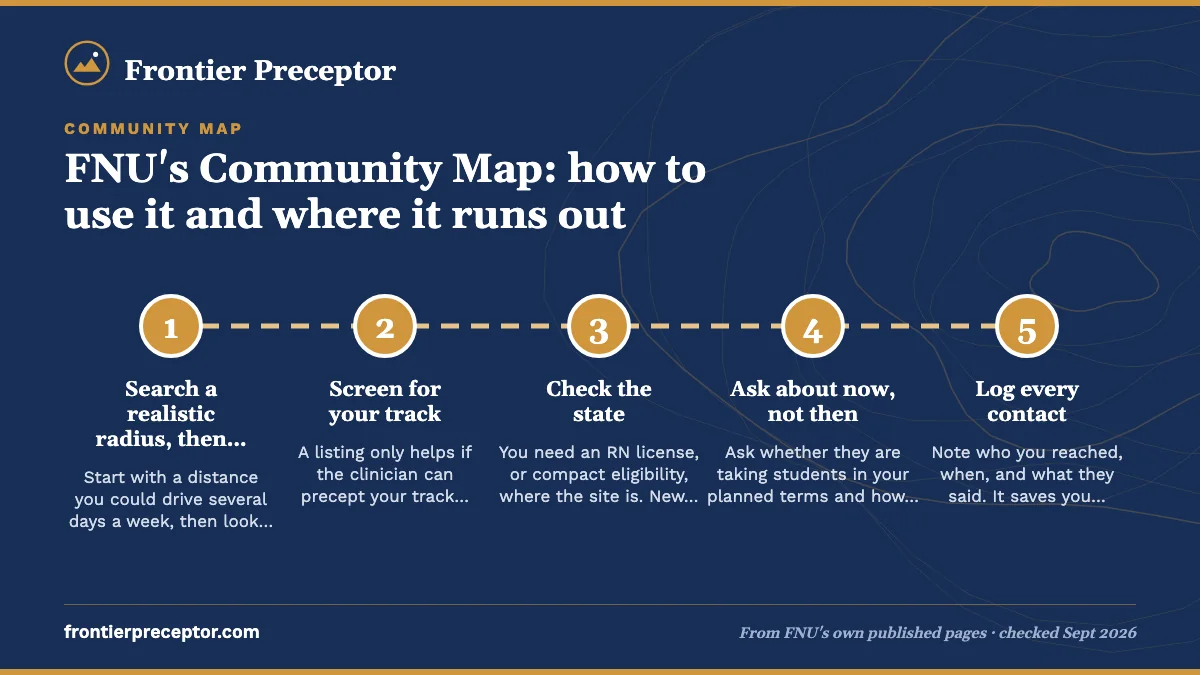
- Search a realistic radius, then widen itStart with a distance you could drive several days a week, then look further. Many FNU students live in rural areas, and the nearest usable listing may be further away than you hope.
- Screen for your trackA listing only helps if the clinician can precept your track under FNU's rules, for example a CNM or CM as a midwifery primary preceptor, or psychiatric prescribing authority for PMHNP.
- Check the stateYou need an RN license, or compact eligibility, where the site is. New York is off-limits for most FNU tracks.
- Ask about now, not thenAsk whether they are taking students in your planned terms and how many weekly hours they could offer. How to word that first message is covered in asking a preceptor.
- Log every contactNote who you reached, when, and what they said. It saves you re-asking the same practice and gives your Clinical Advisor something concrete to work with.
- Submit once someone commitsWhen a preceptor says yes, talk to your RCF, then file the CSAF through the map.
What a listing does not tell you
A listing tells you that a site or preceptor worked with FNU at some point, or volunteered to. It leaves out most of what decides whether they can take you.
- Whether the preceptor has capacity in your terms or has already given that time to another student.
- Whether the clinician still works at that address. The map records where students trained, and people change jobs.
- Whether the practice will take your track now. A clinic that hosted an FNP student may not suit a midwifery or PMHNP student.
- Whether the site has extra requirements. The Catalog says sites may add their own, which you complete at your own expense.
- Whether an earlier affiliation agreement is still on file. FNU does not say publicly whether a past approval shortens credentialing, so ask your Clinical Credentialing Coordinator.
- Whether the site is approved for you. Every rotation still needs your CSAF, RCF acceptance and credentialing.
Distance, rural areas and competitive regions
FNU says 75% of its students live in rural or underserved areas, and its public pages warn that rotations "can be competitive, especially in certain regions." Both show up on the map. A long list in a busy metro can still mean waiting if many students are asking the same clinicians, while a short list in a frontier county can mean a long drive.
FNU is open about the fallback. Most students complete clinicals near home, but FNU notes that in some cases travel or temporary relocation will be necessary. One Texas nurse-midwifery student, quoted in FNU's 2026 Preceptor Scholarship report, described driving "330 miles one-way every other week" to reach a CNM.
If the map leaves you with nothing close, the rural clinicals page looks at searching outside metros, where the map is often thinnest.
Behind the login, and who to ask
The map itself, the CSAF inside it and the placement team's internal page, which sits on FNU's SharePoint site as part of Banyan Tree 2.0, all need an FNU login. The CSAF instructions are in CB101 in Canvas. Nothing on this page replaces what those show you.
When you cannot tell whether a listing is usable, ask your Clinical Advisor about the search and your RCF about whether the site could work for your track. They see current information the public pages do not. If you find a listing that is plainly out of date, mention it; FNU's outreach staff also work on preceptor recruitment and retention.
Reaching past the map
Our search reaches clinicians FNU students have never asked, which matters most where the map is thin. We contact practices near you, check each clinician against your track's rules, ask about hours and dates before you spend a CSAF on them, and consider telehealth preceptors where your course permits it, inside FNU's limits.
Every lead we find goes through your CSAF, your RCF and Clinical Credentialing like any map listing, screened in advance so it arrives ready for review. Start with the form if you want help.
Questions FNU students ask
Can I see FNU's Community Map before I enroll?
No public version exists. The Clinical Outreach and Placement team gives students access at Frontier Bound. If you already have a preceptor lined up before enrolling, the Catalog says you can list that commitment on your enrollment application, and the map then becomes your backup rather than your starting point.
How do preceptors get listed on the Community Map?
FNU's public material describes two routes. The map is built from sites and preceptors Frontier students have used before, and any clinician can sign up through the Preceptor Inquiry Form to be listed with contact details. If a clinician you know is open to precepting, pointing them to that form helps future students as well as you.
Is a site on the Community Map already approved for my rotation?
Not automatically. A listing means FNU has a record of the site or preceptor, not that your rotation is cleared. You still submit a CSAF, your RCF still reviews it, and Clinical Credentialing still confirms the affiliation agreement, insurance and preceptor credentials. Ask your coordinator whether an existing agreement is already on file.
What if no one on the Community Map is near me?
Tell your Clinical Advisor early, widen your radius, and look beyond the map: clinicians you already know, local practices and your region's Case Days, which preceptors and alumni can attend. FNU notes that travel or temporary relocation is sometimes needed. The can't find a preceptor page sets out the next steps in order.
Can I use a Community Map preceptor in another state?
Yes, if the rules fit. FNU has no home-state requirement, but you need an RN license or compact eligibility where the site is, and for telehealth, where the patient lives. New York is closed to most tracks, and US territories are excluded. The page on clinicals by state covers the detail.
Related pages
Last checked 2026-09-23
We check these pages against FNU's own published sources. Your Clinical Advisor, your RCF and FNU's current guidelines have the final word.
Your site submitted before Clinical Bound.
Tell us your FNU track, your county and your Clinical Bound date. We look for a preceptor and site that fit FNU's rules for your track, and help you get the CSAF and credentialing details right.
- Matched to your track: CNM/CM, NP, or the right mix FNU allows
- Ready for the CSAF, the RCF and Clinical Credentialing
- In person near you, or telehealth within FNU's caps
Start your placement plan
A placement advisor replies with what an FNU-ready preceptor and site look like for you.