Finding an FNU preceptor outside the metros
Rural care is FNU's founding purpose, and by FNU's count three in four of its students live in rural or underserved areas. That history helps, but it does not shorten the drive: a small-town practice still has to meet your track's visit counts, weekly hours and credentialing, so a rural plan may need a site near home plus one farther away.
Get your placement plan
Tell us your FNU track and where you live. A placement advisor replies with what a FNU-ready preceptor and site look like for you.
Why rural is written into FNU
The Frontier Nursing Service began in 1925 in Leslie County, Kentucky, founded by Mary Breckinridge, and it introduced the first nurse-midwives to the United States. FNU's catalog describes its nurses riding horses up mountains to reach one of the poorest and most inaccessible areas in the country. The Frontier Graduate School of Midwifery followed in 1939, and the school later developed the first family nurse practitioner program in the US.
In 1989 the school launched its community-based distance model for nurse-midwifery so nurses could stay in their own communities while they trained, with the aim of putting more midwives into underserved areas. Hyden was the historic campus; the Versailles land was purchased in 2017, and Frontier Bound and Clinical Bound are held there now. In 2025 it marked 100 years since the Frontier Nursing Service began.
The current mission keeps the same focus: to work with all people, with an emphasis on rural and underserved communities. FNU's vision statement commits it to educating nurse-midwives and nurse practitioners to work in rural and other underserved areas.
Who trains where
FNU reports about 2,700 students from every US state, and says 75% of them live in rural or underserved areas. Its catalog describes a long tradition, since 1989, of students identifying their own clinical sites, usually in their own communities.
Most students complete their clinicals near home, according to FNU. It also says some students choose a distinctive setting, such as a birthing center or a rural health clinic, and relocate for it, and that travel or temporary relocation is sometimes necessary.
FNU's own 2026 Preceptor Scholarship report shows what that can look like. A Texas nurse-midwifery student quoted there describes driving 330 miles each way, every other week, because there are no CNMs nearby. That is not typical of every rural plan, but it shows why distance deserves a place in your planning from the first term.
What makes a rural plan harder
Your track's visit counts do not shrink for a small practice. Forty births for midwifery, 300 gynecologic visits for WHNP, 300 medication management visits for PMHNP and a full pediatric-to-geriatric spread for FNP all need patient volume. When a site cannot provide it, FNU's catalog expects you to add sites, which may mean relocating, possibly out of state, and changes go through the RCF who covers your current region.
Weekly minimums are the other constraint, because each practicum requires a set number of clinical hours per week:
| Practicum | Courses | Minimum hours a week | Rural planning note |
|---|---|---|---|
| First | NM751, FNP751, WH751, MH751 | 20 | Your RCF accepts a first site only if it can offer this |
| Second | NM752, FNP752, WH752, MH752 | 28 | The heaviest weekly load, so plan lodging if the site is far away |
| Third | NM753, FNP753, WH753, MH753 | 24 | Check your visit counts against the full list before this term starts |
Sites are capped at four for most tracks and three for WHNP in the catalog, so a rural plan cannot fix low volume by adding small practices without limit.
Where to look outside a metro
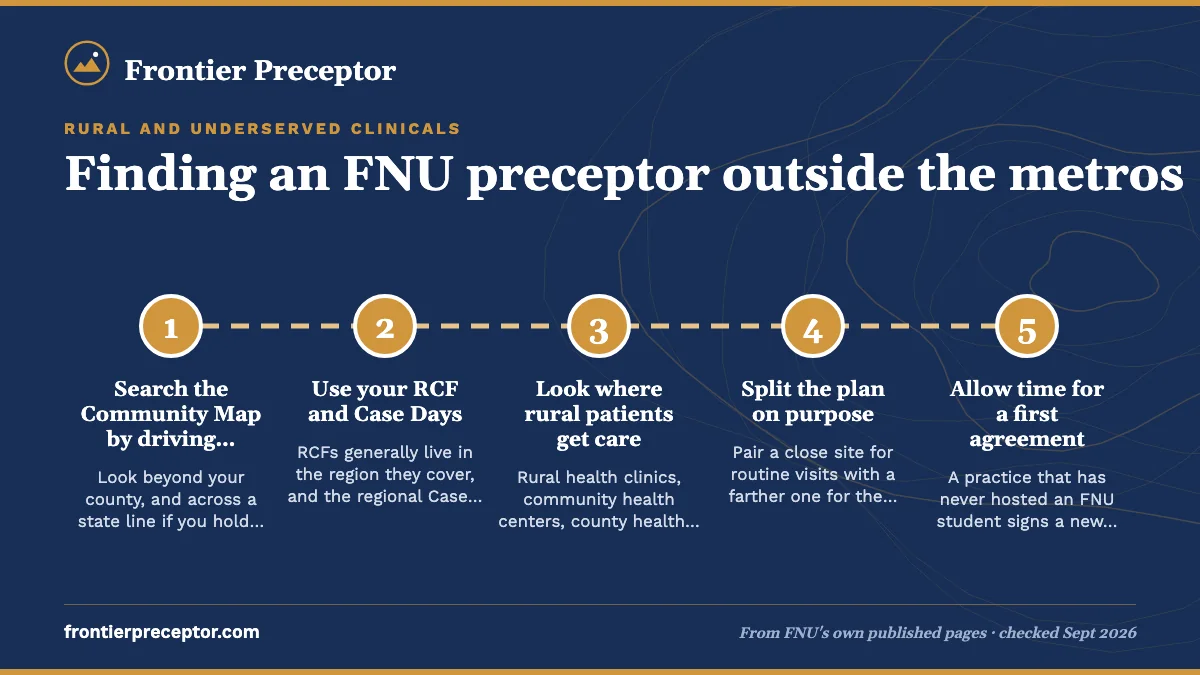
A rural search works best when it is deliberate about geography. These steps reflect FNU's own tools and rules:
- Search the Community Map by driving distanceLook beyond your county, and across a state line if you hold a compact or second RN license. Ask your Clinical Advisor to help widen the search.
- Use your RCF and Case DaysRCFs generally live in the region they cover, and the regional Case Days they organize are open to students, alumni, preceptors and applicants, which makes them a practical place to meet local clinicians.
- Look where rural patients get careRural health clinics, community health centers, county health departments and small hospitals are all worth approaching directly. FNU notes that some military and Indian Health Service sites accept any US nursing license.
- Split the plan on purposePair a close site for routine visits with a farther one for the counts you cannot get locally, such as hospital births or child and adolescent psychiatry, within your track's site cap.
- Allow time for a first agreementA practice that has never hosted an FNU student signs a new affiliation agreement and must show professional liability insurance. FNU says credentialing can take several months.
Telehealth and licenses across state lines
Telehealth can cut some driving, within FNU's caps: percentage limits for midwifery, WHNP and FNP, and a 450-hour limit for PMHNP students whose clinicals start in 2025 or later. It helps PMHNP students most. FNP students gain little travel relief, because FNU requires them to be in the same office as the preceptor for telehealth visits. For any telehealth visit you must meet licensure rules where the patient lives; see the telehealth page.
For in-person work, each state you train in must be covered by an unencumbered RN license or compact eligibility, and MSN and PGC sites have to be in the continental US or Hawaii. US territories such as Puerto Rico, Guam and the US Virgin Islands count as international sites and are not approved.
New York's rule has its own rural angle: the six MSN nurse-midwifery students FNU may place there each year train in upstate, rural and underserved areas. Every other MSN and PGC student has to train elsewhere, federal government facilities in New York excepted.
What a rural preceptor gets from FNU
A clinician in a small practice weighing your request is also weighing time. FNU pays preceptors an honorarium, sized by program and hours precepted, once you finish your practicum. It also offers The Gift of Precepting, a six-contact-hour continuing education course, 10% off non-degree FNU courses, DynaMed access that you can set up for them through FNU's library, and documentation of precepting hours for recertification. FNU's preceptor orientation pairs The Gift of Precepting with the FNU preceptor guide.
Your RCF supports the preceptor too, with monthly contact during your practicum and a mid-practicum site visit that can happen virtually. Mentioning that support can help a preceptor who has never worked with FNU. The preceptor outreach page covers how to make the request.
Why rural students choose us
Rural searches are where extra reach counts most. We search a wide radius around where you live, including across state lines where you are licensed, and we look at telehealth only within FNU's caps and where your course allows it. We check each lead against your track's rules and weekly minimums before passing it on, so you are not asked to drive two hours to a practice that cannot meet them.
Once a rural preceptor commits, we help you pull together the CSAF details and Clinical Credentialing contacts, and we can restart the search if that preceptor withdraws. Your RCF and Clinical Credentialing approve every site, and a rural lead that already clears the weekly minimums gives them a straightforward review. Tell us where you live and your track on the contact page.
Questions FNU students ask
Does FNU require clinicals in my home state?
No. The only residence-based rule FNU publishes is New York's. You can train in another state as long as you meet its licensing requirements, and the catalog allows that clinical needs may require relocating, possibly out of state. Changing sites is done in consultation with your region's RCF.
Can I do FNU clinicals at an Indian Health Service site?
FNU's compliance rules name Indian Health Service and military sites as examples of sites that may accept any US nursing license, which can spare you a second state license. The site still goes through the usual process: a CSAF, acceptance by your RCF, an affiliation agreement and preceptor credentialing through Clinical Credentialing.
Will FNU pay for travel to a distant clinical site?
FNU's public materials do not describe travel support for distant sites, and the catalog says a relocation required by the RCF or Clinical Director is at the student's expense. FNU does review rotation fees that sites charge and may pay them against an invoice. It also runs a Preceptor Scholarship funded partly by donated honoraria; ask Financial Aid about eligibility.
Can FNU students do clinicals in Alaska?
It is unclear from FNU's public sources. FNU's clinical-site policy limits MSN and PGC sites to the continental US and Hawaii and does not name Alaska, yet FNU lists Alaska among the states where its programs meet licensure education requirements. If you live in Alaska, confirm with your Clinical Advisor and RCF before you ask a preceptor there to commit.
What if a rural preceptor's employer won't let them accept FNU's honorarium?
FNU recognizes that some employers bar their clinicians from taking individual payments. A preceptor can still precept and receive the continuing education and hour documentation, and FNU gives preceptors the option to donate their honorarium to FNU, which helps fund the Preceptor Scholarship for students.
Related pages
Last checked 2026-09-23
We check these pages against FNU's own published sources. Your Clinical Advisor, your RCF and FNU's current guidelines have the final word.
Your site submitted before Clinical Bound.
Tell us your FNU track, your county and your Clinical Bound date. We look for a preceptor and site that fit FNU's rules for your track, and help you get the CSAF and credentialing details right.
- Matched to your track: CNM/CM, NP, or the right mix FNU allows
- Ready for the CSAF, the RCF and Clinical Credentialing
- In person near you, or telehealth within FNU's caps
Start your placement plan
A placement advisor replies with what an FNU-ready preceptor and site look like for you.