FNP751, FNP752 and FNP753: FNU's family NP practicum
After the five-day FNP750 Clinical Bound, FNU's FNP students take three practicum courses: FNP751 (4 credits), FNP752 (6) and FNP753 (5). Together they carry 750 clinical hours and a visit list that runs from newborns to older adults. FNU sets the hours and visits for the whole practicum, not per course, so your sites need to reach every age group.
Planning FNP751 to FNP753?
Tell us where you live and your projected Clinical Bound term. A placement advisor will reply by email.
The FNP courses as FNU lists them
The MSN and PGC programs of study list the same FNP clinical block with the same course titles. What differs is how many terms of didactic work come before it.
| Course | Title | Credits | Type |
|---|---|---|---|
FNP750 | FNP CB: Transition to Clinical (the five-day Clinical Bound) | 1 | Lab |
FNP751 | FNP Clinical Practicum I | 4 | Clinical |
FNP752 | FNP Clinical Practicum II | 6 | Clinical |
FNP753 | FNP Clinical Practicum III | 5 | Clinical |
FNP717 | FNP Final Comprehensive Review | 1 | Didactic |
The FNP didactic courses, FNP700 to FNP706, and PC719 come first in both programs; the MSN adds PC701, PC705, PC707 and PC716. Clinical Bound lands in term 6 of the full-time MSN and term 10 of the part-time MSN; in the PGC, term 4 full-time and term 7 part-time.
Hours in the FNP practicum
FNP students whose clinical courses start in 2025 or later owe 750 clinical hours spread over 19 weeks of clinical. FNU does not publish a split of those hours across FNP751, FNP752 and FNP753. The only course-level figure in the catalog is a weekly minimum, and your first site has to be able to offer the FNP751 minimum before your RCF accepts it.
| Course | Minimum hours a week | Published maximums |
|---|---|---|
FNP751 | 20 | 10 a day, 40 a week |
FNP752 | 28 | 10 a day, 40 a week |
FNP753 | 24 | 10 a day, 40 a week |
The daily cap shapes which preceptors can carry you alone. By our arithmetic, a preceptor who works two days a week cannot, on those days alone, reach the 28-hour minimum in FNP752. The clinical hours page covers what counts toward the 750.
FNP visit counts across the lifespan
FNU builds the FNP list by age group, which is why a single adult-only site cannot cover it alone.
| Population or visit type | Required |
|---|---|
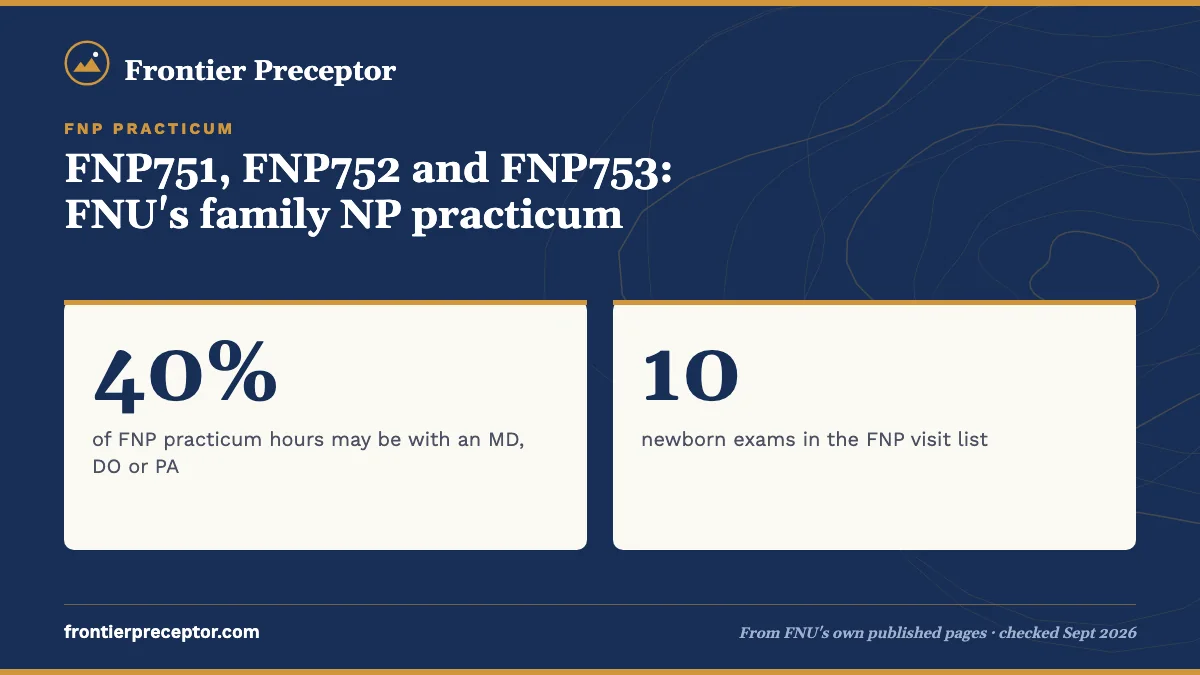
| Newborn exams | 10 |
| Ages 1 month to 5 years | 20 well and 20 episodic |
| Ages 6 to 12 | 20 well and 20 episodic |
| Ages 13 to 19 | 20 well and 20 episodic |
| Adult episodic or wellness care | 150 |
| Adult chronic illness care, under 65 | 100 |
| Geriatric episodic or wellness care, over 65 | 50 |
| Geriatric chronic illness care, over 65 | 70 |
| Gynecologic visits (the catalog includes 10 speculum or bimanual exams) | 20 |
| Antepartum visits | 20 |
| Mental health visits | 20 |
| Men's health visits | 10 |
Pediatric, antepartum and gynecologic visits are worth planning early, since an adult-focused practice may see few of them. A family practice that sees children, or a second site within the four-site limit, is one way to close those gaps.
Who can precept FNP students
FNU's FNP rules let you mix professions, within limits.
- Up to 40% of practicum hours may be with an MD, DO or PA. PAs must be NCCPA-certified.
- Specialty sites may make up no more than 20% of your time, with one specialty rotation allowed, chosen from the catalog's approved list.
- Each FNP preceptor must hold a valid, unencumbered US license and have practiced for at least a year in a relevant advanced practice or medical role. Nurse preceptors also need a master's or higher in a nursing-related field.
- No family member may precept you, and FNU rules out sites that a relative or household member owns or runs, or that you have a stake in.
- Each preceptor fills in a weekly DDAT. FNP students send the end-of-course EDAT but no mid-course MDAT.
For how these rules line up against the other tracks, see preceptor requirements.
Sites, telehealth and state rules
FNP students may use as many as four clinical sites. Telehealth is capped at a tenth of your hours and a tenth of each population-focused visit type, and counts only when you share an office location with your preceptor; the telehealth page works through the numbers.
Sites must sit in the continental US or Hawaii, and you need to be licensed as an RN, or compact-eligible, in each of their states. FNP students may not do clinicals in New York except at federal government facilities there. New York residents in the FNP track therefore complete clinicals in another state or at a federal site.
Where a single site lacks the patient volume, the catalog expects a second, even if that means relocating, possibly out of state. The four-site limit leaves room for that, but each new site needs its own CSAF and credentialing.
Approvals to have in hand before FNP751
Nothing in FNP751 can start until FNU has cleared both you and the site. Use this as a checklist with your RCF.
- An accepted CSAF for each site, submitted through the Community Map after you speak with your RCF and recorded in My Clinical Plan.
- A complete clinical plan covering all visit types and hours. Without one you may not be registered for
FNP750and may need an Academic Hiatus. - Your CastleBranch items: RN license verification through Nursys Quick Confirm, BLS (ACLS does not count), the clinical background check, the health verification form, the OSHA/HIPAA module, health insurance and the records release.
- Clinical Credentialing's sign-off: the affiliation agreement, the site's liability insurance, a fully credentialed preceptor and any required Pre-Clinical Site Visit.
- Your Pre-Clinical Interview with the RCF, plus a pre-clinical orientation meeting with every preceptor.
- Clinical Bound attended, then the RCF's final release of site and preceptor.
According to FNU staff, RCFs sign off on the clinical plan roughly four to six months before Clinical Bound, and site credentialing can itself run for months. Start from the placement timeline rather than the term calendar.
How we search for the FNP sequence
For FNP students, we look for family practice preceptors whose panels span children, adults and older adults, since that mix covers the most lines of the visit list. When a lead is a physician or PA, we note how it sits against the 40% limit, and we treat a specialty clinic as the single optional rotation it is. We help you assemble the preceptor and site information each CSAF and Clinical Credentialing require.
Your RCF and FNU's credentialing team decide on every site, and each one we suggest is matched to the visit list before you submit. If a preceptor withdraws during FNP752 or FNP753, we search again with you straight away. Request a search and include your projected Clinical Bound term.
Questions FNU students ask
Does urgent care count for FNU FNP clinical hours?
FNU's public materials do not say whether urgent care counts as a primary care site or a specialty site. The difference matters, because specialty time is capped at 20% with a single rotation from the catalog's approved list. Ask your RCF how an urgent care site would be classified before you submit its CSAF.
Can a PA be one of my FNP preceptors?
Yes. FNU caps time with an MD, DO or PA at 40% of FNP practicum hours, and a PA preceptor must be NCCPA-certified. The 40% reads as one combined limit for all three professions, so a PA and a physician together should stay within it. Settle the balance with your RCF before the CSAFs go in.
How many clinical hours is FNP752?
FNU does not publish a per-course total for FNP752 or the other two practicum courses. The catalog gives a weekly minimum of 28 hours during FNP752, the highest of the three, inside the 750-hour track total. Check your syllabus in Canvas, and treat any other per-course figure as unconfirmed until your RCF agrees.
As a PGC student with an adult NP background, do I still need pediatric visits?
FNU publishes one FNP visit list and one clinical block for both the MSN and the PGC, and it publishes no reduced list for students with prior certification. Clinical courses are also not eligible for transfer credit. If you think an exception applies to you, confirm it with your RCF before planning sites around it.
Related pages
Last checked 2026-09-23
We check these pages against FNU's own published sources. Your Clinical Advisor, your RCF and FNU's current guidelines have the final word.
Your site submitted before Clinical Bound.
Tell us your FNU track, your county and your Clinical Bound date. We look for a preceptor and site that fit FNU's rules for your track, and help you get the CSAF and credentialing details right.
- Matched to your track: CNM/CM, NP, or the right mix FNU allows
- Ready for the CSAF, the RCF and Clinical Credentialing
- In person near you, or telehealth within FNU's caps
Start your placement plan
A placement advisor replies with what an FNU-ready preceptor and site look like for you.