FNU Clinical Credentialing: contracts, insurance and preceptor checks
Clinical Credentialing is the FNU team that turns an accepted site into one you are allowed to work at. It signs an affiliation agreement with the site, exchanges insurance certificates, credentials your preceptor and handles your onboarding. FNU says the process can take several months, which is why an early CSAF matters more than a fast one.
Get your placement plan
Tell us your FNU track and where you live. A placement advisor replies with what a FNU-ready preceptor and site look like for you.
What Clinical Credentialing does
The team's Clinical Credentialing Coordinators, overseen by a Director and an Assistant Director of Clinical Credentialing, have five jobs. In FNU's own words, they:
- "establish an affiliation agreement (contract)" with your site
- "exchange certificates of insurance"
- "credential preceptors"
- "facilitate your student onboarding"
- "meet state board of nursing requirements" for clinical placement
Coordinators work with FNU's administration and legal counsel on affiliation agreements. The team also collects your own clinical compliance items through CastleBranch.
Credentialing is separate from approval. Your RCF decides whether a site and preceptor suit your track; Credentialing makes that site legally and administratively ready. Both have to finish before you start.
When it starts, and what must be done before day one
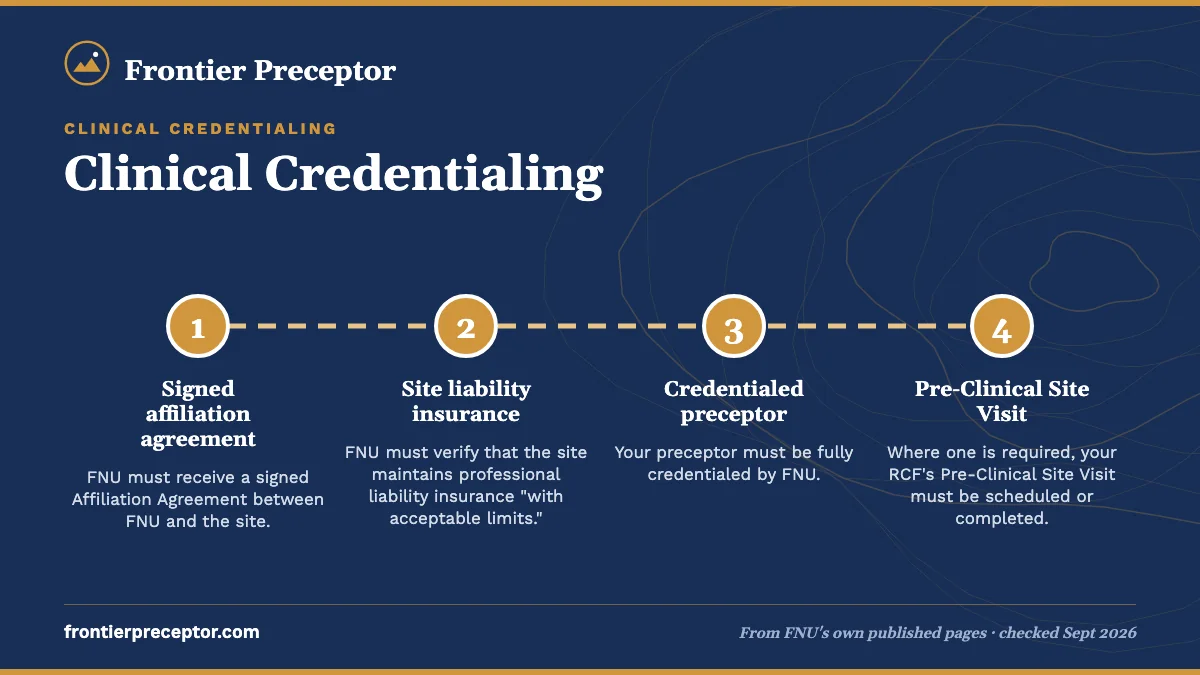
Credentialing begins only after your RCF accepts your CSAF. Before you may see a single patient, the Catalog requires all four of these:
- Signed affiliation agreementFNU must receive a signed Affiliation Agreement between FNU and the site.
- Site liability insuranceFNU must verify that the site maintains professional liability insurance "with acceptable limits."
- Credentialed preceptorYour preceptor must be fully credentialed by FNU.
- Pre-Clinical Site VisitWhere one is required, your RCF's Pre-Clinical Site Visit must be scheduled or completed.
Your own compliance file and your RCF's final release after Clinical Bound sit on top of those four.
Even if a site is keen to have you early, do not begin: the Catalog treats any clinical start ahead of finished site and preceptor credentialing as grounds for dismissal.
Affiliation agreements and insurance
The affiliation agreement is the contract between FNU and your site. Some sites will have their own contract process and reviewers; a small practice may never have signed one before. Either way, someone with authority at the site has to sign, so knowing who that is before you submit the CSAF saves a round of emails.
Insurance runs both ways. FNU provides general and professional liability insurance for clinical students, and that coverage ends once you finish clinical courses and graduate. The site has to show its own professional liability coverage, and coordinators exchange certificates of insurance with it. FNU does not publish its policy limits. The clinical insurance page covers your side in more depth.
You also need your own health insurance, and you give proof of it during credentialing. The Catalog warns that clinical sites may not accept health sharing memberships, and that students are not covered by workers' compensation.
Credentialing your preceptor
Once you submit your preceptor's contact details, FNU emails the preceptor instructions for the Preceptor Login, FNU's portal area for preceptors. FNU's public pages do not list which documents it collects from preceptors; that sits on the Credentialing pages behind the login. Tell your preceptor an email from FNU is on its way, so it does not sit unread.
FNU's baseline preceptor holds a US license without encumbrance, has at least a year in a relevant advanced-practice or medical role, and has a master's or higher in a nursing-related field, with track rules on top. Exceptions are possible but need the Clinical Director, the Department Chair and the Director of Clinical Credentialing. The full list by track is on the preceptor requirements page.
Midwifery sites carry extra checks: a birth center needs CABC accreditation, and the Clinical Director and the Director of Clinical Credentialing review any home birth site.
Why it can take several months
The Catalog's phrase is that credentialing sites "can take several months." Most of the reasons are structural:
- A contract needs two sides to sign. FNU's side involves administration and legal counsel, and the site's side depends on who reviews contracts there.
- Insurance certificates have to be exchanged and checked against acceptable limits.
- Your preceptor has to complete their own steps through the Preceptor Login.
- Some states require advance notice and approval before FNU students do clinicals there, and FNU does not publish which ones.
- Sites may add their own onboarding requirements, which you complete at your own expense.
What you control is the start. The earlier your CSAF is accepted, the more of those months pass before Clinical Bound rather than after it. The placement timeline page works through the dates.
Your compliance file, fees and other fine print
Credentialing also gathers your own clinical compliance items, through CastleBranch rather than the CSAF. Its first email reaches you in Week 1 of the term that precedes your Clinical Bound term, the items are due in Week 5, and the team runs three information sessions that term. Missing the deadline blocks registration, and FNU says that may bring late registration fees.
Some sites charge rotation fees. The Catalog says FNU reviews them case by case and, if it deems a fee appropriate, pays once the site sends an invoice. It will not pay fees without an invoice, cash paid to a site, or supplies offered in place of payment.
If your projected Clinical Bound term changes, the Catalog lists your Clinical Credentialing Coordinator among the people you must tell, along with your RCF, preceptors and Academic Advisor.
What isn't public, and who knows
Most of Credentialing's working detail is not public. Its student pages moved to Banyan Tree 2.0, FNU's SharePoint site, and need a login. The preceptor document list, FNU's liability policy limits and the list of states needing advance notice are not published. Compliance instructions sit in CB101 in Canvas. When a site asks for something beyond FNU's list, such as a specific type of background check, the Catalog expects you to complete it, so tell your coordinator early.
Your Clinical Credentialing Coordinator is the person to ask where your site stands. Your RCF can tell you whether a site is worth submitting in the first place, and course-level rules live in the program guidelines on Canvas and Banyan Tree.
Making your credentialing file easy to complete
Credentialing is FNU's work, and we make the file behind it simple. Before you submit the CSAF, we collect with you the details a credentialing team usually asks about, such as the preceptor's CV and license information, the site's legal name and address, and the contact who handles contracts. Clinical Credentialing tells you what it actually requires, and most of it is already in your hands.
FNU signs the agreements, credentials the preceptor and sets the timeline, and our job is to have the site ready for each of those steps. If you want a site found and its details organized, get in touch.
Questions FNU students ask
Why is my FNU clinical site still not credentialed?
Often one piece is still open: the affiliation agreement is with the site's reviewers, insurance certificates are pending, your preceptor has not finished the Preceptor Login steps, or the state needs advance notice. The Catalog says site credentialing can take several months. Your Clinical Credentialing Coordinator can tell you which piece is outstanding and whether you can help move it.
Does FNU provide malpractice insurance for clinicals?
Yes. FNU carries general and professional liability coverage for its students while they are in the clinical practicum, ending once you complete clinical courses and graduate. It covers you only where Credentialing and your RCF have cleared the site. Your site must carry its own professional liability insurance too, and FNU's coordinators exchange certificates of insurance with it.
What documents does FNU need from my preceptor?
FNU does not publish the list. After you submit your preceptor's contact details, FNU emails them instructions for the Preceptor Login, and Clinical Credentialing takes it from there. It helps to have the preceptor's license details and a current CV ready, but your Clinical Credentialing Coordinator confirms what is actually needed for your site and track.
Will FNU pay my clinical site's rotation fee?
Possibly. The Catalog says FNU reviews rotation fees case by case and, if it deems a fee appropriate, pays the site against an invoice. Fees the site has not invoiced, supplies offered instead of payment, cash handed to the site and preceptor-finding services are all on the Catalog's list of things FNU will not pay. Raise any fee with Clinical Credentialing before you commit to the site.
Do DNP project sites go through Clinical Credentialing?
Yes. DNP students submit a CSAF for the project site through DNP850 or DNP Prep 101 in Canvas, and Clinical Credentialing credentials the site, which may take several months. If you work at the site and your employer requires no affiliation agreement, the Catalog says you follow your employer's requirements instead of FNU's compliance items.
Related pages
Last checked 2026-09-23
We check these pages against FNU's own published sources. Your Clinical Advisor, your RCF and FNU's current guidelines have the final word.
Your site submitted before Clinical Bound.
Tell us your FNU track, your county and your Clinical Bound date. We look for a preceptor and site that fit FNU's rules for your track, and help you get the CSAF and credentialing details right.
- Matched to your track: CNM/CM, NP, or the right mix FNU allows
- Ready for the CSAF, the RCF and Clinical Credentialing
- In person near you, or telehealth within FNU's caps
Start your placement plan
A placement advisor replies with what an FNU-ready preceptor and site look like for you.