FNU FNP clinicals: the family practice preceptor you need, and when
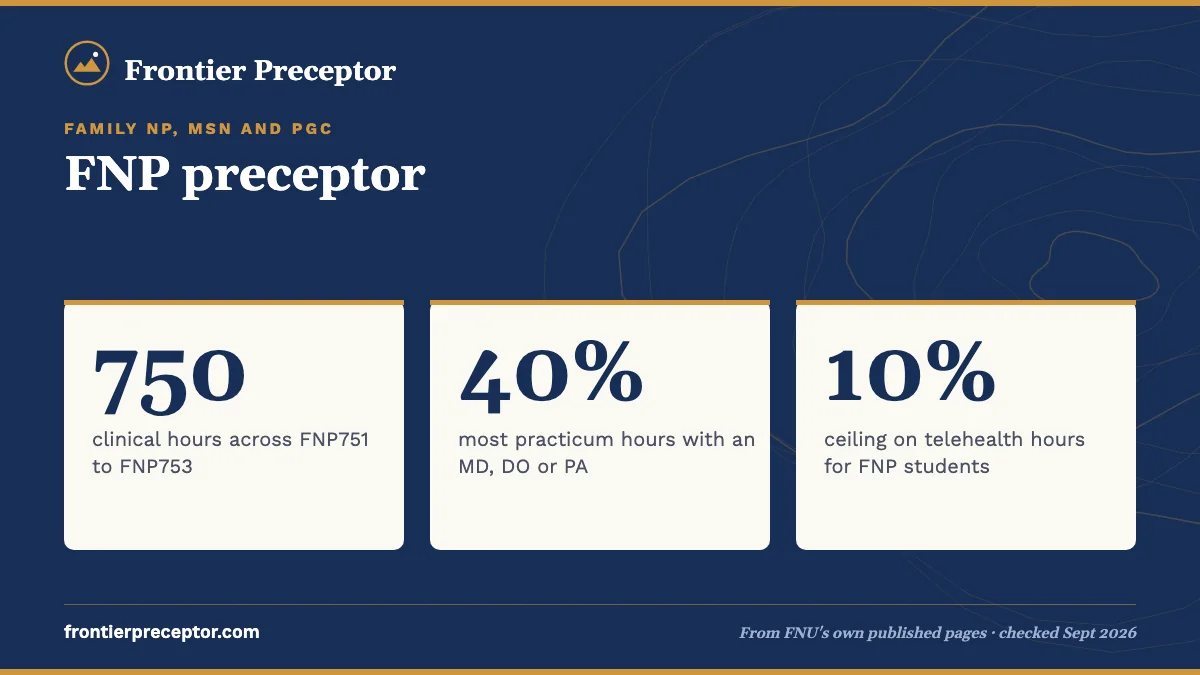
FNU's FNP track needs sites that see patients from newborns to older adults, because your 750 clinical hours carry visit counts in every age band plus gynecologic, prenatal, mental health and men's health care. You find and secure those sites yourself, with FNU's support, and your RCF must accept at least one before you can register for FNP750 Clinical Bound.
Get your placement plan
Tell us your FNU track and where you live. A placement advisor replies with what a FNU-ready preceptor and site look like for you.
Credits, terms and your Clinical Bound term
The MSN in family nurse practitioner is 52 credits. On the full-time Program of Study it runs 8 terms with Clinical Bound in term 6; part-time, 12 terms, reaching Clinical Bound in term 10. The FNP post-graduate certificate is 39 credits, with Clinical Bound in term 4 of 6 full-time or term 7 of 9 part-time.
Before clinicals you complete the FNP didactic courses, including Primary Care I to III (FNP702, FNP705, FNP706), FNP703 Gynecologic Health and Childbearing and FNP704 Primary Care: Pediatrics. MSN students also take the shared core, including PC705, PC707 and PC716. Your Program of Study also sets a milestone for sending in a CSAF for each clinical site, placed in the didactic phase several terms ahead of Clinical Bound.
The year holds four 11-week terms, and the 2027 starts are January 4, April 5, July 5 and October 4. Your first stop is Frontier Bound, three days in Versailles, Kentucky, where you also sit in on information sessions about clinical credentialing.
The visits your sites must produce
If your first clinical course falls in 2025 or later, the FNP minimum is 750 hours across 19 weeks of clinical. FNU also sets the patient mix, and this list is what decides whether a practice can carry you:
- 10 newborn exams
- Ages 1 month to 5 years: 20 well and 20 episodic visits
- Ages 6 to 12: 20 well and 20 episodic visits
- Ages 13 to 19: 20 well and 20 episodic visits
- Adults under 65: 150 episodic or wellness visits and 100 chronic illness visits
- Adults over 65: 50 episodic or wellness visits and 70 chronic illness visits
- 20 gynecologic visits (including 10 speculum and bimanual exams), 20 antepartum, 20 mental health and 10 men's health visits
An adult-only internal medicine office cannot fill the pediatric or antepartum lines, so hold each prospective site up against this list before you ask the preceptor to commit. Time spent observing during site orientation counts toward hours, but a visit you only watched does not count toward these numbers. The clinical hours page covers how hours and visits are logged.
FNP750 to FNP753: the clinical block
MSN and PGC students take the same four clinical-block courses, followed by FNP717 Final Comprehensive Review. FNU publishes weekly minimums for each practicum but not hours per course. On the 2026 calendar, Clinical Bound sessions are scheduled Monday through Friday during the opening weeks of each term, and the CB101 course in Canvas gives your arrival and departure details.
| Course | Credits | Content | Minimum hours a week |
|---|---|---|---|
FNP750 | 1 (lab) | Clinical Bound: five-day skills intensive in Versailles | Not a practicum |
FNP751 | 4 | FNP Clinical Practicum I (course detail) | 20 |
FNP752 | 6 | FNP Clinical Practicum II | 28 |
FNP753 | 5 | FNP Clinical Practicum III | 24 |
FNP students may use up to four sites, with no more than 10 clinic hours a day and 40 a week. Build the first site around FNP751, because your RCF accepts a site only when it can offer the weekly hours that course requires.
Who can precept an FNP student
Up to 40% of your practicum hours may be with an MD, DO or physician assistant, and a PA must be NCCPA-certified. The rest of your time is with an advanced practice nurse who meets FNU's general standard: an unencumbered US license, at least a year of relevant advanced-practice experience, and a master's degree or higher in a field related to nursing.
Specialty practices are allowed in small doses. The catalog caps specialty time at 20%, permits only one specialty rotation, and names the approved specialties. Family is off limits too: no relative as preceptor, and no site run or owned by a relative or household member, and none you partly own. The preceptor requirements page lists the rules for every track.
Keep a running total of your physician and PA hours. Once more than 40% of your practicum hours sit with an MD, DO or PA, the plan no longer fits FNU's FNP rule, and that is hard to repair late in FNP753.
Telehealth and state limits
Telehealth is tightly capped for FNPs: no more than 10% of your hours and 10% of each population-focused visit type. Each telehealth visit also requires you to satisfy the licensing rules of the patient's home state. The telehealth page compares FNP's cap with the other tracks.
For in-person clinicals you must be licensed as an RN without encumbrance, or compact-eligible, in each state where you see patients, unless the site accepts any US nursing license; FNU names military and Indian Health Service sites as examples. Clinicals for MSN and PGC students are limited to the continental US and Hawaii, and FNU treats Guam, Puerto Rico and the US Virgin Islands as international sites it will not approve.
New York is closed to FNP clinicals. You can enroll from New York, but FNP students must train in another state, the one exception being a federal government facility in New York. The state rules page covers the rest.
How FNU supports your search
FNU puts the search in your hands and backs it with people and data. FNU's Clinical Outreach and Placement team assigns Clinical Advisors by program track; they help you work the Community Map, which lists over 20,000 active clinical sites and preceptors, and keep you current on placement timelines. Your RCF, assigned in your first term alongside a projected Clinical Bound term, reviews the plan and makes a pre-clinical visit to your primary site.
Clinical Credentialing then handles the contract side: the affiliation agreement, certificates of insurance and preceptor credentialing. FNU warns that site credentialing can run to several months, and FNU staff put RCF approval of the clinical plan at roughly four to six months ahead of Clinical Bound. A family practice that has never hosted an FNU student will need a new agreement, so leave room for it.
FNU gives preceptors reasons to say yes, including an honorarium, a six-hour continuing education course and 10% off non-degree FNU courses. The preceptor outreach page shows how to make the ask.
Why FNP students choose us
We specialize in the FNP search FNU asks of you. We look first for family practices near you that see children, adults and older adults, and we flag early when a lead would push you past the 40% physician and PA share or into a second specialty rotation. Telehealth leads are kept inside FNU's 10% ceiling.
Once a preceptor commits, we pull together with you what the CSAF asks for and the practice contacts Clinical Credentialing needs, and a placement advisor stays available if a preceptor drops out mid-plan. The final approval is FNU's, through your RCF and Clinical Credentialing, and a family practice that already fits the FNP mix is the strongest lead you can put in front of them. You can start with the form below or on the contact page.
Questions FNU students ask
Can a physician assistant precept me in FNU's FNP track?
Yes, if the PA is NCCPA-certified and meets FNU's general preceptor standard of an unencumbered US license and a year of relevant experience. Hours with a PA sit in the same 40% share as hours with MDs and DOs, so a PA works best as a second preceptor alongside an advanced practice nurse who carries most of your time.
Is urgent care or a pediatric office a specialty rotation for FNU FNP students?
The catalog lists the specialty sites FNU approves, and your RCF reviews each site when you submit the CSAF, so check the list and ask your RCF before you commit. The distinction matters because only one specialty rotation is allowed and specialty time is capped at 20% of your hours.
Can I count telehealth visits if my FNP preceptor works from home?
Not if you are in a different place. FNU requires FNP students doing telehealth to be in the same office location as the preceptor, and the visits still count toward the 10% ceiling on hours and on each population-focused visit type. Your licensing also has to satisfy the patient's state.
How many preceptors does an FNU FNP student usually need?
FNU publishes a limit of four sites rather than a set number of preceptors. What drives the count is the patient mix: a practice that sees newborns, teens, adults, older adults and pregnant patients can carry most of the list, while an adult-focused practice leaves you needing a second site for pediatrics and antepartum care. Map your likely gaps before Clinical Bound.
When should an FNU FNP student start looking for a preceptor?
Early in the program, as FNU recommends. Full-time MSN students reach Clinical Bound in term 6 and full-time PGC students in term 4. Clinical Credentialing's compliance request goes out in week 1 of the term preceding Clinical Bound, with a week-5 due date, and a site can take several months to credential.
Related pages
Last checked 2026-09-23
We check these pages against FNU's own published sources. Your Clinical Advisor, your RCF and FNU's current guidelines have the final word.
Your site submitted before Clinical Bound.
Tell us your FNU track, your county and your Clinical Bound date. We look for a preceptor and site that fit FNU's rules for your track, and help you get the CSAF and credentialing details right.
- Matched to your track: CNM/CM, NP, or the right mix FNU allows
- Ready for the CSAF, the RCF and Clinical Credentialing
- In person near you, or telehealth within FNU's caps
Start your placement plan
A placement advisor replies with what an FNU-ready preceptor and site look like for you.