How to ask a preceptor for an FNU rotation
Ask with specifics: your track, your courses, hours per week, your start term and what FNU gives in return. FNU offers preceptors an honorarium, a 6-hour CE course, 10% off its non-degree courses, DynaMed access and documentation of precepting hours, and it handles the contract and insurance exchange with the site.
Want help with outreach?
Tell us your track, location and term. A placement advisor will reply.
Know your ask before you make it
A clinician's first questions are how many hours, how many weeks and when. FNU's practicum is 750 hours over at least 19 weeks, with weekly minimums of 20 hours in your first clinical course, 28 in the second and 24 in the third. Tie your start to your projected Clinical Bound term, and say whether you're asking them for the whole practicum or part of it.
Check fit before you ask. They need a valid, unencumbered US license, a year in an advanced-practice or medical role and the right credential for your track, and they can't be family. The preceptor requirements page covers the FNP 40% share for MDs, DOs and PAs and the PMHNP 135-hour cap for therapists, so you only approach people whose hours will count.
Have one line ready on who approves what. Your Regional Clinical Faculty member (RCF) and Clinical Credentialing review the site and preceptor; a yes from the clinician starts that process rather than finishing it.
Where to find people worth asking
Start with FNU's Community Map, which FNU describes as "over 20,000 active clinical sites and preceptors throughout all 50 states." It is built from preceptors and sites FNU students have used before, so many of the people on it have hosted an FNU student already. Clinicians can also add themselves through FNU's Preceptor Inquiry Form, which puts their contact details on the map.
Then widen the net: colleagues from past jobs, clinicians you've worked alongside, alumni in your region, and Case Days, the RCF-run seminars that are open to students, alumni, preceptors and applicants. Students on nursing forums report that networking works. Your Clinical Advisor can help you work through leads and troubleshoot when replies dry up.
What FNU gives preceptors
These come from FNU's preceptor pages and catalog. Describe them the way FNU does, and don't put a number on the honorarium, because FNU doesn't publish one.
- An honorarium, paid after you finish the practicum. FNU says it is based on the program and the number of hours. Some employers don't let clinicians accept individual payments, and preceptors can donate the honorarium to FNU, where donations help fund a Preceptor Scholarship for students.
- The Gift of Precepting, an ANCC-approved course worth 6 contact hours, plus other CE sessions that FNU says include pharmacology.
- 10% off FNU's non-matriculating (non-degree) courses. FNU's non-matriculating page said in September 2026 that it wasn't taking those applications, so check what is open before you mention it.
- DynaMed access, which you set up by registering your preceptor through the FNU library's DynaMed link.
- Documentation of precepting hours for recertification, with a confirmation of hours and CE credits emailed to the preceptor.
- Support from your RCF, plus the FNU Preceptor Guidebook and online training.
FNU also holds a Preceptor Celebration Week in the second week of August and keeps a Featured Preceptor archive, worth mentioning to clinicians who value recognition.
What precepting asks of them
Be straight about the work. Preceptors who know the load up front can plan for it; here is the sequence FNU takes them through.
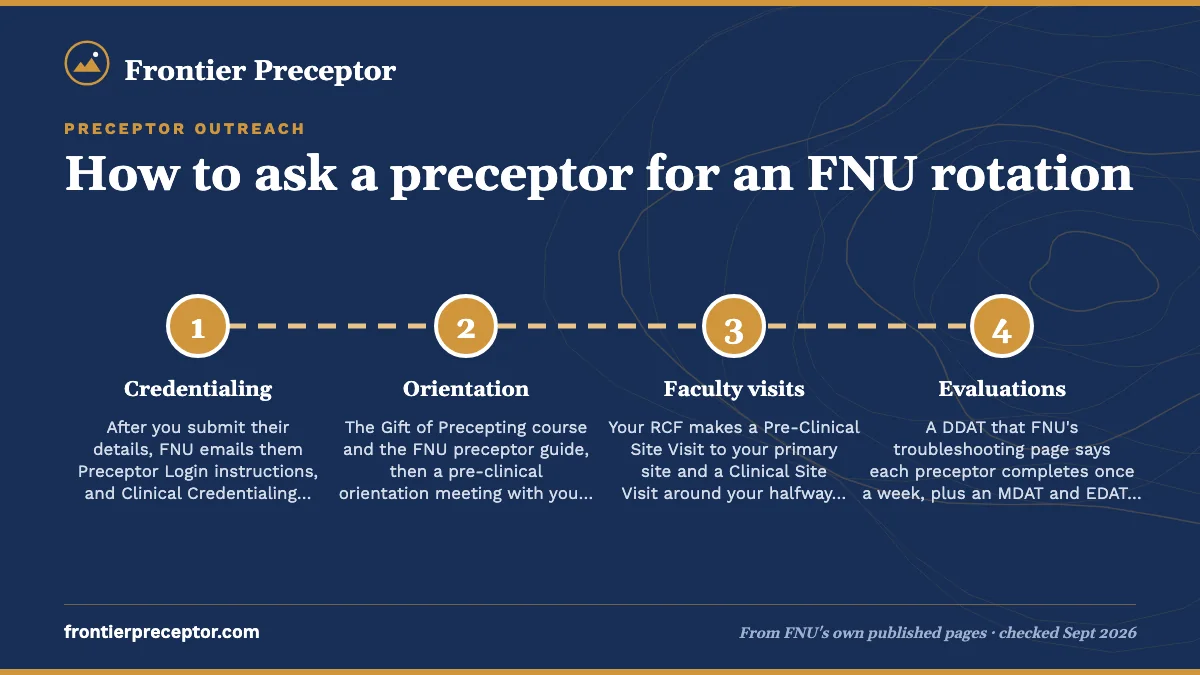
- CredentialingAfter you submit their details, FNU emails them Preceptor Login instructions, and Clinical Credentialing works with the site on an affiliation agreement and certificates of insurance. FNU insures you, the student, with general and professional liability coverage.
- OrientationThe Gift of Precepting course and the FNU preceptor guide, then a pre-clinical orientation meeting with you that follows a 10-point agenda set in the catalog.
- Faculty visitsYour RCF makes a Pre-Clinical Site Visit to your primary site and a Clinical Site Visit around your halfway point, which may be virtual or in person. The RCF also contacts preceptors monthly.
- EvaluationsA DDAT that FNU's troubleshooting page says each preceptor completes once a week, plus an MDAT and EDAT for midwifery and WHNP students or an EDAT alone for FNP and PMHNP, through the Preceptor Login. See preceptor evaluations.
A first message that gets a real answer
Keep first contact short and specific, and make it easy to forward to a practice manager. Whether it goes through a mutual colleague or as a brief email, cover these five parts.
- Who you areYour name, that you're an RN in FNU's program for your track, and how you found them.
- What you needYour course numbers (for an FNP,
FNP751toFNP753), the start term, hours per week and the total hours you're asking them to cover. - What FNU handlesThe affiliation agreement, insurance exchange and credentialing run through FNU's Clinical Credentialing, and your RCF supports them through the practicum.
- What they getThe honorarium, CE, course discount, DynaMed access and hours documentation, in FNU's own terms.
- The next stepAsk for a short call and offer to send FNU's preceptor page. If you hear nothing, follow up once after a week.
Never quote a preceptor an honorarium amount. FNU doesn't publish one, and a wrong figure can sour the arrangement before it starts.
After they say yes
Contact your RCF, then submit the Clinical Site Approval Form through the Community Map and record the rotation in My Clinical Plan. Clinical Credentialing starts only once your RCF accepts the CSAF, and it can take several months.
Keep the preceptor in the loop while that runs. If your Clinical Bound term moves, FNU expects you to tell your preceptors along with your RCF, Clinical Credentialing Coordinator and Academic Advisor. Share the placement timeline so they know roughly when to expect you.
If the site asks for a rotation fee, don't pay it yourself. FNU reviews site fees case by case and, if it agrees, pays against an invoice from the site; it won't pay fees without an invoice or cash handed to a site.
How we reach preceptors for you
A placement advisor contacts clinicians who fit your track and location, explains what FNU asks of preceptors and what it gives them, and brings you the ones open to a conversation, along with the details your CSAF will need. We describe the honorarium, CE and other perks in FNU's own wording, so every clinician knows exactly what FNU offers. Clinicians who want a plain explanation can read precepting FNU students.
A preceptor's yes is where FNU's review begins, with your RCF looking at the CSAF and the credentialing team vetting the preceptor, and the clinicians we introduce already fit your track. If you've already worked the map and your own network without luck, can't find a preceptor sets out next steps, or use the form below.
Questions FNU students ask
How much does FNU pay preceptors?
FNU doesn't publish an amount. Its preceptor pages say the honorarium is based on the program and the number of hours and is paid after the student finishes the practicum. Preceptors update W9 and payment details in their Preceptor Profile. Some employers don't allow individual payments, and preceptors can choose to donate the honorarium to FNU.
Who carries liability insurance when I train with a preceptor?
FNU provides general and professional liability insurance for its clinical students during the practicum. Clinical Credentialing also exchanges certificates of insurance with the site and checks that the site carries professional liability insurance of its own. Your FNU coverage ends once you finish clinical courses and graduate, so it covers the practicum and nothing after it.
Do FNU preceptors get CE credit?
Yes. The Gift of Precepting is ANCC-approved for 6 contact hours, and FNU's preceptor pages mention other CE sessions, including pharmacology, along with CE and training through the FNU Preceptor Guidebook on Canvas Catalog. FNU also documents hours spent precepting, which preceptors can use for recertification, and emails the preceptor a confirmation of hours and CE credits.
Should I message preceptors on the Community Map directly?
Yes, that is what the map is for. It lists preceptors and sites FNU students have used, plus clinicians who filled in the Preceptor Inquiry Form. A listing isn't a commitment, so expect some to be full or unavailable for your term. Your Clinical Advisor can help you work through the list and troubleshoot when replies dry up.
What if the preceptor's employer has to approve?
Expect it. The affiliation agreement is between FNU and the site, not the preceptor personally, so the practice or hospital signs it. Get the name of whoever handles student agreements and pass it to Clinical Credentialing with your CSAF, so the agreement doesn't stall waiting for the right contact.
Related pages
Last checked 2026-09-23
We check these pages against FNU's own published sources. Your Clinical Advisor, your RCF and FNU's current guidelines have the final word.
Your site submitted before Clinical Bound.
Tell us your FNU track, your county and your Clinical Bound date. We look for a preceptor and site that fit FNU's rules for your track, and help you get the CSAF and credentialing details right.
- Matched to your track: CNM/CM, NP, or the right mix FNU allows
- Ready for the CSAF, the RCF and Clinical Credentialing
- In person near you, or telehealth within FNU's caps
Start your placement plan
A placement advisor replies with what an FNU-ready preceptor and site look like for you.