DDAT, MDAT and the Preceptor Login: how your preceptor evaluates you
FNU preceptors rate students with three Developmental Assessment Tools, the DDAT, MDAT and EDAT, which they complete through the Preceptor Login on the portal. Your RCF uses them, with input from your preceptors, when assigning clinical grades. Knowing when each one is due keeps your evaluations from becoming the reason a course runs late.
Need a preceptor who knows the drill?
Tell us your track and when your practicum starts.
The three tools and when each is due
FNU calls them Developmental Assessment Tools, and the preceptor troubleshooting page on the portal sets out who sends which one and when.
| Tool | Applies to | Timing |
|---|---|---|
| DDAT (Daily) | Every preceptor, every track | Completed once per week per preceptor |
| MDAT (Monthly or Mid-course) | Nurse-midwifery and WHNP students | Sent at the halfway point of each course |
| EDAT (End-of-course) | All tracks | Sent near the end of each course |
Despite its name, the troubleshooting page says the DDAT is “completed once per week per preceptor. All preceptors must complete this form.” FNP and PMHNP students send only the EDAT, with no MDAT. Preceptors are asked to complete each form within one week. The catalog describes the tools as filled in by both the student and the preceptor, so expect a part of your own in each.
How the Preceptor Login gets set up
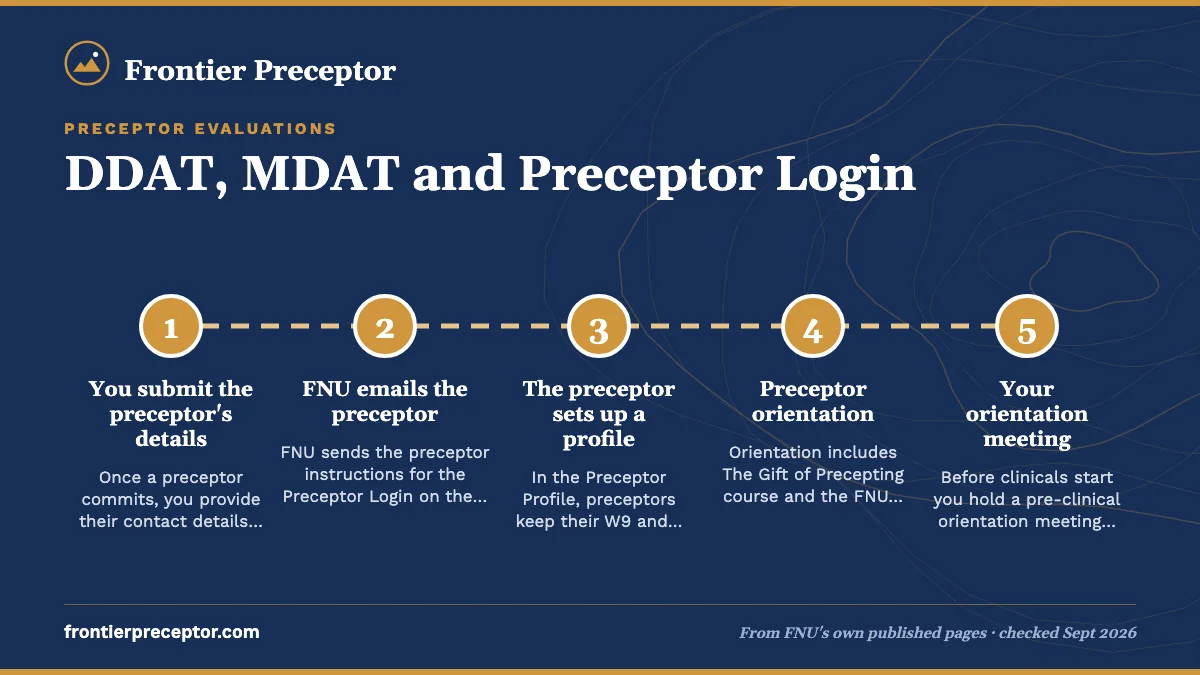
- You submit the preceptor's detailsOnce a preceptor commits, you provide their contact details as part of the site approval process.
- FNU emails the preceptorFNU sends the preceptor instructions for the Preceptor Login on the Banyan Tree portal.
- The preceptor sets up a profileIn the Preceptor Profile, preceptors keep their W9 and payment-election forms current and reach the assessment tools.
- Preceptor orientationOrientation includes The Gift of Precepting course and the FNU preceptor guide; FNU's Preceptor Guidebook opens with a Canvas Catalog login that also gives access to CE and training.
- Your orientation meetingBefore clinicals start you hold a pre-clinical orientation meeting with each preceptor, covering a ten-point agenda set out in the catalog. It is a good moment to show them where the forms live and when each is due.
What your preceptor is rating
Each tool uses the same developmental scale: Not Observed, Novice, Advanced beginner, Competent and “Safe entry-level practitioner.” The tools are developmental by name and by design, so expect ratings to rise across the 751, 752 and 753 courses rather than start high.
Because every preceptor completes a DDAT each week, students with two or three preceptors get parallel streams of feedback. Read them as they arrive. A pattern across preceptors, such as the same skill flagged by more than one of them, is the most useful thing the tools can tell you, and it is far easier to act on in week four than in the final week of a course.
Your part of each tool is a chance to say what you are working on. Being specific there makes the preceptor's next rating more useful to you and to your RCF.
How evaluations feed your grade
Your RCF assigns clinical grades with input from your preceptors, and the assessment tools are the main written form of that input. The RCF also contacts your preceptor every month and you every two weeks, and makes a Clinical Site Visit around your halfway point, which may be virtual or in person. After that visit, you and your preceptor can each give a written evaluation of it. More on the RCF's role is on Regional Clinical Faculty.
When progress is a concern, FNU uses a set sequence: a Problem Identification Sheet, then a Learning Plan, then a Performance Plan. If the RCF or preceptor finds progress or supervision inadequate, the catalog allows the RCF or Clinical Director to move you to a different site at your own expense. Late or missing evaluations make that picture harder for everyone to read.
Keeping evaluations from slipping
- Set expectations at the orientation meeting: which tools apply to your track, and that each should be done within a week.
- Send the MDAT at the halfway point of each course if you are a midwifery or WHNP student, and the EDAT near the end of each course whatever your track.
- If you have more than one preceptor, remember each of them completes a weekly DDAT.
- If a preceptor cannot get into the Preceptor Login, point them to FNU's troubleshooting page on the portal before a backlog builds.
- Tell your RCF early if forms are overdue; the RCF is already in monthly contact with your preceptor.
Your own hours and visits sit in a separate system, the Clinical Log, and your RCF sees both when grading.
What preceptors receive for the paperwork
Weekly forms are extra work for a busy clinician, and FNU recognizes it. The portal lists an honorarium based on the share of time spent precepting, paid after the student finishes the practicum. FNU does not publish the amount, some employers do not allow their providers to accept individual payments, and preceptors can choose to donate the honorarium to FNU.
Other benefits include the six-hour Gift of Precepting continuing education course, DynaMed access that you can set up through FNU's library, a 10% discount on non-matriculating FNU courses, and documentation of hours spent precepting for recertification. If you are asking someone to precept, preceptor outreach covers how to raise these, and clinicians can read precepting FNU students.
Preceptors briefed on FNU's weekly forms
Evaluations run between you, your preceptor and your RCF, and our work sets them up well from the start. A placement advisor looks for preceptors who fit your track and briefs them up front on what FNU's weekly forms involve, then helps you prepare the details FNU needs to credential them.
If a preceptor steps back partway through a course, we search for a replacement right away, and your RCF and Clinical Credentialing review the new site as usual. Ask the placement desk.
Questions FNU students ask
What does DDAT stand for at FNU?
DDAT is the Daily Developmental Assessment Tool. The MDAT is the Monthly or Mid-course tool and the EDAT is the End-of-course tool. Despite the daily name, FNU's preceptor troubleshooting page says each preceptor completes a DDAT once per week, and that every preceptor must complete it.
Do FNP students need an MDAT?
No. FNU's preceptor troubleshooting page says FNP and PMHNP students send only the EDAT near the end of each course, alongside the weekly DDAT. Nurse-midwifery and WHNP students send an MDAT at the halfway point of each course as well as the EDAT near the end.
My preceptor never received the Preceptor Login email. What now?
FNU emails Preceptor Login instructions after you submit the preceptor's contact details, so first confirm the email address you entered was correct and ask them to check their junk folder. The portal has a troubleshooting page for preceptors. If it still fails, contact your RCF or Clinical Credentialing.
How quickly should my preceptor complete an evaluation?
FNU asks preceptors to complete the forms within one week. Because the DDAT is weekly and every preceptor completes one, a delay of a few weeks quickly becomes a backlog. Agree a routine at your pre-clinical orientation meeting, such as finishing the DDAT after the last shift of each week.
Does a Novice rating mean I am failing?
Not by itself. Novice is one level on FNU's developmental scale, which runs from Not Observed through Novice, Advanced beginner and Competent to Safe entry-level practitioner. Your RCF assigns the grade with preceptor input, and a Problem Identification Sheet is the first formal step FNU lists when there is a real concern.
Related pages
Last checked 2026-09-23
We check these pages against FNU's own published sources. Your Clinical Advisor, your RCF and FNU's current guidelines have the final word.
Your site submitted before Clinical Bound.
Tell us your FNU track, your county and your Clinical Bound date. We look for a preceptor and site that fit FNU's rules for your track, and help you get the CSAF and credentialing details right.
- Matched to your track: CNM/CM, NP, or the right mix FNU allows
- Ready for the CSAF, the RCF and Clinical Credentialing
- In person near you, or telehealth within FNU's caps
Start your placement plan
A placement advisor replies with what an FNU-ready preceptor and site look like for you.