Logging hours and visit counts in FNU's Clinical Log
FNU records your practicum in what it calls the Clinical Log, also referred to as the Case Log Report. It is where your 750 hours and your track's visit counts become something your RCF can review and grade. Most logging problems come from the rules about what counts, not from the software.
Log showing a gap?
Tell us your track and which counts are short.
What FNU calls it, and what is public
FNU's students page refers to the Clinical Log and a Case Log Report, and says students have Clinical Log access after graduation for all of their submissions. FNU does not name a vendor, and its public pages make no mention of Typhon, Exxat, Medatrax or InPlace, so do not assume the tool works like one you used before.
The field-by-field instructions are not public. Look for them in CB101 and your practicum course in Canvas, and ask your RCF how entries should be written, since the RCF is the one reading them. In an undated FNU podcast, an RCF describes grading students' reflections and case logs.
The catalog adds one rule that applies whatever the software: clinical logs and other records of clinical information “must be fully de-identified.”
Two things you are logging: hours and visits
Every MSN and PGC track needs 750 clinical hours and 19 weeks of clinical for students starting clinical courses in 2025 or later, spread across the 751, 752 and 753 courses. The catalog sets weekly minimums of 20, 28 and 24 hours for those courses and caps clinic or office time at 40 hours a week. A preceptor troubleshooting page on FNU's portal lists course minimums of 200, 300 and 250 hours; treat your course syllabus as the figure you log against.
Visits are counted separately from hours, by type. A few examples from FNU's lists:
- Nurse-midwifery: 40 births, 40 labor management experiences and 40 newborn assessments, alongside antepartum, postpartum, gynecologic and other visits.
- FNP: pediatric exams by age band, adult and geriatric episodic and chronic care, and gynecologic, antepartum, mental health and men's health visits.
- WHNP: 300 gynecologic, 120 return antepartum and 100 primary care visits, among others.
- PMHNP: 300 medication management, 50 substance use disorder and 20 psychotherapy sessions, among others.
Full lists are on clinical hours and, for births, midwifery births.
What counts, and what does not
Most disputes over a log come down to a handful of FNU rules. The catalog is specific about them:
- Time spent observing during orientation at a site counts toward hours.
- Visits you only observed do not count toward required experiences, except PMHNP therapy visits.
- For WHNP and PMHNP students, observation at a specialty site does not count toward hours.
- Procedures FNU does not allow students to perform, such as vacuum deliveries, ultrasound and colposcopy, cannot be logged as your own, even if you already know how.
- No FNU source says Clinical Bound simulation counts toward the 750 hours, so check with your RCF before entering any.
- Hours at a site that has not finished credentialing do not belong in the log at all; the catalog treats starting early as grounds for dismissal.
An observed visit is not a counted visit. Log only what you did under supervision, with PMHNP therapy visits the one exception.
Caps to watch as the log fills
Some limits only show up as a share of the finished log, so it helps to track them week by week rather than discover them in the last course.
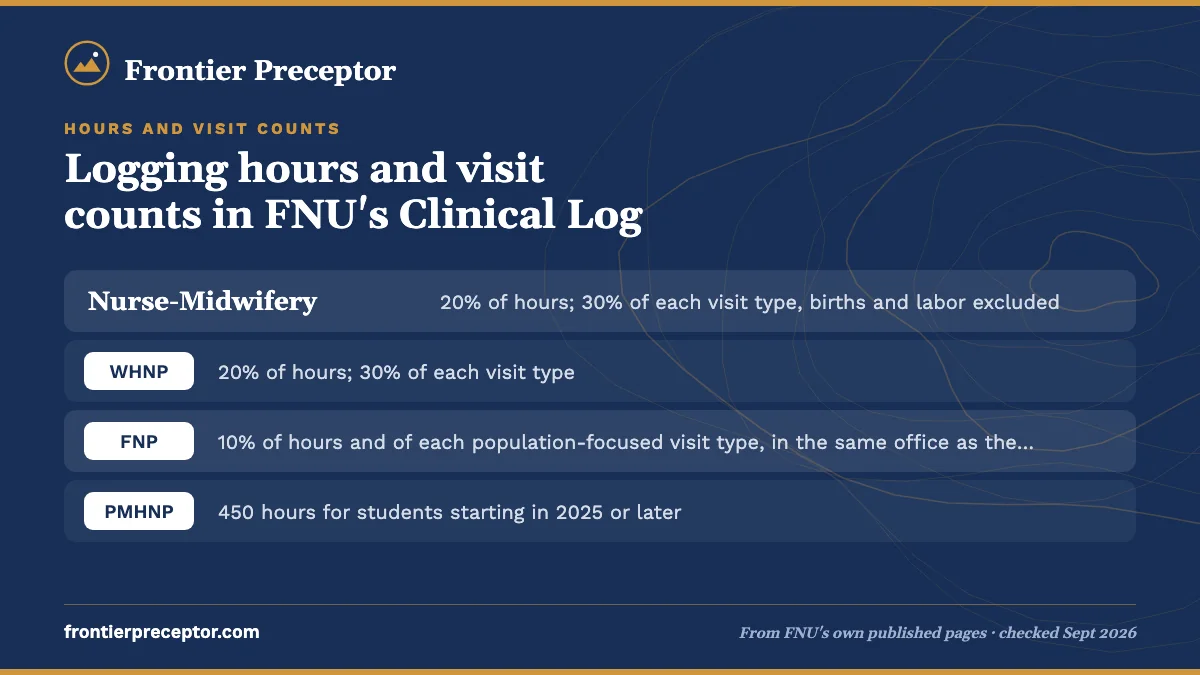
| Track | Telehealth limit | Other cap to watch |
|---|---|---|
| Nurse-Midwifery | 20% of hours; 30% of each visit type, births and labor excluded | At least 8 of the 40 births in a hospital |
| WHNP | 20% of hours; 30% of each visit type | Specialty-site observation does not count toward hours |
| FNP | 10% of hours and of each population-focused visit type, in the same office as the preceptor | Up to 40% of hours with an MD, DO or PA; specialty sites up to 20% |
| PMHNP | 450 hours for students starting in 2025 or later | Up to 135 hours with a therapy provider |
Telehealth rules, including licensing in the patient's state, are on telehealth hours.
Keeping the log clean and de-identified
De-identification is not optional. The catalog requires clinical logs to be fully de-identified, and HIPAA training and a signed HIPAA Agreement Form are part of FNU's clinical compliance. Leave out names, dates of birth, record numbers and anything else that could point to a patient, and describe cases in clinical terms instead.
Log on the day where you can. Your preceptor completes a DDAT once a week and your RCF checks in with you every two weeks, so a log that is current keeps those conversations short and accurate. If a site's own schedule and your Clinical Log disagree about a date or a total, fix it while the week is still fresh rather than at the end of the course.
Who reads your log
Your RCF assigns clinical grades with input from your preceptors, and case logs are part of what the RCF reviews. The preceptor's view arrives separately, through the DDAT, MDAT and EDAT tools completed in the Preceptor Login. Together they show whether your hours, visit counts and competence are moving at the same pace.
Preceptors care about hours too. FNU gives them documentation of hours spent precepting for recertification, and bases their honorarium on the program and the number of hours.
If the log shows you falling behind on hours or on one visit type, raise it with your RCF early, while there are still weeks left to add a site. The behind on clinical hours page covers the options.
Filling a gap the log reveals
A log often reveals a problem before anyone says it out loud: plenty of hours but too few pediatric visits, or births that are all out of hospital. A placement advisor looks for an added preceptor or site that supplies the missing visit type, within your track's site limit and preceptor rules, and prepares the CSAF details for it with you.
Hours at the new site count only after RCF acceptance and credentialing, so we move quickly on the search and have its details ready early. Tell us which counts are short.
Questions FNU students ask
Does FNU use Typhon or Exxat for clinical logs?
FNU's public sources do not name any vendor. They refer to the Clinical Log or Case Log Report, and none of them names Typhon, Exxat, Medatrax or InPlace. Use the instructions in CB101 and your practicum course in Canvas, and ask your RCF if an entry format is unclear.
Can I see my Clinical Log after I graduate?
Yes. FNU's students page says students have Clinical Log access after graduation for all of their submissions. That can help when an employer or credentialing office later asks you to document clinical experience, so keep entries complete and accurate from the first week rather than tidying them at the end.
Do observed visits count toward my FNU visit numbers?
Generally not. The catalog says observed-only visits do not count toward required experiences, with an exception for PMHNP therapy visits. Time spent observing during orientation at a site does count toward hours, though, while for WHNP and PMHNP students observation at a specialty site does not count toward hours.
How many hours a week should I be logging?
The catalog sets weekly minimums of 20 hours in the 751 course, 28 in 752 and 24 in 753 for every track, with a maximum of 40 clinic or office hours a week. FNU's website lists 32 as the midwifery maximum and a 10-hour daily cap for the NP tracks, so confirm with your RCF.
Can I include patient initials in my log?
Check with your RCF before including any identifier. The catalog says clinical logs and other clinical records must be fully de-identified, and FNU's compliance list includes HIPAA training and a HIPAA Agreement Form. The safest habit is to record age range, visit type and clinical detail with nothing that points to a person.
Related pages
Last checked 2026-09-23
We check these pages against FNU's own published sources. Your Clinical Advisor, your RCF and FNU's current guidelines have the final word.
Your site submitted before Clinical Bound.
Tell us your FNU track, your county and your Clinical Bound date. We look for a preceptor and site that fit FNU's rules for your track, and help you get the CSAF and credentialing details right.
- Matched to your track: CNM/CM, NP, or the right mix FNU allows
- Ready for the CSAF, the RCF and Clinical Credentialing
- In person near you, or telehealth within FNU's caps
Start your placement plan
A placement advisor replies with what an FNU-ready preceptor and site look like for you.