Behind on hours or visit counts mid-practicum
Falling behind at FNU usually means one of two things: too few hours for the weeks left, or enough hours but missing visit types. They need different fixes. Measure both from your Clinical Log, check the limits on how fast you can catch up, and raise it with your RCF before the gap grows.
Get your placement plan
Tell us your FNU track and where you live. A placement advisor replies with what a FNU-ready preceptor and site look like for you.
Two finish lines, not one
Every MSN and PGC track at FNU requires 750 clinical hours, and students who begin clinical courses in 2025 or later also need 19 weeks of clinical. On top of that, each track sets visit counts by type. You can be on pace for hours and still be well short on a count, and that is the harder problem, because extra hours at the same site will not create visit types it does not see.
Nurse-midwifery shows this most clearly. The track asks for 40 births with no fewer than eight in hospital, and matching counts of 40 for labor management and newborn assessments. A busy clinic can supply plenty of prenatal and gynecologic visits and still leave you far from the births. The detail sits on our midwifery births page, and the hour rules on FNU clinical hours.
Measure the gap before you react
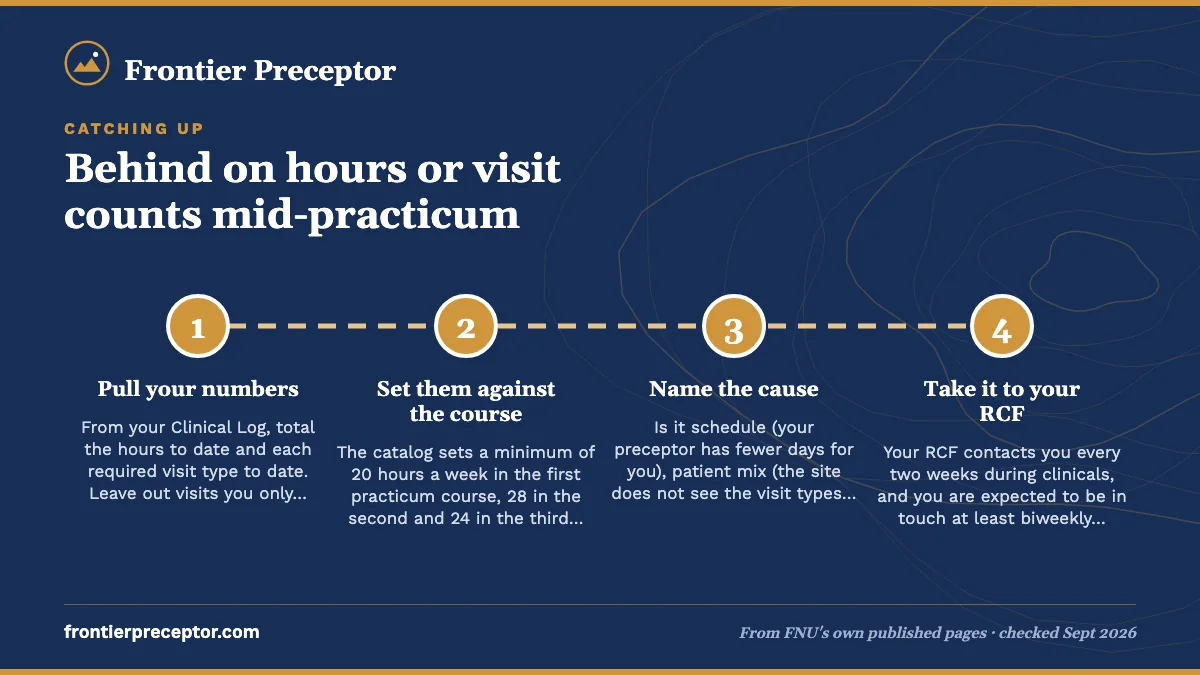
- Pull your numbersFrom your Clinical Log, total the hours to date and each required visit type to date. Leave out visits you only observed; they do not count toward required experiences, except PMHNP therapy visits.
- Set them against the courseThe catalog sets a minimum of 20 hours a week in the first practicum course, 28 in the second and 24 in the third. Note which course you are in,
FNP752orNM753for example, and how many weeks remain. - Name the causeIs it schedule (your preceptor has fewer days for you), patient mix (the site does not see the visit types you lack) or volume (too few patients overall)? Each has a different fix.
- Take it to your RCFYour RCF contacts you every two weeks during clinicals, and you are expected to be in touch at least biweekly. Raise the gap at the next contact, with the numbers, rather than at the end of the course.
Limits that cap how fast you can catch up
It is tempting to simply add hours. FNU's rules put a ceiling on that, and on the shortcuts that look obvious.
- Weekly maximum: the catalog sets 40 hours a week of clinic or office time, with midwifery dependent on call schedule. FNU's website instead gives midwifery a 32-hour weekly ceiling and caps NP-track days at 10 hours, so confirm which figure applies to you.
- Telehealth: midwifery and WHNP students may count it for up to 20% of hours and 30% of any visit type, with births and labor excluded for midwifery; FNP students up to 10% of hours and of each population-focused visit type; PMHNP students starting in 2025 or later up to 450 hours.
- Specialty time: FNP students may spend no more than 20% of time at specialty sites, with one specialty rotation.
- Observation: observed-only visits do not count toward required experiences, and specialty-site observation does not count toward hours for WHNP or PMHNP. Observation during site orientation does count toward hours.
Our telehealth hours page explains the caps and the licensing rule behind them.
More hours at the wrong site will not produce missing visit types. Fix the patient mix, not just the schedule.
Which kind of site closes which gap
| Track | Counts to watch | Settings that usually help |
|---|---|---|
| Nurse-midwifery | 40 births (8 in hospital), 40 labor management, 40 newborn assessments | A hospital birth unit with a CNM or CM; a CABC-accredited birth center for out-of-hospital births |
| FNP | Newborn exams, well and episodic visits in three pediatric age bands, geriatric and chronic illness visits | A family practice with a broad age mix, from young children to adults over 65 |
| WHNP | 300 gynecologic, 120 return antepartum and 30 new antepartum visits | An ob-gyn or women's health practice with steady prenatal volume |
| PMHNP | 300 medication management, 50 child or adolescent and 50 substance use visits | A psychiatric prescriber's practice, or a service that sees younger patients or substance use |
The catalog expects you to use more than one site when one cannot provide enough patient volume, up to four in most tracks, and it notes this can mean relocating, possibly out of state.
Adding a site in the middle of a course
A site added to fill a gap follows the same path as your first. It needs its own CSAF, submitted through the Community Map and accepted by your RCF, and then Clinical Credentialing signs the affiliation agreement, checks insurance and credentials the preceptor. You cannot see patients there before credentialing is complete; the catalog makes that grounds for dismissal.
Because credentialing can take several months, a gap spotted in your first practicum course is far easier to close than one found in the last weeks of the third. That is the strongest reason to measure early and often. Ask your RCF early whether the new site should run alongside your current one or take over part of your week, and keep each preceptor informed. The paperwork is covered on our CSAF page.
How we help close a gap
When the fix is a second site, we can run that search. We look for a preceptor and setting that supply the visit types you are short on, ideally in person and close to home, using telehealth only where your track allows it and inside FNU's caps. Tell us which counts are short and by roughly how much, which days your current preceptor gives you, and how far you can travel, so the search looks for a site that complements the one you have rather than duplicating it.
Every lead is screened against FNU's published preceptor rules, and we help you get the CSAF details and Clinical Credentialing's items ready. Your RCF and Clinical Credentialing approve the site on FNU's timeline, and a complete first submission keeps that review moving. Send us your current counts using the form below, or read how it works.
Questions FNU students ask
Can I work extra days to catch up on FNU clinical hours?
Within limits. Clinic or office time tops out at 40 hours a week under the catalog, with midwifery depending on call schedule, and FNU's website gives lower figures for some tracks. You also cannot finish in fewer than 19 weeks of clinical if you started in 2025 or later. Agree any schedule change with your preceptor and RCF.
Do telehealth visits count toward FNU visit counts?
Yes, within caps. Midwifery and WHNP students may count telehealth for up to 30% of each visit type; FNP students for up to 10% of each population-focused visit type, while in the same office as their preceptor. PMHNP students work to an hour cap of 450. Licensing follows the state where the patient lives.
Does time spent observing count toward my hours?
Some of it does. Observation during orientation at a site counts toward hours. Visits you only observed do not count toward required experiences, with PMHNP therapy visits the exception, and observation at specialty sites does not count toward hours for WHNP or PMHNP students.
What if I cannot finish my hours by the end of a practicum course?
Talk to your RCF as soon as you see it coming. FNU's portal lists an IP extension request under Clinical Practicum, but the public pages do not explain when it applies, so ask your RCF whether it fits your situation and what it would mean for the next course.
Can a midwifery student add a fifth site to find more births?
Possibly. The catalog allows nurse-midwifery students four sites unless the RCF approves more, and FNU's website says this is typically two clinics and two hospitals. A fifth site needs your RCF's agreement, and like every site it needs a CSAF and full credentialing before you start there.
Related pages
Last checked 2026-09-23
We check these pages against FNU's own published sources. Your Clinical Advisor, your RCF and FNU's current guidelines have the final word.
Your site submitted before Clinical Bound.
Tell us your FNU track, your county and your Clinical Bound date. We look for a preceptor and site that fit FNU's rules for your track, and help you get the CSAF and credentialing details right.
- Matched to your track: CNM/CM, NP, or the right mix FNU allows
- Ready for the CSAF, the RCF and Clinical Credentialing
- In person near you, or telehealth within FNU's caps
Start your placement plan
A placement advisor replies with what an FNU-ready preceptor and site look like for you.