FNU's post-graduate certificate: same clinicals, shorter runway
An FNU post-graduate certificate (PGC) student completes the same clinical courses, 750 hours and visit counts as an MSN student on the same track, but reaches Clinical Bound two terms sooner on the full-time sequence. That leaves less time to find and credential a preceptor, so for most PGC students the search starts almost as soon as Frontier Bound ends.
Get your placement plan
Tell us your FNU track and where you live. A placement advisor replies with what a FNU-ready preceptor and site look like for you.
Who FNU's post-graduate certificate is for
FNU offers the PGC in all four of its tracks: nurse-midwifery, FNP, WHNP and PMHNP. It is built for nurses who already hold a master's or higher in nursing and want a new specialty without repeating a full MSN. Applicants also need an unencumbered US RN license and a GPA of 3.0 or higher.
Your coursework is mostly specialty courses from the first term. If your earlier graduate study did not include advanced pathophysiology, advanced pharmacology and advanced physical assessment across the lifespan, FNU may add PC705, PC707 and PC716 to your Program of Study. Transfer credit and gap analysis together can cover no more than 10 credit hours, and clinical courses are never transferable, so every clinical hour happens at FNU.
Like MSN students, you come to the Versailles, Kentucky campus twice: for Frontier Bound, the three-day orientation before your first term, and for Clinical Bound, the five-day skills intensive before your first practicum.
The same clinical block as the MSN
Only the didactic portion is shorter. Once you reach clinicals, you take the same courses as MSN students on your track, then a one-credit Final Comprehensive Review. This is how the four certificates line up on the October 2025 Programs of Study:
| Track | PGC credits | Full-time: terms, Clinical Bound | Part-time: terms, Clinical Bound | Clinical courses |
|---|---|---|---|---|
| Nurse-Midwifery | 42 | 7 terms, term 5 | Table runs to term 10, term 8 | NM750 to NM753 |
| FNP | 39 | 6 terms, term 4 | 9 terms, term 7 | FNP750 to FNP753 |
| WHNP | 36 | 6 terms, term 4 | 9 terms, term 7 | WH750 to WH753 |
| PMHNP | 35 | 6 terms, term 4 | 9 terms, term 7 | MH750 to MH753 |
From 2025 clinical starts onward, certificate students owe the same 750-hour minimum and 19 clinical weeks as MSN students, with weekly minimums of 20, 28 and 24 hours across the three practica. The visit counts and preceptor rules are those of your track, with no PGC reductions.
A shorter runway to Clinical Bound
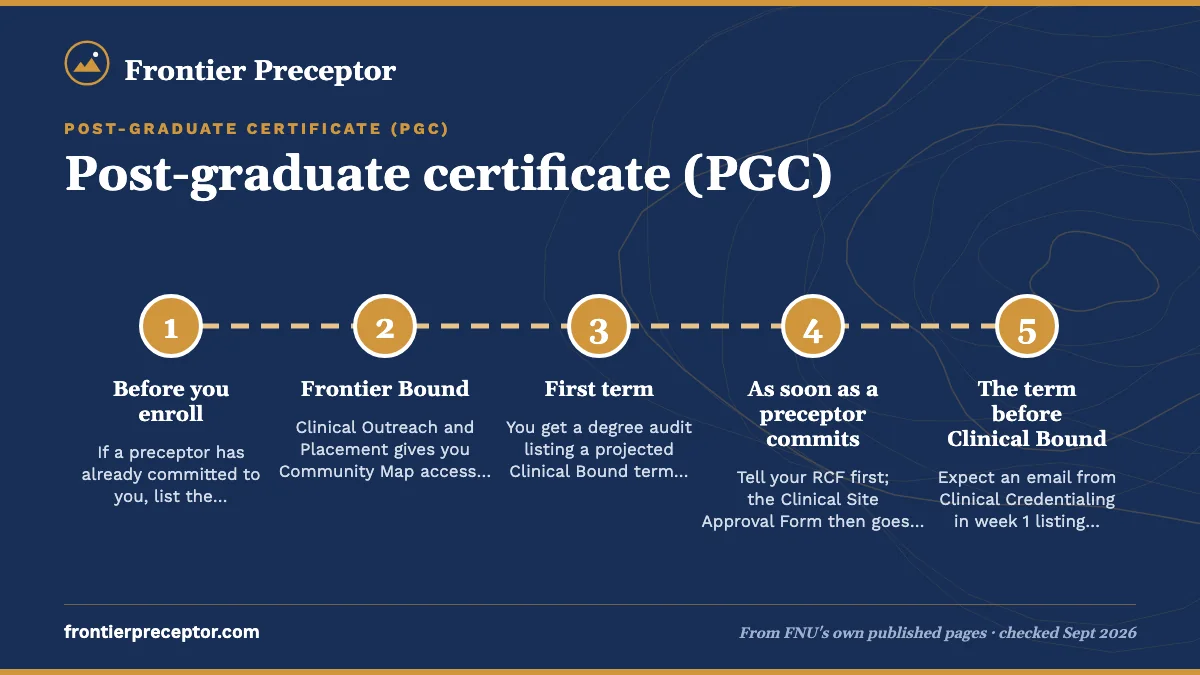
Each FNU term is 11 weeks plus a two-week break, so a full-time NP-track certificate student reaches Clinical Bound about three terms after starting. Working back from that date, FNU staff put the RCF's approval of your plan four to six months earlier, and site credentialing can itself take several months. In practice, that points to having your plan together around your second term.
- Before you enrollIf a preceptor has already committed to you, list the commitment on your enrollment application, as FNU invites.
- Frontier BoundClinical Outreach and Placement gives you Community Map access, and you attend information sessions on credentialing.
- First termYou get a degree audit listing a projected Clinical Bound term, and an RCF is assigned to you. If gap courses were added, check that the projected term reflects them.
- As soon as a preceptor commitsTell your RCF first; the Clinical Site Approval Form then goes in through the Community Map. Clinical Credentialing starts only after your RCF accepts it.
- The term before Clinical BoundExpect an email from Clinical Credentialing in week 1 listing compliance items for CastleBranch, due by week 5.
Track rules you carry into the certificate
The preceptor you need depends on the track, not on the credential. Midwifery students ideally work under a CNM or CM and need at least 8 hospital births among 40. WHNP students should have a WHNP as primary preceptor. An FNP student's hours with MDs, DOs and PAs are capped at 40%. PMHNP students get no Clinical Bound date until an accepted CSAF names a preceptor with psychiatric prescribing authority, and therapist time tops out at 135 hours.
Telehealth limits follow the track too. Midwifery and WHNP students may count telehealth for up to 20% of hours, FNP students for up to 10%, and PMHNP students for up to 450 hours if their clinicals start in 2025 or later. For every telehealth visit you must meet licensure rules in the patient's state.
One state rule falls harder on certificate students. FNU's limited New York approval is reserved for six MSN nurse-midwifery students a year, so PGC students on every track, midwifery included, train in another state, with federal government facilities in New York the sole exception. The New York page explains the rule.
Your existing network, and its limits
Coming in with a master's in nursing, you may already know clinicians in your new specialty, and they are a natural first call. Two FNU rules shape who you can ask. A family member cannot precept you, and no practice that a relative or someone in your household owns or runs, or that you have an ownership stake in, can host you.
Whether you can train at your own workplace turns on your course syllabus, your program guidelines and the employer's policy. If it is permitted, FNU insists that your job and your student role stay strictly separate. FNU treats practicing in an advanced-practice role you are not yet licensed for, without your preceptor supervising, as grounds for automatic dismissal, which matters if you already hold an APRN license in another specialty.
FNU's certificate page describes dedicated Clinical Placement Services behind you. Clinical Advisors matched to your track support the Community Map search and keep you up to date on placement timelines.
Why certificate students choose us
Since FNU does not cover the cost of preceptor-finding services, bringing us in is your own choice, and certificate students often make it because the runway is short. We concentrate on exactly that: we search for preceptors on your track near where you live, check each lead against the track's rules, and have preceptor and site details ready for the CSAF early.
We also help gather the names and contacts Clinical Credentialing will want, and we remain available if a preceptor backs out before or during your practicum. FNU's RCF and Clinical Credentialing approve every site and preceptor, and an early, complete CSAF gives a short program the most room. If you are still choosing between routes, compare MSN and PGC, or read how it works.
Questions FNU students ask
Do I need to be a certified APRN to join FNU's post-graduate certificate?
FNU's admissions criteria require a master's or higher in nursing from a CNEA, CCNE or ACEN accredited program and say current certification or state APRN licensure is not required. FNU's PGC program page, however, describes applicants with a master's in an APRN specialty. If your master's is not in an APRN specialty, confirm your eligibility with FNU Admissions before applying.
Can I transfer clinical hours from my first NP program into FNU's PGC?
No. FNU's course transfer policy says clinical and DNP project courses are not eligible for transfer, so all clinical hours for your new specialty are completed in FNU's own clinical courses. Some didactic courses can transfer, including PC705, PC707, PC716 and PC719, but transfer and gap analysis together are capped at 10 credit hours.
Is the PGC clinical practicum shorter than the MSN's at FNU?
Not any more. For students starting clinical courses in 2025 or later, both the MSN and the PGC require 750 clinical hours and 19 weeks of clinical. Before 2025 the certificate required 540 hours over 14 weeks, against 675 hours over 16 weeks for the MSN, so older advice may quote the lower figures.
How long does FNU's post-graduate certificate take?
The full-time FNP, WHNP and PMHNP certificates run 6 terms, which FNU's older Programs of Study label 18 months, and FNU's PMHNP page estimates roughly 18 months for that certificate. The full-time midwifery certificate runs 7 terms. FNU also says the clinical practicum itself can be completed in 4 to 10 months.
Can I do FNU's PGC if I live in New York?
You can enroll, but your clinicals must happen in another state. FNU's limited New York approval applies only to MSN nurse-midwifery students, so no PGC student on any track may train in New York, federal government facilities aside. Plan for travel or temporary relocation from the start, and check RN licensing in the state you choose.
Related pages
Last checked 2026-09-23
We check these pages against FNU's own published sources. Your Clinical Advisor, your RCF and FNU's current guidelines have the final word.
Your site submitted before Clinical Bound.
Tell us your FNU track, your county and your Clinical Bound date. We look for a preceptor and site that fit FNU's rules for your track, and help you get the CSAF and credentialing details right.
- Matched to your track: CNM/CM, NP, or the right mix FNU allows
- Ready for the CSAF, the RCF and Clinical Credentialing
- In person near you, or telehealth within FNU's caps
Start your placement plan
A placement advisor replies with what an FNU-ready preceptor and site look like for you.