FNU Clinical Advisors: what the placement team does, and what stays with you
FNU's Clinical Advisors belong to the Clinical Outreach and Placement team and help you search for a preceptor and site, one-on-one and in small groups. That support is real and ongoing. They do not assign you a preceptor or approve a site: the search is yours, and approval sits with your RCF and Clinical Credentialing.
Get your placement plan
Tell us your FNU track and where you live. A placement advisor replies with what a FNU-ready preceptor and site look like for you.
The team and its job
The Clinical Outreach and Placement Services Team, which FNU also calls a unit or an office, is FNU's staffed response to a model where students find their own sites. Its Clinical Advisors, including Senior Clinical Advisors, are assigned by program track. In FNU's words, they "assist students with placement for clinical rotations."
The team is younger than the model it supports. In an FNU podcast from around 2021, its director said the team was created in mid-2019 after students reported a gap in help with identifying clinical sites. A 2022 FNU article described a director, an assistant director and four Clinical Advisors. Both sources are dated, and FNU does not publish the team's current size.
Above the advisors, the Catalog says the Director of Clinical Outreach and Placement "ensures students have appropriate information and tools" to obtain a site. An Assistant Director of Clinical Outreach and a Clinical Services Coordinator focus on preceptors: support, recruitment and retention.
What a Clinical Advisor does for you
FNU's public pages and the Catalog's job descriptions describe the same core help.
- Assistance and resources for locating clinical sites and preceptors, using the Community Map and what the Catalog calls "the clinical app."
- One-on-one work on your overall clinical search, plus meetings in small groups.
- Keeping you up to date on clinical site placement timelines.
- Troubleshooting challenging situations as they come up.
FNU's recruiting site says the team's staff work one-on-one with each student to help them find a preceptor and clinical site in or near their community. For a distance university spread across the country, that is substantial support, and it is worth using from your first term rather than saving it for a crisis.
What the team does not do
The team supports your search; it does not run it for you. FNU's admissions page puts the responsibility for securing a site on the student, and no FNU source says advisors assign or promise placements. The asking, the follow-up and the preceptor's commitment stay with you.
Advisors also do not approve anything. Your Regional Clinical Faculty member accepts or declines each CSAF, and Clinical Credentialing handles affiliation agreements, insurance and preceptor credentialing.
One money point is worth knowing. The Catalog says "FNU does not pay for preceptor-finding services" or preceptor-for-hire services. FNU publishes no rule for or against students arranging outside help themselves. If you want to know how your program would view it, ask your Clinical Advisor.
Who does what in your placement
Several FNU roles touch your site, and each owns a different part. Sending a question to the right one saves a round of forwarding.
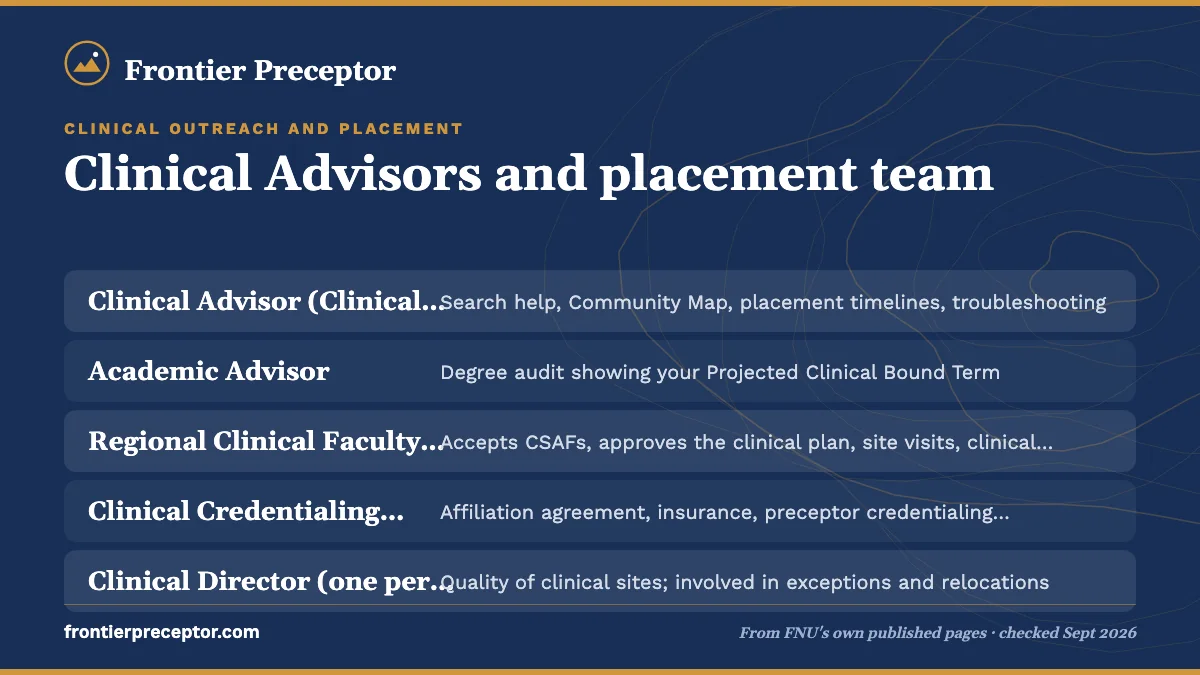
| Role | What they do for your site | When they come in |
|---|---|---|
| Clinical Advisor (Clinical Outreach and Placement) | Search help, Community Map, placement timelines, troubleshooting | From Frontier Bound onward |
| Academic Advisor | Degree audit showing your Projected Clinical Bound Term | First term |
| Regional Clinical Faculty (RCF) | Accepts CSAFs, approves the clinical plan, site visits, clinical grades | Assigned in your first term |
| Clinical Credentialing Coordinator | Affiliation agreement, insurance, preceptor credentialing, onboarding | After your RCF accepts a site |
| Clinical Director (one per specialty) | Quality of clinical sites; involved in exceptions and relocations | When something needs a decision above the RCF |
The contract side is explained on the Clinical Credentialing page.
Getting the most from your advisor
An advisor works with many students on a track, so the more you bring to each conversation, the more specific the help you get back.
- Meet early. FNU recommends finding preceptors early in the program, and an advisor can only build on a search you have started.
- Bring your basics: track, home location and how far you can travel, the states where you hold an RN license, and the weekly hours you can commit.
- Bring your log of who you have contacted, from the Community Map and elsewhere, and what each said.
- Ask about timing against your Projected Clinical Bound Term, since placement timelines are part of the advisor's brief.
- Report dead ends quickly. A stalled lead is far easier to replace with months to spare than with weeks.
Login-only material, and where to check
The Clinical Outreach and Placement team's own page lives on FNU's SharePoint site, part of Banyan Tree 2.0, and needs a login, as do the Community Map and the Clinical Site Preparation Timeline. Whatever the team publishes for students is there rather than on the public site, and FNU sends official messages to your FNU Outlook email once you are admitted.
For questions this page cannot settle, go in order: your Clinical Advisor for the search, your RCF for whether a site fits your track, and the guidelines posted for your program in Canvas or on Banyan Tree for anything course-specific. One example is whether you can use your own workplace, which the Catalog leaves to the syllabus and program guidelines; the employer site page explains why.
Your advisor and our placement desk, side by side
Your Clinical Advisor and our placement desk make a strong pair. Your advisor guides the search with FNU's own tools; we add hands to it by contacting practices near you, checking each lead against your track's preceptor rules, and preparing with you what the CSAF and Credentialing will need. A placement advisor stays on call if a preceptor withdraws.
Your advisor remains your FNU contact and your RCF gives the approval, so share every lead we bring with your advisor; it keeps everyone working from one plan. Use the form to tell us your track and area.
Questions FNU students ask
Does FNU help with clinical placements?
Yes, through support rather than assignment. FNU's program pages offer "dedicated Clinical Placement Services to support you," which in practice means Clinical Advisors, the Community Map and faculty review of each site. FNU is also clear that securing the site is the student's job, so you get real help with the search, but the preceptor's agreement is something you secure yourself.
How do I contact my FNU Clinical Advisor?
Advisors are assigned by program track, and FNU introduces the Clinical Outreach and Placement team at Frontier Bound. Current contact routes sit behind your FNU login on the team's SharePoint page, and FNU sends official communication to your FNU email. If you cannot find your advisor, ask your Academic Advisor or RCF to point you to the right person.
Is my Clinical Advisor the same person as my RCF?
No. Your Clinical Advisor is placement staff who help with the search. Your RCF is a faculty member who generally lives in your region, accepts your CSAFs, approves your clinical plan, makes site visits and grades your clinical work. You will usually deal with both, and FNU describes the RCF as your primary advisor once clinical coursework starts.
Will FNU pay for a preceptor placement company?
No. Among the costs the Catalog says FNU will not cover are preceptor-finding and preceptor-for-hire services, as well as uninvoiced rotation fees and cash handed to sites. Invoiced fees from a site are a different matter, and FNU reviews those individually. There is no published FNU rule on students hiring help themselves, so ask your Clinical Advisor if you want a view.
What if every lead my advisor suggested has said no?
Go back with a record. Troubleshooting challenging situations is part of the team's stated role, and a clear list of who declined, and why, makes the next round of suggestions sharper. At the same time, widen your own search beyond the Community Map, and read the can't find a preceptor page for a structured next round.
Related pages
Last checked 2026-09-23
We check these pages against FNU's own published sources. Your Clinical Advisor, your RCF and FNU's current guidelines have the final word.
Your site submitted before Clinical Bound.
Tell us your FNU track, your county and your Clinical Bound date. We look for a preceptor and site that fit FNU's rules for your track, and help you get the CSAF and credentialing details right.
- Matched to your track: CNM/CM, NP, or the right mix FNU allows
- Ready for the CSAF, the RCF and Clinical Credentialing
- In person near you, or telehealth within FNU's caps
Start your placement plan
A placement advisor replies with what an FNU-ready preceptor and site look like for you.