FNU's placement support, your own network, or hired help
FNU's model is student-found preceptors backed by real support, and FNU says the approach has worked well since 1989. Your own contacts are a second route, and paid help is a third for students who have run out of leads or time. Here is what each offers, including what FNU's help does that no outside service can.
Get your placement plan
Tell us your FNU track and where you live. A placement advisor replies with what a FNU-ready preceptor and site look like for you.
What FNU gives every student
FNU's support is substantial, and it comes with your enrollment: FNU's fee table lists no placement fee. The Clinical Outreach and Placement team assigns Clinical Advisors by track. They meet students one-on-one and in small groups, keep you current on site placement timelines, and help troubleshoot when a search stalls.
The Community Map gives you a database of more than 20,000 active sites and preceptors in all 50 states, built from places FNU students have trained before. Your Regional Clinical Faculty member, one of more than 50 across the country, usually lives in your region. Regional Case Days bring students, alumni and preceptors together for learning and networking.
FNU also does work no outside service can. Clinical Credentialing sets up the Affiliation Agreement, exchanges insurance certificates and credentials your preceptor, and FNU insures you during clinicals. It offers preceptors an honorarium and continuing education, which helps when you ask. See FNU's Clinical Advisors and the Community Map.
What FNU leaves to you
FNU doesn't assign placements. Its admissions page is plain that students are responsible for securing their clinical site, and FNU's help is built to support your search rather than run it. FNU also says rotations can be competitive in certain regions, and that some students will need to travel or relocate temporarily.
The Community Map tells you who has worked with FNU students; it can't tell you who has room for you this term. So every contact is still a request that can be declined. And FNU states that it won't pay for preceptor-finding services, so any outside help is at your own cost.
Your own network
Your own contacts are often the most direct route. Clinicians you've worked beside, former managers, your employer's APRNs, physicians who know your work, and people you meet at Case Days all know you as a nurse, and that counts when you ask someone to teach you for a term or more.
The limits are practical. FNU bars family members as preceptors and sites owned by your family or household. Training at your own workplace depends on your course syllabus, program guidelines and the employer's policy, with strict separation of roles. And in a small town, your network may simply not include a CNM or a psychiatric prescriber. For how to make the ask well, see asking a preceptor for an FNU rotation.
Hiring placement help
A placement service adds search capacity outside your own circle: time spent contacting practices, checking each lead against FNU's rules for your track, and preparing the details the CSAF and Clinical Credentialing need. It's most useful when your leads are exhausted or the calendar is short.
The best help works inside FNU's process: your RCF and Clinical Credentialing still approve the site on FNU's timeline, so a strong service puts its effort into making that review straightforward. It is a fee FNU won't reimburse, so compare what each offer includes; what the best placement service does sets out the standard we work to.
The three routes side by side
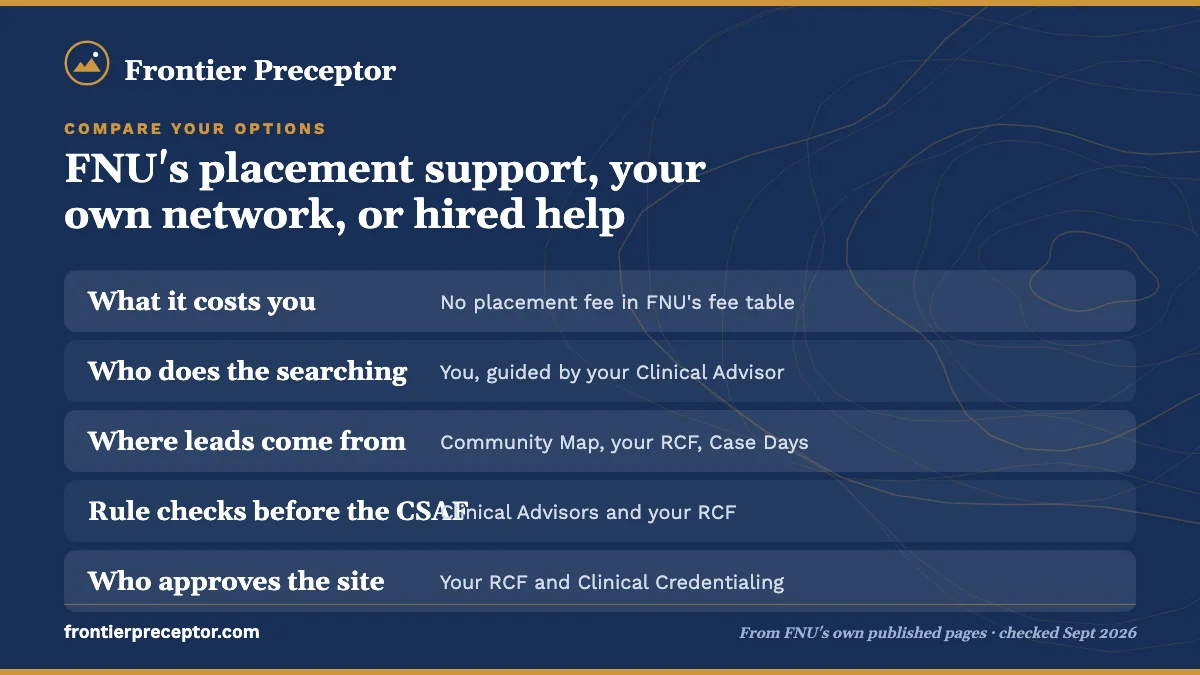
| FNU's support | Your own network | Hired help | |
|---|---|---|---|
| What it costs you | No placement fee in FNU's fee table | Your time | A quoted fee that FNU won't reimburse |
| Who does the searching | You, guided by your Clinical Advisor | You | A placement advisor, with you deciding |
| Where leads come from | Community Map, your RCF, Case Days | People who already know you | Practices beyond your contacts |
| Rule checks before the CSAF | Clinical Advisors and your RCF | You, using FNU's guidelines | Checked against FNU's published rules |
| Who approves the site | Your RCF and Clinical Credentialing | Your RCF and Clinical Credentialing | Your RCF and Clinical Credentialing |
| Best suited to | Every student, from the first term | Students with local clinical ties | Students out of leads or short on time |
Using the routes together
The routes aren't exclusive. The strongest approach starts with FNU in your first term: meet your Clinical Advisor, learn the Community Map once you have access after Frontier Bound, and talk with your RCF early. Work your own network at the same time.
Keep your Clinical Advisor and RCF informed whatever you do, so efforts don't overlap and they can flag a doubtful site before you invest in it. If you bring in outside help, the site still goes through your RCF like any other.
Signs it may be time for outside help
- Your Community Map contacts and your own network have all said no.
- You live somewhere with few preceptors in your specialty, such as a rural area far from any CNM.
- Your Projected Clinical Bound Term is close and no CSAF has been accepted.
- A preceptor has withdrawn and your hours are at risk.
If that sounds like you, can't find a preceptor walks through what to try next.
Questions FNU students ask
Will FNU find a preceptor for me?
No. FNU supports your search with Clinical Advisors, the Community Map and your RCF, and it approves and credentials every site. The search itself is yours: FNU encourages students to take the lead in identifying their preceptor, and no current FNU source says it assigns placements.
Will FNU pay for a placement service?
No. The catalog lists preceptor-finding and preceptor-for-hire services among the things FNU does not pay for. FNU does review rotation fees a clinical site charges and, where it judges them appropriate, pays the site against an invoice. That is a separate arrangement from any service fee.
Can I use the Community Map and a placement service at the same time?
FNU's public pages don't prohibit it, and there's a case for both: the Map holds sites FNU students have used before, while outside help reaches practices you haven't contacted. Share your Map contacts with any service so no practice is asked twice. If unsure, ask your Clinical Advisor.
When should I decide whether to get outside help?
Earlier than most students expect. FNU staff describe the RCF approving the clinical plan about four to six months before Clinical Bound, and credentialing can take several months. If you're two or three terms from Clinical Bound with no committed preceptor, that's a sensible point to weigh your options.
Related pages
Last checked 2026-09-23
We check these pages against FNU's own published sources. Your Clinical Advisor, your RCF and FNU's current guidelines have the final word.
Your site submitted before Clinical Bound.
Tell us your FNU track, your county and your Clinical Bound date. We look for a preceptor and site that fit FNU's rules for your track, and help you get the CSAF and credentialing details right.
- Matched to your track: CNM/CM, NP, or the right mix FNU allows
- Ready for the CSAF, the RCF and Clinical Credentialing
- In person near you, or telehealth within FNU's caps
Start your placement plan
A placement advisor replies with what an FNU-ready preceptor and site look like for you.