What the best placement service does for an FNU student
The best placement service for an FNU student knows FNU's approval path by heart: the CSAF comes from you, acceptance from your RCF, and credentialing of the site and preceptor from Clinical Credentialing. It writes its terms down, has a plan for the day a preceptor drops, and checks every lead against your track's rules. Here is each standard, and how we meet it.
Get your placement plan
Tell us your FNU track and where you live. A placement advisor replies with what a FNU-ready preceptor and site look like for you.
Start with what FNU already gives you
FNU puts the job of securing a site on the student, but it does not leave you alone with it. Clinical Advisors in the Clinical Outreach and Placement team help with the search, the Community Map lists sites and preceptors FNU students have used, your RCF knows the region, and Clinical Credentialing handles contracts and preceptor credentialing. Use those first; our comparison of FNU's help, going it alone and hiring help sets them side by side.
Know one fact before you shop. FNU's catalog says the university does not pay for preceptor-finding or preceptor-for-hire services. It publishes no rule for or against students using one, so if you are unsure how your program views it, ask your Clinical Advisor.
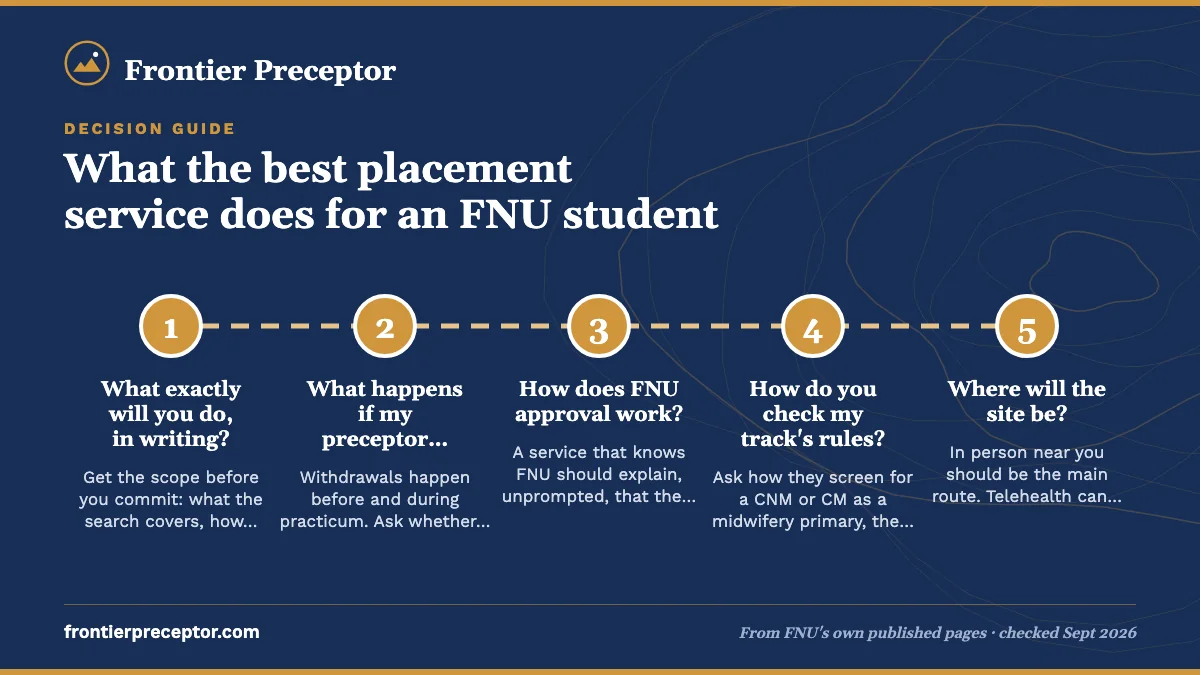
Five questions the best service answers in writing
- What exactly will you do, in writing?Get the scope before you commit: what the search covers, how leads reach you, what help you get with FNU's paperwork, and what happens if nothing suitable turns up. Spoken reassurance is not a term.
- What happens if my preceptor drops?Withdrawals happen before and during practicum. Ask whether the service searches again, on what terms and for how long. A service with no answer has not thought about 19 weeks of clinical.
- How does FNU approval work?A service that knows FNU should explain, unprompted, that the CSAF goes in through the Community Map, the RCF accepts it, and Clinical Credentialing handles the affiliation agreement, insurance and preceptor credentialing, which can take several months.
- How do you check my track's rules?Ask how they screen for a CNM or CM as a midwifery primary, the 40% MD, DO or PA share for FNP, a psychiatric prescriber and the 135 therapist hours for PMHNP, and the family and ownership rule.
- Where will the site be?In person near you should be the main route. Telehealth can fill only part of a plan: at most a fifth of hours in midwifery and WHNP, a tenth in FNP, and 450 hours in PMHNP.
Red flags
- Any promise that a site will be approved, or approved by a date. Approval belongs to your RCF and Clinical Credentialing.
- A telehealth-only package for an FNU track, or a telehealth plan that says nothing about licensing in the patient's state.
- A New York site for an NP or PGC student outside a federal facility, or any site in the US territories.
- Encouragement to start seeing patients while credentialing finishes. FNU's catalog names that as grounds for dismissal.
- A suggestion to use a relative's practice, or a site where you hold an ownership stake.
- Instructions to pay a site in cash or send supplies instead. FNU pays some site rotation fees against an invoice and says it will not pay cash handed to sites or supplies sent in lieu of payment.
- Vague answers about what you are paying for and when, or no written terms at all.
One flag on its own may be a misunderstanding worth a follow-up question. Two or more usually means the service does not know how FNU works. Several of these map directly onto the reasons FNU declines sites, set out on our page about a site that was not approved.
Comparing terms, not just totals
Price alone tells you little. What matters is what the fee covers, when it is due, what happens if no suitable preceptor is found, and what happens after a drop, all written down before you pay anything. Two services with similar totals can offer very different protection. Ask, too, whether any part of the fee depends on outcomes only FNU controls, such as approval.
Keep FNU's own cost rules in view as you compare. FNU's fee table lists Clinical Bound fees but no placement fee, and it reviews site rotation fees case by case, paying against a site invoice where appropriate. A service that asks you to cover a site's fee directly should explain why it is not going through FNU. Our cost page sets out what shapes our own quote.
Why FNU students choose us
We built our service to answer all five before you ask. A placement advisor looks for a clinical site and preceptor right for your FNU track, close to where you live by default, adding telehealth only where FNU's caps leave room. Every candidate is tested against the preceptor rules FNU publishes, and we assemble the CSAF details and the items Clinical Credentialing asks for with you, so nothing is missing when you submit.
Your RCF and Clinical Credentialing hold every approval, for sites and preceptors alike, and our work is shaped to make their review simple: the right preceptor type for your track, a site with the volume your hours need, and complete details from day one. When a preceptor withdraws, a new search starts at once. Our terms come in writing before you commit, and we welcome being held to the five questions above. Read how it works and about us, or use the form below.
Questions FNU students ask
Does FNU allow students to use a paid placement service?
FNU publishes no rule for or against it. The catalog says only that FNU does not pay for preceptor-finding or preceptor-for-hire services. Whatever route you use, the site still goes through the CSAF, your RCF and Clinical Credentialing. If you want certainty for your own track, ask your Clinical Advisor.
Will FNU reimburse what I pay a placement service?
No. FNU's catalog is explicit that it will not pay for preceptor-finding or preceptor-for-hire services, nor for uninvoiced rotation fees or cash given to a site. Where a site sends FNU an invoice for a rotation fee, FNU reviews it case by case and may pay it.
Can a placement service get my clinical site approved?
Approval is FNU's to give. Your RCF accepts or declines the Clinical Site Approval Form, and Clinical Credentialing signs the affiliation agreement, verifies insurance and credentials the preceptor. The best service brings you a site that fits FNU's rules with a complete set of details, which gives your CSAF the smoothest path through that review.
Should I tell my RCF I am using a placement service?
Nothing public from FNU requires it. Your RCF is your primary advisor during clinical and has to accept any site you propose, though, so keeping them informed avoids surprises. The catalog expects you to contact your RCF before submitting a CSAF, whoever found the site.
What should a placement service put in writing?
At minimum: what the search includes, what help you get with FNU's CSAF and credentialing details, what happens if no suitable preceptor is found, what happens if a preceptor withdraws, and what you pay for and when. If any of these is missing, ask before you commit, not after.
Related pages
Last checked 2026-09-23
We check these pages against FNU's own published sources. Your Clinical Advisor, your RCF and FNU's current guidelines have the final word.
Your site submitted before Clinical Bound.
Tell us your FNU track, your county and your Clinical Bound date. We look for a preceptor and site that fit FNU's rules for your track, and help you get the CSAF and credentialing details right.
- Matched to your track: CNM/CM, NP, or the right mix FNU allows
- Ready for the CSAF, the RCF and Clinical Credentialing
- In person near you, or telehealth within FNU's caps
Start your placement plan
A placement advisor replies with what an FNU-ready preceptor and site look like for you.