The FNU clinical placement process, from preceptor to first clinical day
At FNU you find and secure your own preceptor and site, and FNU reviews, approves and contracts it. The order is fixed: a preceptor commits, you submit a CSAF through the Community Map, your RCF accepts it, Clinical Credentialing does its work, and after Clinical Bound your RCF releases you to start. This page walks the whole path and shows where it tends to slow down.
Get your placement plan
Tell us your FNU track and where you live. A placement advisor replies with what a FNU-ready preceptor and site look like for you.
Who secures your site at FNU
You do. FNU's admissions guidance says it in one line: "Students are responsible for securing their clinical site." The FNU Catalog adds that students have "a long tradition of identifying their own clinical sites," usually in their home communities, a model FNU has run since 1989.
That does not leave you on your own. FNU gives you a Clinical Advisor from the Clinical Outreach and Placement team, a Community Map listing 20,000+ active sites and preceptors, a Regional Clinical Faculty member who reviews your plan, and a Clinical Credentialing team that handles the contract with your site. For a distance university, that is a lot of structure.
What FNU does not do is hand you a preceptor. The search, the asking and the preceptor's commitment are yours, and FNU itself acknowledges that competition for rotations is stiffer in some regions.
The path, step by step
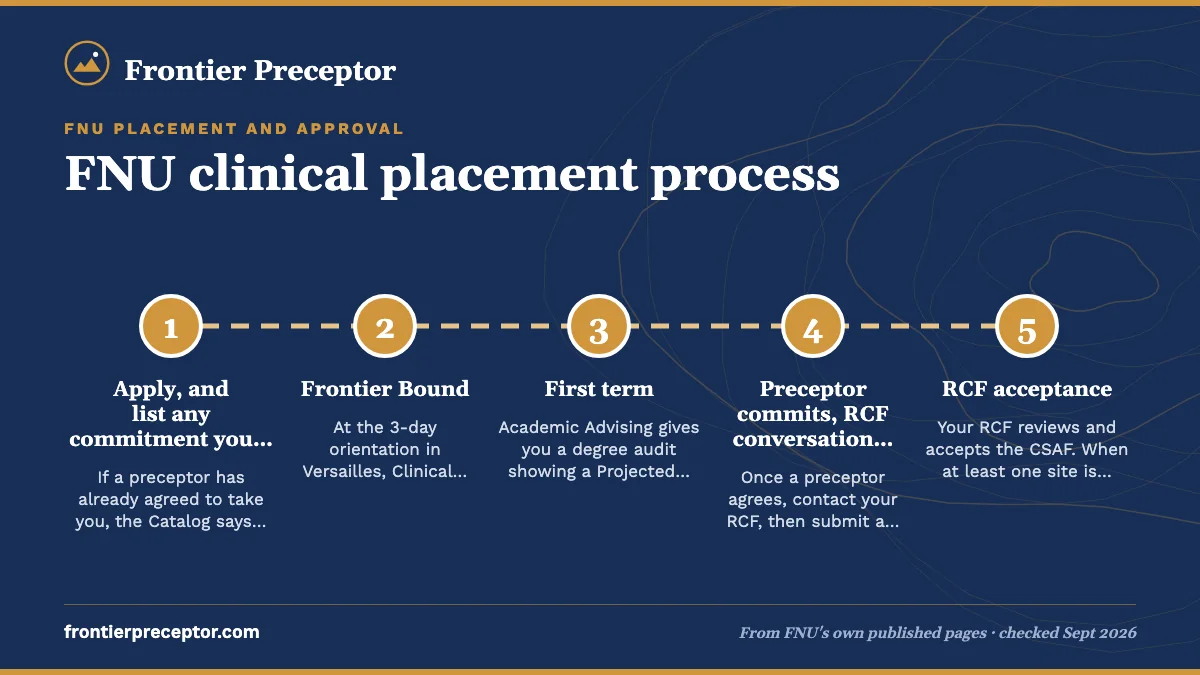
This is the sequence FNU describes for MSN and post-graduate certificate students, pieced together from the Catalog and FNU's onboarding pages.
- Apply, and list any commitment you haveIf a preceptor has already agreed to take you, the Catalog says you can note that commitment on your enrollment application.
- Frontier BoundAt the 3-day orientation in Versailles, Clinical Outreach and Placement opens the Community Map to you, and you attend information sessions on credentialing.
- First termAcademic Advising gives you a degree audit showing a Projected Clinical Bound Term, and you are assigned a Regional Clinical Faculty member (RCF).
- Preceptor commits, RCF conversation, CSAFOnce a preceptor agrees, contact your RCF, then submit a Clinical Site Approval Form through the Community Map for each site. The rotation is recorded in My Clinical Plan.
- RCF acceptanceYour RCF reviews and accepts the CSAF. When at least one site is accepted, the RCF assigns your Clinical Bound date.
- Clinical CredentialingOnly then does Clinical Credentialing begin: the affiliation agreement, the site's liability insurance, preceptor credentialing and, where required, a Pre-Clinical Site Visit.
- Your own complianceIn the term before your Clinical Bound term, Credentialing emails you in Week 1, and your CastleBranch items are due in Week 5.
- Interview and orientationYou complete a Pre-Clinical Interview with your RCF, uploading forms first, and hold an orientation meeting with each preceptor.
- Clinical Bound, then releaseYou attend the 5-day Clinical Bound session (
NM750,FNP750,WH750orMH750). Your RCF then releases you to the site and preceptor, and only then does your first clinical day arrive.
The gate before Clinical Bound registration
The hardest deadline in this process is a condition, not a calendar date. The Catalog says "Students cannot be registered for Clinical Bound until a site has been identified" and submitted to Clinical Credentialing. It also expects a complete clinical plan, covering all your visit types and hours, before you register.
Reach that point without a plan and FNU says you "may need to take an Academic Hiatus." A hiatus is a paused term rather than a penalty, but it can push your graduation back. Missing your CastleBranch compliance items does something similar: FNU places a registration block and warns of possible late registration fees.
If your projected Clinical Bound term moves for any reason, the Catalog asks you to tell four people: your RCF, each preceptor, the Clinical Credentialing Coordinator on your file and your Academic Advisor. Each of them is planning around that date, and a quiet change can undo weeks of their work.
How long each stage can take
FNU publishes few firm durations, and its detailed Clinical Site Preparation Timeline sits behind the student login. Here is everything public, with the type of source for each.
| Stage | What FNU says | Source |
|---|---|---|
| Finding a preceptor | Start early in the program | FNU Catalog |
| Submitting the CSAF | Listed during the didactic terms, well before the Clinical Bound term | FNU programs of study, October 2025 |
| RCF approval of the clinical plan | About four to six months before Clinical Bound | FNU job posting for RCFs, 2025 |
| Site credentialing | Can take several months | FNU Catalog |
| Student compliance | Emailed in Week 1, due in Week 5 of the term before Clinical Bound | FNU student portal |
Read together, those lines put your preceptor search in your first year of coursework, not in the term before Clinical Bound. The placement timeline page works backward from a projected term so you can see your own dates.
From Clinical Bound to your first patient
Clinical Bound is a five-day, four-night skills intensive on the Versailles campus, held after your didactic courses, with simulation labs and standardized patients. Your practicum courses, numbered 751, 752 and 753 for your track, come after it.
Across those three courses every MSN and PGC track completes a minimum of 750 clinical hours, planned over 19 weeks for students starting clinicals in 2025 or later. The Catalog sets weekly minimums of 20 hours in the first course, 28 in the second and 24 in the third, so the site you submitted has to be able to offer that time. The clinical hours page has the detail.
When one site's patient volume falls short, FNU's answer is a second site, and the Catalog warns that can mean relocating, possibly out of state.
The FNU Catalog treats starting clinical before site or preceptor credentialing is complete as "grounds for dismissal." Wait for your RCF's final release.
What FNU keeps behind its login
Several documents that govern this process are not public. The Clinical Site Preparation Timeline, the Community Map, the CSAF itself and the Clinical Credentialing pages (now on Banyan Tree 2.0, FNU's SharePoint portal) all need an FNU login. The CSAF instructions live in CB101, the Clinical Bound 101 course in Canvas.
When public information and your situation disagree, go to whoever owns that step: your Clinical Advisor for the search, your RCF for the plan and approval, your Clinical Credentialing Coordinator for contracts, and the program guidelines in Canvas or Banyan Tree for course rules. This site reflects FNU's public pages as of September 2026. FNU's internal guidance wins if the two differ.
The step we take off your plate
We take on the step FNU leaves to you: finding a preceptor and site suited to your track, ideally close to home, or by telehealth within FNU's caps where your course allows it. We then assemble with you the details your CSAF and Clinical Credentialing will ask about, and if a preceptor withdraws later, a placement advisor is ready to search again.
Every site and preceptor is approved by your RCF and Clinical Credentialing, and each one we bring has been measured against FNU's published rules first. If you want another pair of hands on the search, tell us your track and area.
Questions FNU students ask
Does Frontier Nursing University find clinical placements for students?
No. FNU states that students are responsible for securing their clinical site, and no FNU source says it assigns placements. It backs the search with Clinical Advisors, the Community Map, Regional Clinical Faculty and a credentialing team, and its program pages describe dedicated Clinical Placement Services. Think of FNU as the support desk and approver, and yourself as the person who gets the yes.
Can I put my preceptor on my FNU application?
Yes. The FNU Catalog says applicants who already have a commitment from a preceptor can list it on the enrollment application. Listing it does not skip any step: after you enroll, the site still needs a CSAF, acceptance by your RCF and full credentialing before you start. What it does give you is a head start on the search.
What happens if my FNU clinical site falls through before Clinical Bound?
Tell your RCF and Clinical Advisor straight away, because Clinical Bound registration depends on having a site identified and submitted to Clinical Credentialing. You will need a new preceptor commitment and a new CSAF, and the new site goes through RCF acceptance and credentialing in its own right. Our preceptor dropped out page covers the options.
Can I start seeing patients while my site's credentialing finishes?
No. The Catalog treats starting clinical before site or preceptor credentialing is complete as grounds for dismissal. FNU's liability coverage also applies only at sites cleared by Credentialing and your RCF, and you still need final release after Clinical Bound. If your start date looks at risk, raise the timing with your RCF rather than starting early.
Do FNU students have to do clinicals in their home state?
FNU publishes no home-state rule, and most students complete clinicals near home. You do need to be licensed as an RN, or compact-eligible, wherever your clinicals take place, and New York is sharply limited. If a site cannot provide enough patients, you may need a second site elsewhere, possibly out of state. See clinicals by state.
Related pages
Last checked 2026-09-23
We check these pages against FNU's own published sources. Your Clinical Advisor, your RCF and FNU's current guidelines have the final word.
Your site submitted before Clinical Bound.
Tell us your FNU track, your county and your Clinical Bound date. We look for a preceptor and site that fit FNU's rules for your track, and help you get the CSAF and credentialing details right.
- Matched to your track: CNM/CM, NP, or the right mix FNU allows
- Ready for the CSAF, the RCF and Clinical Credentialing
- In person near you, or telehealth within FNU's caps
Start your placement plan
A placement advisor replies with what an FNU-ready preceptor and site look like for you.