Your FNU Regional Clinical Faculty member: approval, site visits and Case Days
Your Regional Clinical Faculty member (RCF) is the FNU faculty member who approves your clinical plan, visits your site and grades your clinical work. FNU says RCFs generally live in your region and become your primary advisor once clinical coursework begins. Knowing what your RCF looks for, and when, can save you weeks.
Get your placement plan
Tell us your FNU track and where you live. A placement advisor replies with what a FNU-ready preceptor and site look like for you.
Who your RCF is
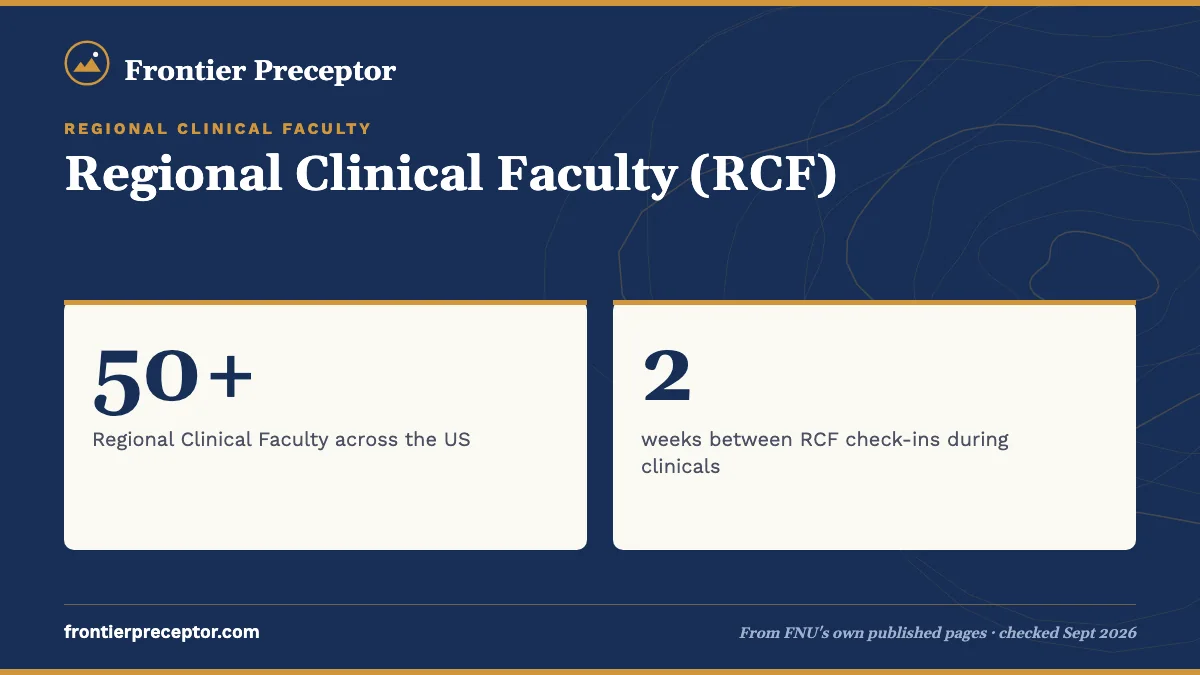
RCFs are FNU faculty members who "generally reside in your geographic region," as FNU's onboarding page puts it. FNU has more than 50 of them across the country, and most students are matched with one who lives in the region closest to them. An undated FNU podcast put a typical caseload at 20 to 40 students and called the role unique to FNU.
You are assigned an RCF at the start of your first term, around the time Academic Advising gives you a projected Clinical Bound term. FNU's clinical experience page says you begin working with your RCF on a clinical plan shortly after enrolling, and during clinical coursework the RCF becomes your primary advisor.
The RCF also sits at the center of everyone else. The Catalog names the RCF as the liaison between sites, preceptors, students, the Clinical Credentialing Coordinator and the Clinical Director.
Approving your clinical plan
Your RCF decides whether each proposed site goes forward. You contact your RCF before submitting a CSAF, you submit it through the Community Map, and the RCF reviews and accepts the rotation in My Clinical Plan. Clinical Credentialing starts only after that acceptance.
The RCF evaluates both the site and the preceptor. For PMHNP students, the Catalog says the accepted CSAF must include a preceptor with psychiatric prescribing authority, and for every track the site has to be able to provide the weekly hours the first clinical course requires. Accepting your first site is also what triggers your Clinical Bound date.
An FNU job posting for Regional Clinical Faculty, published on a third-party job site in 2025, says the RCF approves the Clinical Plan roughly four to six months ahead of Clinical Bound. That is a job description, not a published student deadline, but it is a fair signal of when your plan needs to be in shape.
Talk to your RCF before you submit a CSAF, not after. The Catalog asks for that contact first, and it is the cheapest way to catch a problem.
Pre-clinical interview and final release
Ahead of Clinical Bound your RCF holds a Pre-Clinical Interview with you, which the Catalog also calls a Transition to Clinical Interview, and the required forms have to be uploaded before it. You also hold a pre-clinical orientation meeting with each preceptor, working through an agenda the Catalog sets out.
After the five-day Clinical Bound session, your RCF gives final release for your site and preceptor. That release, together with completed credentialing, is what allows your first clinical day. Seeing patients for credit before both are in place puts your enrollment at risk, since the Catalog treats an early start as grounds for dismissal.
If your projected Clinical Bound term changes, your RCF is on the Catalog's list of people to notify, with your Academic Advisor, the preceptors involved and the Clinical Credentialing Coordinator handling your site.
Site visits during your practicum
According to FNU's preceptor page, the RCF evaluates the site and preceptor "to ensure excellence before the student begins," then follows up during the practicum.
| Visit | When | What FNU says |
|---|---|---|
| Pre-Clinical Site Visit | Before you start, at your primary site | Must be scheduled or made before you begin, where required |
| Clinical Site Visit | Around the halfway point of your practicum | May be virtual or in person; one per student |
| Additional visits | As needed | Depend on the student's or the site's needs |
After the Clinical Site Visit, both you and your preceptor can give a written evaluation of it. Give your preceptor plenty of notice of the visit, and have your logs and assessments up to date before it happens.
Check-ins, grading and when things go wrong
During clinicals the Catalog has the RCF contacting your preceptor every month and you every two weeks, and it expects you to communicate "at least biweekly." The RCF assigns your clinical grades with input from your preceptors, who also complete FNU's daily and monthly assessment tools; see preceptor evaluations. An undated FNU podcast adds that RCFs grade students' reflections and case logs.
If your RCF or preceptor judges your progress or supervision inadequate, FNU uses a stepped process: a Problem Identification Sheet, then a Learning Plan, then a Performance Plan. The Catalog says the RCF or Clinical Director can require you to move to a site they designate, and that such a move is at your expense and "is not optional."
If you move home mid-program, any site change goes through the RCF for the region where you now live.
Case Days
Case Management Days, usually shortened to Case Days, are seminars organized by RCFs for group learning and networking within a region, where clinical students present cases. They run by program (nurse-midwifery with WHNP, PMHNP, and FNP), in person or virtually, and FNU's portal marks them as not recorded, so you have to attend to get the content.
Case Days are open to students, alumni, preceptors and applicants. That makes them one of the few FNU settings where you can meet practicing clinicians in your own region before you need a site. Going in your first year, not only when it is your turn to present, gives you time to turn a conversation into a lead.
The Case Day calendar is on the FNU portal, and your RCF can tell you which sessions suit your track.
Bringing your RCF stronger sites
Your RCF judges sites; we help you bring stronger ones. We search your region for preceptors right for your track, screen them against FNU's preceptor rules before you raise them with your RCF, and collect the site and preceptor details your CSAF needs. If a preceptor withdraws partway through, we stay on call to search again.
The decision on every site is your RCF's, and we make that decision easier with a lead that fits from the outset. Send us your details if you want help with the search.
Questions FNU students ask
What does RCF stand for at Frontier Nursing University?
RCF stands for Regional Clinical Faculty. RCFs are FNU faculty members who usually live in your region. They approve your clinical plan, evaluate sites and preceptors, make site visits and assign clinical grades with preceptor input. FNU has more than 50 of them across the US, and you are assigned one in your first term.
Is the FNU Clinical Site Visit in person or virtual?
It can be either. FNU's preceptor page says the Clinical Site Visit, held around the halfway point of your practicum, may be virtual or in person. The Pre-Clinical Site Visit to your primary site comes before you start, where it is required. Your RCF decides the format and will tell you what to expect.
Does my RCF help me find a preceptor?
The RCF's documented role is approval, evaluation, site visits and grading, and FNU says you work with your RCF on your clinical plan soon after enrolling. The search itself is supported by your Clinical Advisor in the Clinical Outreach and Placement team. In practice, raise leads with both: the advisor for finding, the RCF for whether a site will fit.
Do I need my RCF's approval to add a second clinical site?
Yes. Every site needs its own CSAF and RCF acceptance, then credentialing. FNU caps the number of sites, four for most tracks, with WHNP listed as three in the Catalog and four on FNU's website. Talk to your RCF before adding a site, especially if low patient volume is the reason, since the Catalog expects extra sites in that case.
What happens with my RCF if I move during the program?
Under the Catalog, a site change has to be worked out with the RCF for the region you currently live in. So if you move, expect to plan the new site with the RCF for your new region, and confirm the handover with your current RCF. Tell your Clinical Credentialing Coordinator and preceptors as soon as you know.
Related pages
Last checked 2026-09-23
We check these pages against FNU's own published sources. Your Clinical Advisor, your RCF and FNU's current guidelines have the final word.
Your site submitted before Clinical Bound.
Tell us your FNU track, your county and your Clinical Bound date. We look for a preceptor and site that fit FNU's rules for your track, and help you get the CSAF and credentialing details right.
- Matched to your track: CNM/CM, NP, or the right mix FNU allows
- Ready for the CSAF, the RCF and Clinical Credentialing
- In person near you, or telehealth within FNU's caps
Start your placement plan
A placement advisor replies with what an FNU-ready preceptor and site look like for you.