FNU DNP: the project site, mentor and 500 practice hours
An FNU DNP student is not looking for a preceptor in the MSN sense. You need a practice site willing to host a rapid-cycle quality improvement project, a site mentor with a master's or higher, and a site sponsor, and FNU encourages you to use the place where you already work. Your 500 DNP practice hours run through DNP850 to DNP853.
Get your placement plan
Tell us your FNU track and where you live. A placement advisor replies with what a FNU-ready preceptor and site look like for you.
Two DNP routes and how long they take
The Post-Master's DNP is the only DNP on FNU's current Programs of Study page. It is 30 credits: 6 terms on the full-time sequence, which FNU's older Program of Study labels 18 months, or 9 terms part-time, labeled 27 months. You need a master's in nursing or a related field such as public health or midwifery, a graduate GPA of 3.0 and an active, unencumbered US RN license.
FNU's tuition page also lists a Companion DNP of 21 credits for FNU MSN graduates, planned at 12 months over 4 terms full-time or 15 months over 5 terms part-time. It does not appear on the current Programs of Study page, so ask Admissions whether it is taking students.
DNP cohorts start in the same four terms as FNU's other programs. For example, DNP class 65 begins on January 4, 2027, and FNU's terms run 11 weeks with a two-week break between them.
DNP Bound instead of Clinical Bound
The DNP has one required campus visit: DNP Bound, a three-day orientation in Versailles, Kentucky, before your first term. FNU also runs a one-day virtual version for some FNU alumni, listed on the 2026 calendar as DNP Virtual Bound. DNP students do not attend Clinical Bound.
Before DNP Bound you complete the same admission compliance as other degree-seeking students: a background check, proof of immunizations and current medical information, ordered through CastleBranch as the Frontier Bound Compliance package. For students admitted for Winter 2027, FNU lists that deadline as October 14, 2026, and it warns that missing it may cancel your admission.
Project-site compliance is a separate step that comes later, through the DNP850 course in Canvas. The CastleBranch page explains the account and the packages.
DNP850 to DNP853: the project sequence
Your practice hours sit inside four courses. On the full-time plan, DNP850 comes in term 3 alongside DNP804 Advanced Evidence Based Practice and DNP805 Leadership and Organizational Dynamics, and DNP851 to DNP853 fill terms 4 to 6.
| Course | Credits | Stage | Full-time term |
|---|---|---|---|
DNP850 | 1 clinical | Scholarly Project Preparation, where the project-site CSAF is filed (hours and courses) | 3 |
DNP851 | 4 clinical | Scholarly Project Planning | 4 |
DNP852 | 4 clinical | Scholarly Project Implementation | 5 |
DNP853 | 3 (2 didactic, 1 clinical) | Scholarly Project Dissemination | 6 |
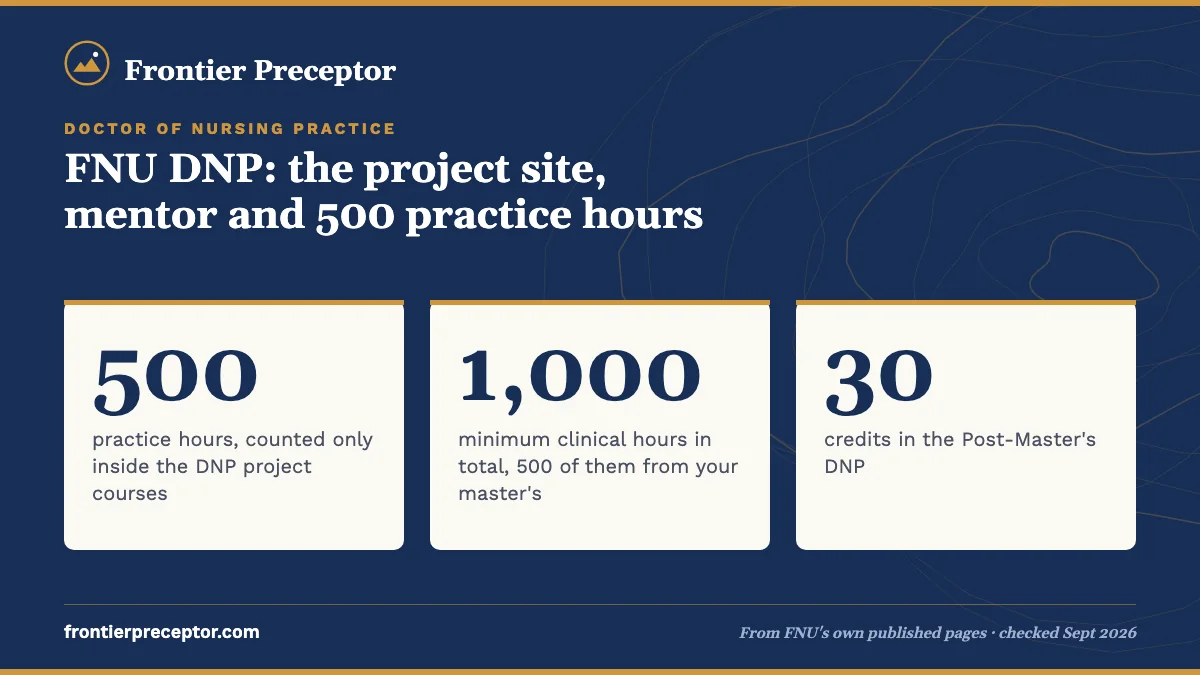
FNU's catalog counts 500 contact hours, earned only within these courses, and the Program of Study sets a minimum of 1,000 clinical hours for the degree, with 500 coming from your master's. FNU's sources disagree on the details: the website says the 500 hours fall over three terms, while the Program of Study spreads clinical credit over four, and one program overview cites 360 contact hours. Confirm your own figure with your DNP faculty.
The project, the mentor and the sponsor
FNU describes the DNP project as leading a rapid-cycle quality improvement initiative shaped by your practice site's needs, using the Institute for Healthcare Improvement's Model for Improvement. The projects are small in scope and can be carried out within three months, with the IHI model applied over eight weeks. You work with the site's sponsors, FNU faculty and faculty from the IHI Open School.
Two people at the site matter most. Your mentor must hold a master's degree or higher and bring quality improvement or clinical expertise. FNU sets no defined level of education for your sponsor. You, your sponsor and your mentor then sign a Sponsor/Mentor agreement, and on FNU's side you work with DNP clinical faculty and DNP continuity faculty.
DNP students may not base their project at a site a first-degree relative owns or runs.
The Sponsor/Mentor agreement is due no later than week 8 of the term before DNP851. On the full-time plan that is your DNP850 term, so a site without a willing mentor by mid-term can hold up your next registration.
Your workplace first, and what happens if it can't host you
FNU encourages you to do your DNP hours in your current workplace, and the catalog's ideal is a project at the site where you are employed as an APRN. That makes your own manager or medical director the natural first conversation. FNU applicants are strongly encouraged to identify potential project sites and mentors before they start, and FNU's catalog notes that DNP clinical faculty take a close part in identifying sites.
The paperwork follows a set order. You submit the CSAF for your project site through the DNP850 course in Canvas, which the catalog also calls DNP Prep 101, and Clinical Credentialing credentials the site, which FNU warns may take several months. Your compliance items must be on file before you can register for DNP851. Whether you need FNU's full compliance list or your employer's rules depends on whether you work at the site; the employer site page explains the difference.
If your employer will not host the project, you need another site with a qualified mentor, and the calendar is the same.
State, license and telehealth notes
FNU's New York limits are written around MSN and PGC clinicals. FNU states that its limited New York approval does not apply to DNP applicants and that they are eligible for admission, and no DNP state exclusion is published.
The license rule still applies. Your RN license, or compact eligibility, must be unencumbered in each state where the project's clinical work takes place. FNU makes an exception for sites that accept any US nursing license, such as some military and Indian Health Service facilities. The RN license page covers compact licenses.
FNU's published telehealth caps are written for the MSN and PGC tracks, and none is published for the DNP. If your project involves telehealth patients across state lines, ask your DNP faculty how FNU will treat it.
Finding a project site when the workplace is out
The workplace is FNU's intended project site, and when that route closes, we step in: you have moved, changed jobs, work outside a practice setting, or your employer has declined.
We look for a practice near you willing to host a quality improvement project and a master's-prepared mentor willing to sign the Sponsor/Mentor agreement, and we gather with you the site and contact details for the CSAF and Clinical Credentialing. Your DNP faculty and Clinical Credentialing approve the site, and it reaches them with a sponsor and mentor already on board. Tell us your DNP851 term on the contact page.
Questions FNU students ask
Does FNU offer a BSN-to-DNP?
Not according to its current pages. FNU lists no BSN-to-DNP or MSN-entry DNP pathway. Its DNP page says MSN and post-graduate certificate graduates may then consider applying to the Post-Master's DNP. If you hold a BSN now, the route at FNU runs through one of the MSN tracks first.
I'm an APRN in a state that dropped my RN license. Can I still join FNU's DNP?
Yes, but you must reinstate your RN license first. FNU requires an active, unencumbered US RN license for the DNP, and its application page says that if your state, Utah being FNU's example, lets the APRN license replace the RN license, you must reinstate the RN license.
Does my employer need an affiliation agreement with FNU for my DNP project?
Not always. The catalog says that if you are employed at the project site and the employer requires no affiliation agreement, you follow the employer's requirements instead of FNU's compliance items. If you volunteer at a site, you complete FNU's compliance list, including BLS, through DNP850, and Clinical Credentialing credentials the site.
Can I do my FNU DNP project outside the United States?
Possibly. Unlike MSN and PGC students, who must train in the continental US or Hawaii, DNP students may petition FNU's DNP leadership for an international project site. The catalog names the DNP Program Chair and the admissions page the DNP Program Director. Raise it early, since a petition adds a step before the site can be credentialed.
Do my MSN clinical hours count toward FNU's DNP?
They count toward the degree's 1,000-hour total, which the Program of Study splits into 500 from your master's and 500 in the DNP. The DNP's own 500 hours, however, are counted only within DNP850 to DNP853, so hours from your MSN or from work before those courses do not reduce them.
Related pages
Last checked 2026-09-23
We check these pages against FNU's own published sources. Your Clinical Advisor, your RCF and FNU's current guidelines have the final word.
Your site submitted before Clinical Bound.
Tell us your FNU track, your county and your Clinical Bound date. We look for a preceptor and site that fit FNU's rules for your track, and help you get the CSAF and credentialing details right.
- Matched to your track: CNM/CM, NP, or the right mix FNU allows
- Ready for the CSAF, the RCF and Clinical Credentialing
- In person near you, or telehealth within FNU's caps
Start your placement plan
A placement advisor replies with what an FNU-ready preceptor and site look like for you.