Your RN license for FNU clinicals: every state, compact licenses and telehealth
FNU requires an unencumbered RN license, or eligibility for compact licensure, in every state where you do clinical hours. For telehealth, the rule follows the patient: you must meet licensing requirements where the patient lives. Your license is verified through Nursys Quick Confirm as part of clinical compliance.
Searching across a state line?
Tell us your track and the states your license covers.
The rule in FNU's words
The catalog's compliance list asks for an unencumbered nursing license in every state where clinicals will be completed, or for the student to be “eligible for nursing compact state licensure.” Verification must go through Nursys Quick Confirm, and it is one of the items due in CastleBranch the term before Clinical Bound.
The admissions section of the catalog says the same thing more broadly: students must meet the licensing requirements for any state where they complete a rotation or, for telehealth, where patients reside. Elsewhere the catalog adds that if a site requires you to practice in another state, you must obtain the appropriate license under that state's statutes.
Unencumbered matters. MSN admission already requires a current, active US RN license with no encumbrances on any active license, and the clinical rule carries that standard into every state where you practice as a student.
Compact licenses and what eligible means
FNU's wording accepts a license in the clinical state or eligibility for compact licensure. Under the Nurse Licensure Compact, a nurse whose primary state of residence is a compact state can hold a multistate license that allows practice in other compact states. A single-state license covers only the state that issued it.
For clinical planning, that splits students into two groups. If you hold a multistate license and your prospective site is in another compact state, you may not need a new license, and Nursys will show what your license covers. If you hold a single-state license, or the site is in a state outside the compact, you will need a license from that state before hours there can count.
Compact membership and board processing times differ by state and change over time, so check with the board of nursing in the site's state before you commit a CSAF. Our state pages and clinical state rules cover state-level detail.
Telehealth: the patient's state decides
For telehealth rotations, the catalog says students must meet all Board of Nursing licensure requirements in the state where the patient resides. Your own location, and your preceptor's, do not settle it. A telehealth practice that sees patients in several states can therefore need several licenses from you.
Telehealth also has track caps: 20% of hours for nurse-midwifery and WHNP, 10% for FNP with the student in the same office as the preceptor, and 450 hours for PMHNP students starting in 2025 or later. The PMHNP allowance is the largest, so PMHNP students have the most reason to settle licensing before building a telehealth-heavy plan. See telehealth hours and virtual clinical options.
One question stays open: FNU's sources do not say whether a student outside New York may count telehealth visits with patients in New York. Ask your RCF before planning any.
Sites that accept any US license
The catalog carves out one exception: a site “that permits any US nursing license,” with military facilities and Indian Health Services given as examples. At those sites, your existing unencumbered license may be enough even in a state where you hold no license of your own.
Federal facilities matter for New York in particular. FNU's clinical approval in New York is limited to six MSN nurse-midwifery students a year who live there, but all FNU students can attend clinical in a federal government facility in New York. See New York clinicals for the full rule.
The exception does not stretch FNU's map. US military bases outside the continental US count as international sites and are not approved for MSN or PGC students. Confirm the exception with the site and with Clinical Credentialing before relying on it, since it depends on the facility's own policy.
Crossing a state line for a site
FNU has no rule that clinicals must be in your home state; the only residence-based rule is New York's. Most students stay near home, but FNU notes that travel or temporary relocation is sometimes necessary, and the catalog says a low-volume site can mean relocating, possibly out of state.
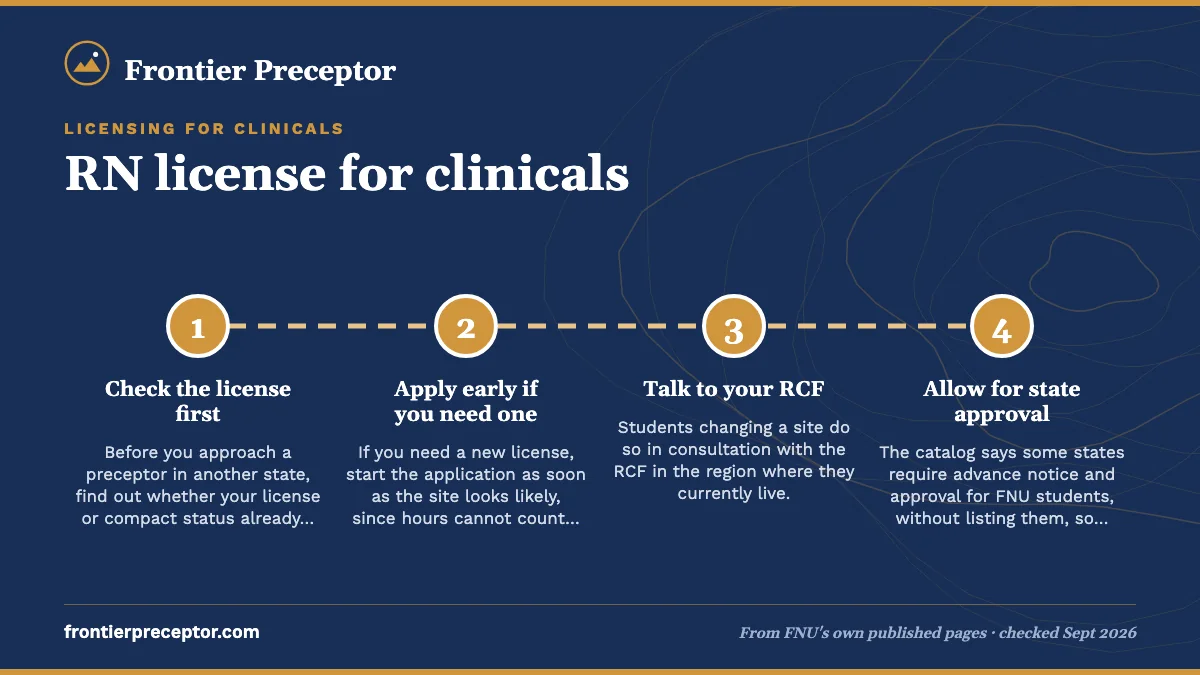
- Check the license firstBefore you approach a preceptor in another state, find out whether your license or compact status already covers that state.
- Apply early if you need oneIf you need a new license, start the application as soon as the site looks likely, since hours cannot count until you meet that state's rules.
- Talk to your RCFStudents changing a site do so in consultation with the RCF in the region where they currently live.
- Allow for state approvalThe catalog says some states require advance notice and approval for FNU students, without listing them, so Clinical Credentialing may need extra time.
MSN and PGC clinicals must stay within the continental US and Hawaii. Guam, the US Virgin Islands and Puerto Rico are not approved, and FNU's sources do not confirm either way whether Alaska sites are allowed.
DNP students and the RN license
DNP admission requires a current, active, unencumbered RN license in the United States. FNU's post-master's DNP application page notes that applicants whose state treats the APRN license as superseding the RN license, with Utah as the example, must reinstate their RN license.
DNP students are encouraged to complete their hours at their own workplace, which often keeps the license question simple. If the project site is in another state, the same catalog principle applies: meet the licensing requirements of the state where you practice. DNP students may also petition for an international project site, an option MSN and PGC students do not have.
Searching where your license already works
Licensing runs between you and each state board, so we plan the search around the licenses you hold. A placement advisor searches first where your current license already works, near home or in a compact state you can reach, and flags early when a promising site would need a new license or sits in a restricted state.
Telehealth searches follow the same rule, matched to your track's cap and the states your license covers. Final approval of every site stays with your RCF and Clinical Credentialing. Share your license states with your request.
Questions FNU students ask
Do I need an RN license in the state where I do FNU clinicals?
Yes, unless you hold a compact license that covers that state or the site accepts any US nursing license, such as a military or Indian Health Services facility. The catalog requires an unencumbered license, or compact eligibility, in every state where clinicals are completed, verified through Nursys Quick Confirm.
Does a compact license cover all my FNU clinicals?
Only in compact states. FNU accepts eligibility for compact licensure, so a multistate license can cover clinicals in other compact states. A site in a state outside the compact needs that state's license. Check the board of nursing for the site's state, since compact membership and rules can change.
Which state license do I need for telehealth hours?
The patient's. The catalog says that for telehealth rotations you must meet all Board of Nursing licensure requirements in the state where the patient resides. If a telehealth preceptor sees patients in several states, you need to be licensed, or compact-eligible, in each state whose patients you see.
Can I do FNU clinicals outside my home state?
Yes. FNU has no rule tying clinicals to your home state, apart from New York's residence-based limit. Most students stay local, but the catalog says relocating, possibly out of state, may be needed if a site lacks patient volume. You must hold, or be eligible for, a license in that state before hours count.
How does FNU verify my RN license?
Through Nursys Quick Confirm, as part of clinical compliance. The license check is one of the items Clinical Credentialing asks for in CastleBranch the term before Clinical Bound, with a Week 5 due date. Keep every license you rely on for clinicals current and unencumbered through the end of your practicum.
Related pages
Last checked 2026-09-23
We check these pages against FNU's own published sources. Your Clinical Advisor, your RCF and FNU's current guidelines have the final word.
Your site submitted before Clinical Bound.
Tell us your FNU track, your county and your Clinical Bound date. We look for a preceptor and site that fit FNU's rules for your track, and help you get the CSAF and credentialing details right.
- Matched to your track: CNM/CM, NP, or the right mix FNU allows
- Ready for the CSAF, the RCF and Clinical Credentialing
- In person near you, or telehealth within FNU's caps
Start your placement plan
A placement advisor replies with what an FNU-ready preceptor and site look like for you.