FNU clinicals in New York: the six-student limit and its exceptions
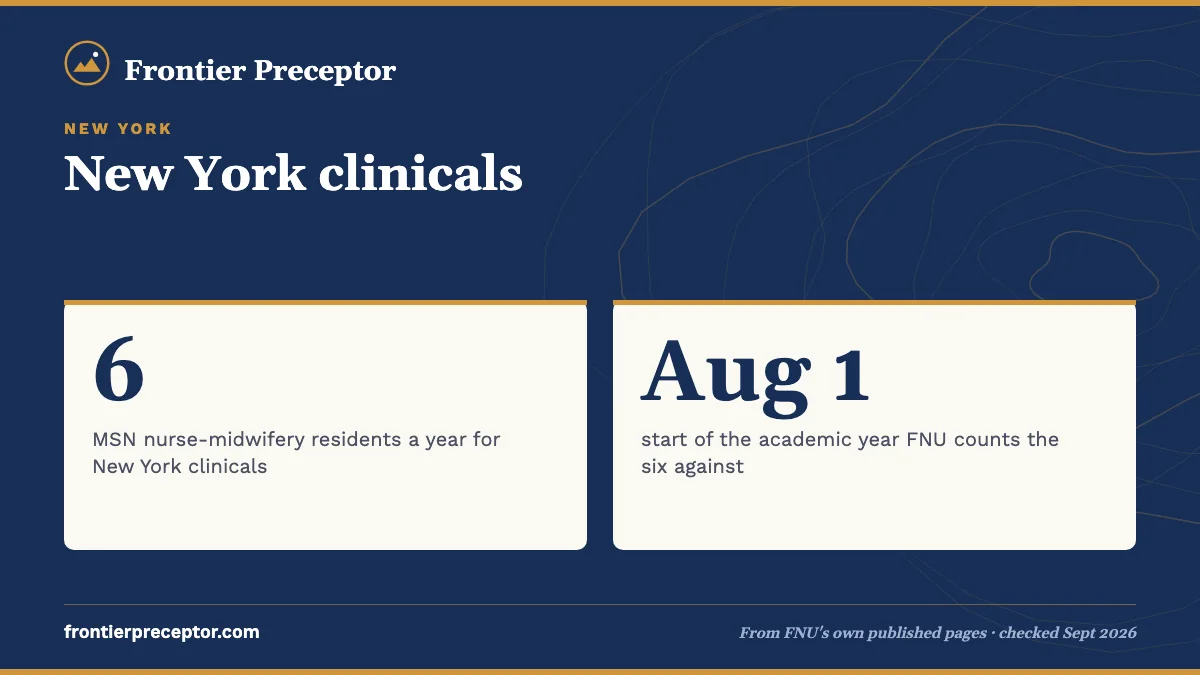
FNU enrolls New York residents, but its New York approval covers clinicals for only six MSN nurse-midwifery students a year who live in the state. Every other FNU student does clinicals outside New York, with one exception: federal government facilities in New York are open to all tracks.
Living in New York?
Tell us your track and where in the state you live. A placement advisor will reply.
Who can do clinicals in New York
FNU's accreditation page says it has "very limited approval" from the New York State Education Department (NYSED) to offer clinical experiences in the state. Here is how that plays out for each kind of student.
| Student | Clinicals in New York? |
|---|---|
| MSN nurse-midwifery, New York resident at admission | Possible: one of six places a year, in upstate, rural or underserved areas |
| MSN nurse-midwifery who moved to New York after admission | Not assured |
| PGC nurse-midwifery | No, except at a federal government facility |
| MSN or PGC FNP, WHNP or PMHNP | No, except at a federal government facility |
| Any student living outside New York | No, except at a federal government facility |
| DNP | The limit doesn't apply; DNP applicants are eligible |
FNU counts the six places per academic year, which runs August 1 to July 31.
The six MSN nurse-midwifery places
The places go to MSN nurse-midwifery students who were New York residents at admission, and their clinicals must be in "upstate, rural, and underserved areas" of the state. Build the search around those regions rather than the nearest large city.
FNU doesn't publish how the six places are allocated, how early to ask, or what happens if more than six residents want one. Ask your Clinical Advisor and Regional Clinical Faculty (RCF) in your first term, and keep a backup plan in a neighboring state in case a place isn't available.
Midwifery students who move to New York during the program have no assurance of a place, so treat an out-of-state site as the likely plan. The usual midwifery requirements still apply wherever you train, including 40 births with at least eight in a hospital; the nurse-midwifery preceptor guide covers them.
FNP, WHNP, PMHNP and PGC students who live in New York
FNU is plain about it: "No other students" may complete clinical experiences in New York. That covers PGC midwifery and every MSN or PGC FNP, WHNP and PMHNP student. If you live in New York and don't fit the midwifery exception, your clinicals happen in another state or at a federal facility in New York.
Crossing the state line brings FNU's license rule with it: an unencumbered RN license in each clinical state, or eligibility for compact licensure. NYSED says New York isn't a Nurse Licensure Compact state, so a New York license covers New York only. Ask the board in your clinical state what it expects from a New York nurse, and start early.
Travel is on you. The catalog says students pay for relocation that clinicals require, and FNU notes that some students travel or move temporarily to reach a site. See our RN license page for how licensing fits into credentialing.
Neighboring states New Yorkers look at
Four of the five states bordering New York have the Nurse Licensure Compact in effect. New York isn't in the compact, so before you plan clinicals in any of them, check with that state's board what a New York-licensed nurse needs, and allow time for an application.
| State | Nurse Licensure Compact |
|---|---|
| New Jersey | In effect since November 2021 |
| Pennsylvania | In effect since July 2025 |
| Connecticut | In effect since October 2025 |
| Vermont | In effect since February 2022 |
| Massachusetts | Enacted, not yet in effect (targeted for May 2027) |
Each state has its own board rules for students from out-of-state programs. Our New Jersey and Pennsylvania pages, and the rest in the state directory, set out each state's rules.
Federal facilities: the exception for every track
FNU says "all FNU students can attend clinical in a federal government facility" in New York State. NYSED's own guidance explains the carve-out: its registration rule for out-of-state programs excludes federal US Armed Forces and Veterans Administration facilities.
That makes a federal site the one New York option for an FNP, WHNP or PMHNP student who wants to stay home. It still goes through FNU's normal path: a CSAF, RCF acceptance, an affiliation agreement and preceptor credentialing. The catalog also waives the clinical-state license rule at sites that accept any US nursing license, such as military sites, so ask whether yours does.
Before you build a plan around a site, confirm with Clinical Credentialing that it counts as a federal government facility, and check that the preceptor meets FNU's rules for your track.
Licensure and telehealth questions to raise early
FNU's New York approval doesn't make it a "licensure qualifying program" there, and its state license page says FNU can't confirm its MSN and PGC programs meet New York's educational requirements. If you plan to practice in New York after graduation, ask NYSED's Office of the Professions how it would review your application before you rely on it.
NYSED also warns NP students that clinicals in New York outside a registered program "could also be illegal," federal sites aside. Telehealth is less settled: FNU requires licensure where the patient lives but doesn't say whether New York patients count for students outside the six places. Ask your RCF before a telehealth site with New York patients goes into your plan.
Planning around New York's limits
For most New York students, our search starts across the border or at a federal site. Preceptors within a realistic drive come first, each flagged with the license its state would need, and we prepare the site and preceptor details for the CSAF with you. For midwifery students aiming at one of the six places, we can search the upstate, rural and underserved regions FNU names.
FNU and NYSED set these rules, and your RCF and Clinical Credentialing approve every site, so every New York student's plan is built inside them from the first call. Read our state rules overview for the wider picture, or use the form below and tell us which towns you could reach on clinical days.
Questions FNU students ask
Can I live in New York and enroll at FNU?
Yes. FNU says it can enroll New York residents in its programs; the limit is on where clinicals happen. If you've read otherwise elsewhere, FNU's own accreditation page is the one to go by. If you aren't an MSN nurse-midwifery student, plan for clinicals in another state or at a federal facility in New York.
Can an FNP student do clinicals at a VA hospital in New York?
Federal government facilities in New York are open to every FNU student, and NYSED's rule for out-of-state programs excludes Veterans Administration and US Armed Forces facilities. A VA site still needs a CSAF, RCF acceptance and full credentialing, and your preceptor must meet FNU's FNP rules. Confirm the facility's status with Clinical Credentialing before you commit.
How are the six New York midwifery places assigned?
FNU doesn't publish the process. It says only that the approval covers six MSN nurse-midwifery students per academic year, August 1 to July 31, who are New York residents, with clinicals in upstate, rural and underserved areas. Ask your Clinical Advisor early in your first term how to be considered, and keep a backup plan in a nearby state.
I moved to New York during my FNU program. Where do I do clinicals?
If you're an MSN nurse-midwifery student, FNU says you aren't assured a New York place, since the six go to students who were residents at admission. Every other track trains outside New York or at a federal facility there. Tell your RCF about the move; the catalog says site changes are made with the RCF for the region where you now live.
Can I get licensed as an NP or CNM in New York after FNU?
FNU says its New York approval doesn't make it a licensure qualifying program there, and it can't confirm its MSN and PGC programs meet New York's educational requirements. It lists every other state and DC as meeting them. If New York practice is your goal, ask NYSED's Office of the Professions how it would review your application before you count on it.
Related pages
Last checked 2026-09-23
We check these pages against FNU's own published sources. Your Clinical Advisor, your RCF and FNU's current guidelines have the final word.
Your site submitted before Clinical Bound.
Tell us your FNU track, your county and your Clinical Bound date. We look for a preceptor and site that fit FNU's rules for your track, and help you get the CSAF and credentialing details right.
- Matched to your track: CNM/CM, NP, or the right mix FNU allows
- Ready for the CSAF, the RCF and Clinical Credentialing
- In person near you, or telehealth within FNU's caps
Start your placement plan
A placement advisor replies with what an FNU-ready preceptor and site look like for you.