Frontier Nursing University students in New York: what the state allows
New York is the one state where FNU can place only a handful of students. The New York State Education Department (NYSED) has approved FNU clinicals for just six MSN nurse-midwifery students each academic year, all New York residents. FNP, WHNP, PMHNP and PGC midwifery students train in other states unless the site is a federal facility.
Studying with FNU from New York?
Give us your track and county. A placement advisor will reply with the options that fit FNU's rules.
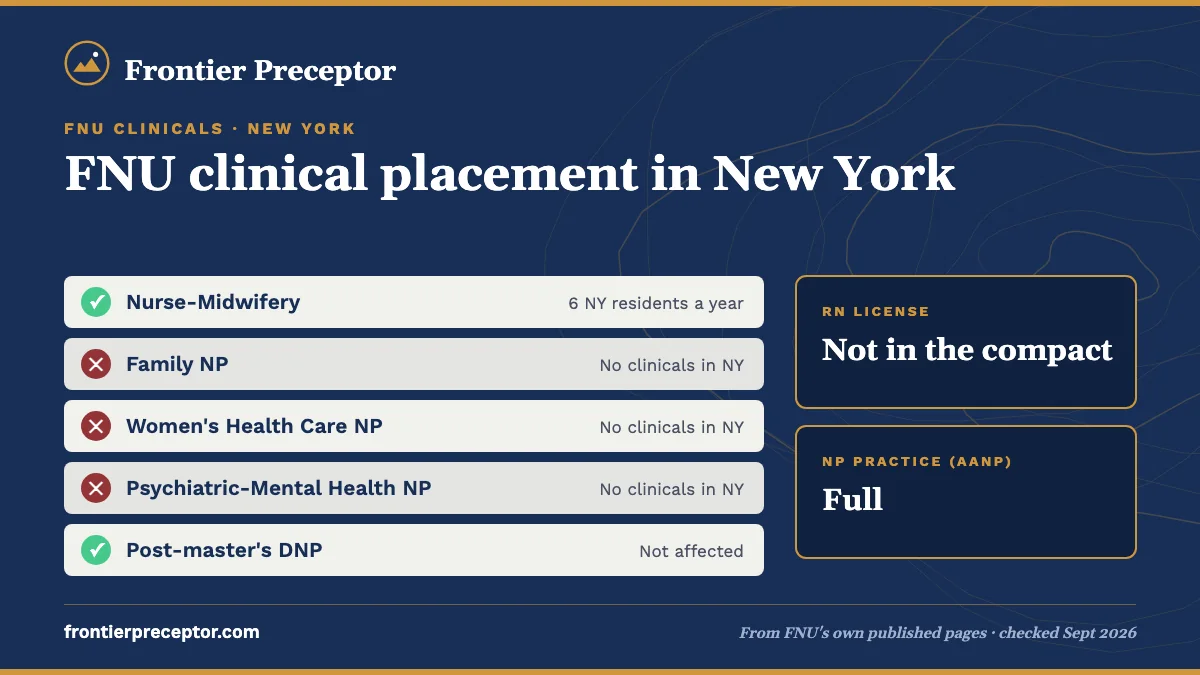
New York at a glance for an FNU student
Find your row in this table before you contact a preceptor.
| Question | New York answer |
|---|---|
| Who licenses nurses | NYSED Office of the Professions, State Board for Nursing |
| Nurse Licensure Compact | Not a member; no pending legislation |
| APRN Compact | Not enacted |
| AANP practice environment | Full practice; NPs under 3,600 practice hours need a written practice agreement and protocols with a collaborating physician |
| FNU clinicals, MSN nurse-midwifery | Six New York residents per academic year, in upstate, rural and underserved areas |
| FNU clinicals, FNP, WHNP, PMHNP and PGC midwifery | None, except at federal government facilities |
| FNU students living outside New York | None, except at federal government facilities |
| DNP | Outside the limit; FNU says DNP applicants are eligible |
NYSED's rule for programs based outside the state
New York's limits start with its own regulator. NYSED says every out-of-state and online nursing program must be registered or approved by the department before placing students in clinical rotations in New York, with sites run by the US Armed Forces or the Veterans Administration excepted. For NP students, the NP program itself must be registered.
NYSED also treats clinical placements in licensed professions as a physical presence needing prior approval or exemption, SARA member schools included, so FNU's NC-SARA membership doesn't open New York sites. It warns NP students outside a registered program that such rotations "could also be illegal." FNU adds that its narrow approval stops short of making it a licensure qualifying program in the state.
The six midwifery places
FNU counts the six midwifery places in each academic year, which it runs from August 1 through July 31, and they are for students who already lived in New York when admitted. Anyone who moves to the state later has no assurance of one. Our New York clinicals page covers the questions to raise with your Clinical Advisor.
A resident holding a place still owes the full midwifery count, including 40 births, no fewer than eight in a hospital. Upstate population centers include the Buffalo, Rochester and Albany-Schenectady-Troy metro areas, home to systems such as the University of Rochester Medical Center, but whether a site meets the rural and underserved test is for your Regional Clinical Faculty to decide.
NP students who live in New York
Downstate systems such as Northwell Health, NewYork-Presbyterian, NYC Health + Hospitals and Mount Sinai can't host FNU FNP, WHNP or PMHNP clinicals unless the site is federal. The realistic options are a VA or Armed Forces facility in New York or a preceptor across a state line.
Five states border New York, each with its own terms; our New Jersey, Pennsylvania and Connecticut pages cover the ones most New Yorkers can drive to. The catalog puts any required relocation at the student's expense.
Licensing when New York is home
NYSED confirms New York is not a compact state: a multistate license from elsewhere doesn't cover practice here, and a New York license is valid in New York alone. The six midwifery students training in the state need a New York RN license, which FNU checks through Nursys Quick Confirm.
Residents training elsewhere need an unencumbered license valid in the clinical state, unless the site accepts any US license, as military sites do, so expect to apply to the neighboring board. Telehealth follows the patient's state; see telehealth hours and ask your RCF before counting visits with New York patients.
Why New York students choose us
For most New York students, our search runs across the border or toward a federal site, within the drive you can manage. For a resident midwifery student with one of the six places, we look for CNM and CM preceptors in the areas FNU names. FNU and NYSED set the limits and FNU approves every site, so every plan we build for a New York student fits inside those limits from the start.
Questions FNU students ask
Is New York closed to Frontier Nursing University students?
Not for enrollment. FNU accepts New York residents into its programs; the limit falls on clinicals. Six MSN nurse-midwifery residents a year may train in upstate, rural and underserved areas, federal facilities are open to every track, and the DNP is outside the restriction. Everyone else trains in another state.
Can my PMHNP telehealth hours include patients who live in New York?
FNU hasn't said. The catalog requires you to meet licensure rules where the patient lives, which for New York means a New York license, but it doesn't say whether students outside the six midwifery places may see New York patients. Put the question to your RCF before you add any site whose telehealth patients are in New York.
I'm an FNU DNP student in New York. Does the six-student limit apply to me?
No. FNU says the limited approval does not apply to DNP applicants and lists no New York exclusion for the DNP. You still need an RN license valid where your practice hours happen, and your project site goes through credentialing. Check the details of a New York project site with your DNP faculty.
Will an FNU degree qualify me for NP or CNM licensure in New York?
FNU can't promise it. Its state license page says it can't promise the MSN and PGC programs satisfy New York's education standards for licensure, and NYSED reviews such applicants case by case. If New York is where you mean to practice, ask the Office of the Professions how it would assess your application.
Related pages
Last checked 2026-09-23
We check these pages against FNU's own published sources. Your Clinical Advisor, your RCF and FNU's current guidelines have the final word.
Your site submitted before Clinical Bound.
Tell us your FNU track, your county and your Clinical Bound date. We look for a preceptor and site that fit FNU's rules for your track, and help you get the CSAF and credentialing details right.
- Matched to your track: CNM/CM, NP, or the right mix FNU allows
- Ready for the CSAF, the RCF and Clinical Credentialing
- In person near you, or telehealth within FNU's caps
Start your placement plan
A placement advisor replies with what an FNU-ready preceptor and site look like for you.