FNU clinical rules, state by state
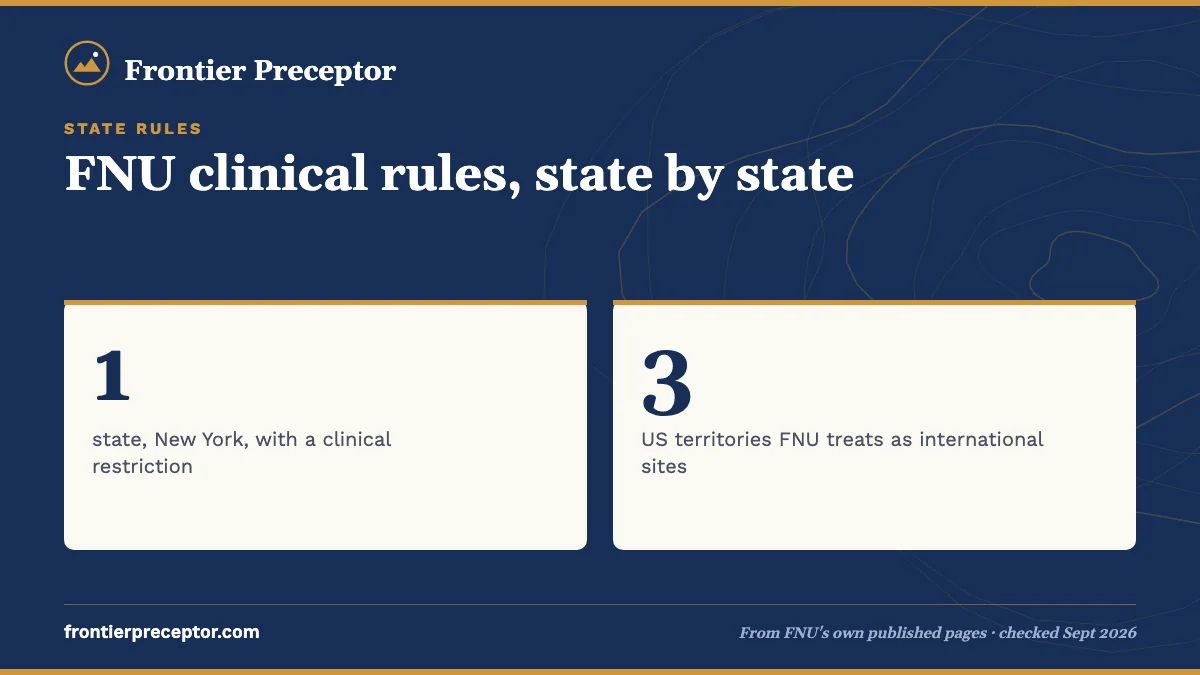
You can do FNU clinicals across the continental US and Hawaii, with an RN license valid in each state where you see patients, including the patient's state for telehealth. US territories are not approved, Alaska is unclear in FNU's wording, and New York is open to only a narrow group of students.
Planning clinicals across a state line?
Tell us where you live and where you're licensed. A placement advisor will reply.
Where FNU approves clinical sites
MSN and PGC students must complete clinicals "within the continental United States (US) and the Hawaiian Islands" (FNU Catalog, Summer 2026). No rule ties you to your home state; most students work near home, and FNU notes that travel or a temporary move is sometimes needed.
| Location | Status | What to know |
|---|---|---|
| Continental states and DC, other than New York | Allowed | RN license or compact privilege in that state |
| Hawaii | Allowed | Not a compact state, so a Hawaii RN license is needed |
| Alaska | Unclear | Not named in the clinical-site policy; ask your RCF first |
| New York | Restricted | Six MSN midwifery residents a year; federal facilities open to all |
| Puerto Rico, Guam, US Virgin Islands | Not approved | Treated as international sites |
| US military bases outside the continental US | Not approved | Also treated as international |
DNP students are the exception to the territory rule: they may petition the DNP Program Chair for an international project site.
An RN license for every state you train in
FNU's compliance list asks for "an unencumbered nursing license in all states" where clinicals happen, or eligibility for compact licensure (FNU Catalog). License verification runs through Nursys Quick Confirm, as one of the compliance items due the term before Clinical Bound.
The one carve-out is a site that accepts any US nursing license; the catalog's examples are military and Indian Health Service sites. Everywhere else, a site across a state line means you need that state covered before you start.
A multistate compact license reaches compact states only. If your plan crosses into a non-compact state, apply for that state's license early, because verification is part of your clinical compliance. Our RN license page goes further, and each state page lists the board and compact status.
Telehealth follows the patient, not you
For telehealth rotations, the catalog says students must "meet state licensing requirements where patients reside." Where you sit doesn't settle it: if a practice sees patients in three states, you need to meet licensing rules in each state whose patients you see.
Telehealth is also capped by track: 20% of hours for nurse-midwifery and WHNP, 10% for FNP (in the same office as your preceptor), and 450 hours for PMHNP students starting clinical in 2025 or later. The telehealth hours page covers the caps and the visit-type limits.
One point is open. FNU doesn't say whether a student outside New York can count telehealth visits with New York patients; it only points to licensure where the patient lives. Ask your RCF before a New York patient panel goes into your plan.
Alaska: settle it before you build a plan
FNU's clinical-site policy names "the continental United States" and Hawaii, not Alaska. Elsewhere FNU lists Alaska as meeting licensure education requirements and as exempt from state authorization because the program is online. Whether Alaska sites are approved for MSN and PGC clinicals isn't confirmed in FNU's public sources.
If you live in Alaska, get an answer from your RCF and Clinical Advisor in writing before you ask a preceptor. The Alaska Board of Nursing also has its own step: students in APRN programs based outside Alaska apply for an APRN Preceptorship Registration, which needs an RN license in good standing and a copy of the preceptorship agreement, and lasts up to 12 months. Alaska is not in the Nurse Licensure Compact. Our Alaska page has the board details.
New York in brief
New York is the only state with a clinical restriction. FNU's approval there covers six MSN nurse-midwifery students a year who live in New York, placed in upstate, rural and underserved areas. PGC midwifery, FNP, WHNP and PMHNP students can't do clinicals in the state, and students living elsewhere can't cross into New York for them.
Federal government facilities in New York are open to every FNU student, and DNP applicants aren't affected by the limit. FNU still enrolls New York residents in every track; the restriction is about where clinical hours happen, not who can study. The detail, including what New York residents on NP tracks do instead, is on our New York clinicals page.
States that want notice before you start
FNU warns that "some states require advance notice and approval" for students doing clinicals there, but doesn't list them. Clinical Credentialing handles state board requirements for placement, which is one reason its work takes months.
Two published points help. FNU holds approval from Washington's Nursing Care Quality Assurance Commission for practice experiences in every MSN and PGC track and the DNP. And an older, undated FNU portal page lists board approvals in Alabama, Connecticut, DC, Kentucky, Louisiana, North Dakota, Oregon, Tennessee, Utah and Washington, with most other boards described as exempt or not regulating.
Treat that older list as background, not current policy. If your site is in one of those states, ask your Clinical Credentialing Coordinator whether extra lead time applies. FNU's NC-SARA membership doesn't change any state's professional licensing rules.
Searching across state lines with the rules in view
We search near you first, in states where you're already licensed. If the right preceptor is across a border, we flag the license you'd need and any known board step before you commit, and we help you gather the site details for the CSAF. For students near a border, that sometimes widens the search to a second state worth licensing in.
FNU approves each site and state boards handle licenses, so we map out which license a lead would need before you commit, leaving you time to apply. If a remote option is on the table, we check it against your track's telehealth cap and the patient-state license rule first; virtual clinical options sets out what telehealth can cover.
Questions FNU students ask
Do I have to do FNU clinicals in the state where I live?
No. FNU has no home-state rule apart from New York's limits. Most students train near home, and FNU says travel or a temporary move is sometimes needed, for example to reach a birth center or a rural clinic. If you need to change sites, the catalog says you do it with the RCF for the region where you currently live.
Can I do FNU clinicals in Puerto Rico or Guam?
Not as an MSN or PGC student. FNU's catalog treats Guam, the US Virgin Islands, Puerto Rico and US military bases outside the continental US as international sites and won't approve them. DNP students are handled differently: they can petition the DNP Program Chair for an international project site, and the chair decides.
Does a compact license cover all my FNU clinical states?
Only the compact states. FNU accepts an unencumbered license in each clinical state or eligibility for compact licensure. New York, Hawaii and Alaska sit outside the compact, so each needs its own license unless your site accepts any US license, like the military and Indian Health Service sites the catalog mentions. Check each state's status before you approach a preceptor there.
Can I see telehealth patients from other states during FNU clinicals?
Only if you meet licensing requirements in each patient's state, and only within your track's telehealth cap. FNP students also have to be in the same office as their preceptor during telehealth visits. Your RCF approves the plan, so tell them which states the practice's patients live in before the site goes in.
Why is California listed differently on FNU's state authorization page?
California is the one state not in NC-SARA, and FNU is exempt from registering with California's private postsecondary bureau. That is an authorization detail for the university. FNU still lists California as meeting educational requirements for CNM, FNP, PMHNP and WHNP licensure, and the usual RN license rule applies to clinicals there.
Related pages
Last checked 2026-09-23
We check these pages against FNU's own published sources. Your Clinical Advisor, your RCF and FNU's current guidelines have the final word.
Your site submitted before Clinical Bound.
Tell us your FNU track, your county and your Clinical Bound date. We look for a preceptor and site that fit FNU's rules for your track, and help you get the CSAF and credentialing details right.
- Matched to your track: CNM/CM, NP, or the right mix FNU allows
- Ready for the CSAF, the RCF and Clinical Credentialing
- In person near you, or telehealth within FNU's caps
Start your placement plan
A placement advisor replies with what an FNU-ready preceptor and site look like for you.