Alaska clinicals at FNU: an open question to settle first
FNU's catalog places MSN and PGC clinicals in "the continental United States (US) and the Hawaiian Islands." It doesn't name Alaska, so whether an Alaska site can be approved is unclear. If you live in Alaska, get that answer from your Clinical Advisor and RCF before you ask anyone to precept you.
Get your placement plan
Tell us your FNU track and where you live. A placement advisor replies with what a FNU-ready preceptor and site look like for you.
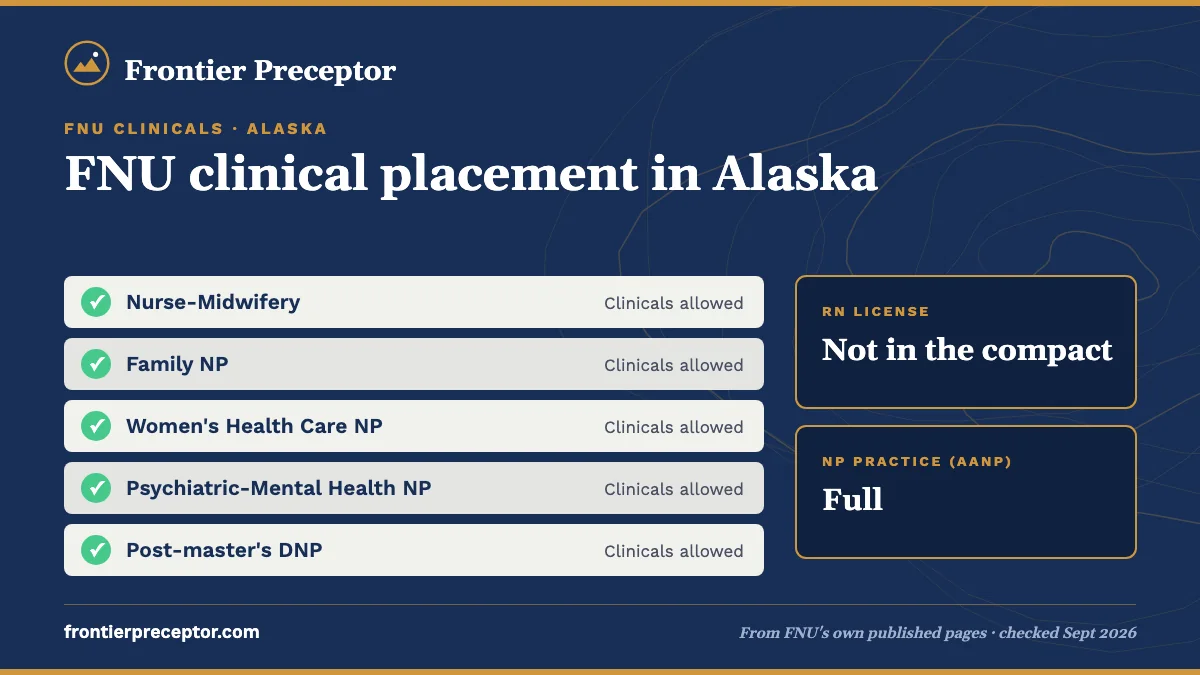
What FNU says about Alaska, and what it doesn't
FNU's accreditation page says Alaska is exempt from state authorization "because the program is online and does not have a physical presence in the state." Its state license page counts Alaska as a state where the MSN and PGC programs satisfy licensure education rules, and FNU has featured an Alaska PMHNP student.
The clinical-site policy is the gap. It names the continental US and Hawaii only, and in the very same passage FNU classes military bases beyond the continental US as international. None of FNU's public sources confirms that Alaska clinical sites are approved, and a military facility in Alaska doesn't sidestep the question.
Get a written answer on Alaska clinical sites from your Clinical Advisor or RCF before you contact a preceptor, not after.
If Alaska sites are allowed: the board registers you
Alaska handles out-of-state APRN students one by one. The Board of Nursing's FAQ says students in APRN programs "must apply for a preceptorship" with the Board, and under 12 AAC 44.460 this is an individual student registration, not a program approval.
- Apply for the registrationFile the APRN Preceptorship Registration (form 08-4253) with the Alaska Board of Nursing. The fee is non-refundable.
- Show your license and enrollmentAttach evidence that you are enrolled in an APRN program now, plus your RN license, which may come from Alaska or any other state as long as it is in good standing.
- Attach the preceptorship agreementBoard approval rests on a copy of the four-party agreement between the school, the facility, you and your preceptor.
- Watch the expiryRegistration ends after 12 months or when the preceptorship ends, whichever comes first, and it can be renewed once.
Line up the timing with FNU's own steps. FNU's agreements with sites run through its credentialing process, which FNU says can take several months, and the Board wants a copy of the preceptorship agreement.
Preceptors and faculty under Alaska rules
Alaska's rules set three conditions for your APRN preceptor: active, unencumbered authority to practice (as an APRN or physician, by license or privilege), a practice focus that resembles your own, and direct responsibility for your supervision, teaching and evaluation during the clinical. FNU's standards apply as well, including a year in an advanced-practice role (preceptor requirements). AANP rates Alaska as full practice.
Faculty rules touch FNU rather than you. Faculty of an out-of-state program need an Alaska RN license if grading clinical coursework, together with other nursing education or consultation in Alaska, exceeds 20 working days in a licensing period (12 AAC 44.090(h)).
Licensing: Alaska sits outside the compact
Alaska isn't in the Nurse Licensure Compact. Joining would take legislation, which the Board's compact page says hasn't passed; it lists HB 131/SB 124 as pending in the 2025-2026 session. A multistate license from elsewhere gives you no practice privilege in Alaska today.
For the student registration, Alaska will take an RN license from any state, its own included; FNU's compliance list, though, wants a license in each state where you do clinicals, unless the site accepts any US license. Ask your Clinical Advisor which license FNU would want for an Alaska site. For telehealth, FNU follows the patient's state, so Alaska patients mean Alaska licensing. See the RN license guide.
Anchorage, Fairbanks, Juneau
Anchorage is the one large metro, at about 406,000 people, followed by Fairbanks-College at about 94,000 and the Juneau micropolitan area at about 32,000. Providence, the state's largest hospital operator, runs Providence Alaska Medical Center; Anchorage adds Alaska Regional Hospital and the tribally run Alaska Native Medical Center, Mat-Su Regional Medical Center serves Palmer, and Foundation Health Partners is based in Fairbanks. These show where students search, not sites known to host FNU students.
For midwifery students, FNU's count applies wherever you train: 40 births, with at least 8 in a hospital.
Why Alaska students choose us
Alaska's status comes first, so we help you put the right question to your Clinical Advisor and get a clear answer on where you can train. Once that is settled, in Alaska or elsewhere, a placement advisor starts the preceptor search and prepares the CSAF details with you. FNU approves every placement, and yours is planned around its answer from day one. Ask us about your situation.
Questions FNU students ask
Can Frontier Nursing University students do clinicals in Alaska?
It isn't clear from FNU's public sources. The catalog limits MSN and PGC clinicals to the continental US and the Hawaiian Islands without naming Alaska, while other FNU pages treat Alaska as a regular state for enrollment and licensure. Ask your Clinical Advisor and RCF for a written answer before you approach any Alaska preceptor.
Do I have to register with the Alaska Board of Nursing as an FNU student?
If you do APRN clinicals in Alaska, yes. The Board requires students of APRN programs based outside the state to hold an APRN Preceptorship Registration, which is an individual registration rather than a program approval. It lasts up to 12 months and can be renewed once.
Can FNU enroll me if I live in Alaska?
Yes. FNU's accreditation page lists Alaska as exempt from state authorization because the program is online with no physical presence in the state, and FNU enrolls students from every state. Being admitted from Alaska doesn't settle whether your clinical sites can be there, though.
What if Alaska sites turn out not to be an option?
Then your clinical hours would need to happen in an approved state. FNU expects that some students will travel or move for a while to reach a site, and any site change runs through the RCF for your current region. Start any license application for that state early.
Related pages
Last checked 2026-09-23
We check these pages against FNU's own published sources. Your Clinical Advisor, your RCF and FNU's current guidelines have the final word.
Your site submitted before Clinical Bound.
Tell us your FNU track, your county and your Clinical Bound date. We look for a preceptor and site that fit FNU's rules for your track, and help you get the CSAF and credentialing details right.
- Matched to your track: CNM/CM, NP, or the right mix FNU allows
- Ready for the CSAF, the RCF and Clinical Credentialing
- In person near you, or telehealth within FNU's caps
Start your placement plan
A placement advisor replies with what an FNU-ready preceptor and site look like for you.