Hawaii clinicals for Frontier Nursing University students
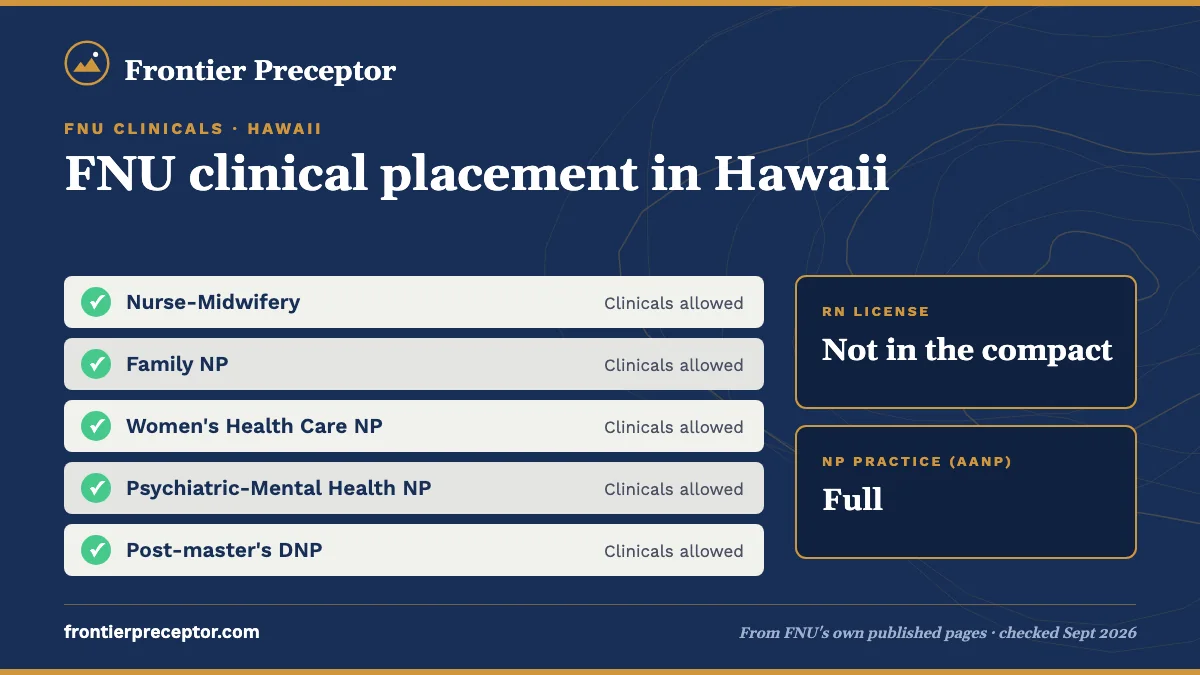
FNU's catalog names the Hawaiian Islands alongside the continental US as the place for MSN and PGC clinicals, so Hawaii is squarely in bounds. The details take more care: Hawaii isn't a compact state, its Board of Nursing hasn't published a position on out-of-state graduate programs, and the state's preceptor tax credit doesn't reach FNU preceptors.
Get your placement plan
Tell us your FNU track and where you live. A placement advisor replies with what a FNU-ready preceptor and site look like for you.
Inside FNU's clinical map, with one caveat
Hawaii is written into FNU's clinical-site rule by name: the catalog allows MSN and PGC clinicals across the continental US and the Hawaiian Islands. No track is excluded, and on FNU's state license list Hawaii is marked as meeting licensure education standards.
The caveat is military sites. The catalog also says military bases not located in the continental US are international and won't be approved. FNU doesn't say how that applies to a base in Hawaii, so ask your Clinical Advisor before you pursue a military facility, and don't assume FNU's any-US-license exception settles it.
What the Hawaii Board of Nursing has said
Hawaii law, HRS 457-13(2), permits nursing incidental to study by students in nursing programs accredited by the Board. For pre-licensure students, the Board's Education Committee agreed in 2016 that an out-of-state BSN program could not place a pre-license student in Hawaii for clinicals.
For post-licensure programs, the Board's FAQ says it doesn't approve out-of-state, online or distance programs that have no Hawaii campus, has no application for them, and doesn't need to be notified. Its examples are LPN-RN and RN-BSN programs. Program faculty need a Hawaii license only if they physically teach or precept a student in Hawaii.
Neither statement addresses graduate or APRN programs. Your Clinical Advisor and FNU's Clinical Credentialing team are the people to confirm how a Hawaii site is cleared.
A Hawaii RN license is the only route
- Hawaii has not joined the Nurse Licensure Compact, and nothing is pending to bring it in.
- A multistate license from another state gives you no practice privilege in Hawaii; you need a Hawaii-issued license.
- Clinical compliance, due the term before Clinical Bound, includes a Nursys Quick Confirm check of that Hawaii license.
- Telehealth with Hawaii patients needs Hawaii licensure, since FNU follows the patient's state, and your track's telehealth cap still applies.
If you're moving to Hawaii mid-program, apply for the license well before your RCF sets a start date. The RN license guide walks through FNU's rule.
The preceptor tax credit, and why it skips FNU
Hawaii's Healthcare Preceptor Income Tax Credit (HRS 235-110.25, created by Act 43 in 2018) gives a nonrefundable credit for each volunteer, uncompensated clinical training rotation, up to a yearly limit. It's open to physicians, osteopathic physicians, APRNs and pharmacists who live in Hawaii and have a primary care practice there, with rotations certified by the Hawaii Department of Health and a statewide cap of 1,500 credits a year.
The credit covers only students in an academic program accredited in or physically located in Hawaii, with more than half its students Hawaii residents. FNU is based in Kentucky, so a preceptor can't claim it for you. Point instead to what FNU gives preceptors directly, from its post-practicum honorarium to CE credit and DynaMed. See the outreach guide.
Honolulu, Kahului-Wailuku and Hilo-Kailua
Urban Honolulu is the main metro at about 989,000 people, with the Kahului-Wailuku metro at about 161,000 and the Hilo-Kailua micropolitan area at about 210,000. Large systems include The Queen's Health Systems, Hawaii Pacific Health (Kapiolani, Pali Momi, Straub and Wilcox), Kaiser Permanente Hawaii and Hawaii Health Systems Corporation. They're examples of where students look, not sites that have agreed to host FNU students.
Midwifery students need at least 8 of their 40 births in a hospital, and FNU notes that some students travel or relocate temporarily to reach the settings they need. No Hawaii-specific midwifery education rule is on record to add.
Why Hawaii FNU students choose us
On your island, we look for a preceptor with a Hawaii license whose practice fits your FNU track, and we get you ready for the CSAF. FNU's approval process runs on its own timeline, so we start early and hand it a complete file. Tell us your island and track.
Questions FNU students ask
Can FNU students do clinicals in Hawaii?
Yes. FNU's catalog names the Hawaiian Islands, along with the continental US, as where MSN and PGC clinicals take place, unlike Puerto Rico, Guam and the US Virgin Islands, which it treats as international. You still need a Hawaii RN license and a site approved by your RCF and credentialed by FNU.
Does my compact license let me do clinicals in Hawaii?
No. Hawaii isn't a Nurse Licensure Compact state, so a multistate license from your home state carries no privilege there. You need a Hawaii-issued RN license, and FNU checks it through Nursys during clinical compliance. Start the application early if you're relocating.
Can my Hawaii preceptor claim the state preceptor tax credit?
Not for an FNU rotation. The credit covers students in programs accredited in or physically located in Hawaii with a majority of Hawaii-resident students, and only uncompensated rotations. FNU is a distance program based in Kentucky with students from every state, and it pays preceptors an honorarium, so an FNU rotation doesn't fit the credit's terms.
Does the Hawaii Board of Nursing need to approve FNU?
Hawaii's published guidance doesn't answer this for graduate programs. The Board has said out-of-state pre-licensure programs can't place students in Hawaii, and that it doesn't approve or need notice from post-licensure distance programs without a Hawaii campus. Ask your Clinical Advisor how FNU handles Hawaii placements before you commit to a site.
Related pages
Last checked 2026-09-23
We check these pages against FNU's own published sources. Your Clinical Advisor, your RCF and FNU's current guidelines have the final word.
Your site submitted before Clinical Bound.
Tell us your FNU track, your county and your Clinical Bound date. We look for a preceptor and site that fit FNU's rules for your track, and help you get the CSAF and credentialing details right.
- Matched to your track: CNM/CM, NP, or the right mix FNU allows
- Ready for the CSAF, the RCF and Clinical Credentialing
- In person near you, or telehealth within FNU's caps
Start your placement plan
A placement advisor replies with what an FNU-ready preceptor and site look like for you.