FNU nurse-midwifery: the preceptor and birth sites you need
FNU's nurse-midwifery track asks you to line up a preceptor who is ideally a CNM or CM, a hospital where at least 8 of your 40 births can happen, and enough clinic time for hundreds of prenatal, postpartum and gynecologic visits. You secure those sites yourself, with FNU's Clinical Advisors and your Regional Clinical Faculty member behind you, and at least one site must be accepted and submitted to Clinical Credentialing before you can register for NM750 Clinical Bound.
Get your placement plan
Tell us your FNU track and where you live. A placement advisor replies with what a FNU-ready preceptor and site look like for you.
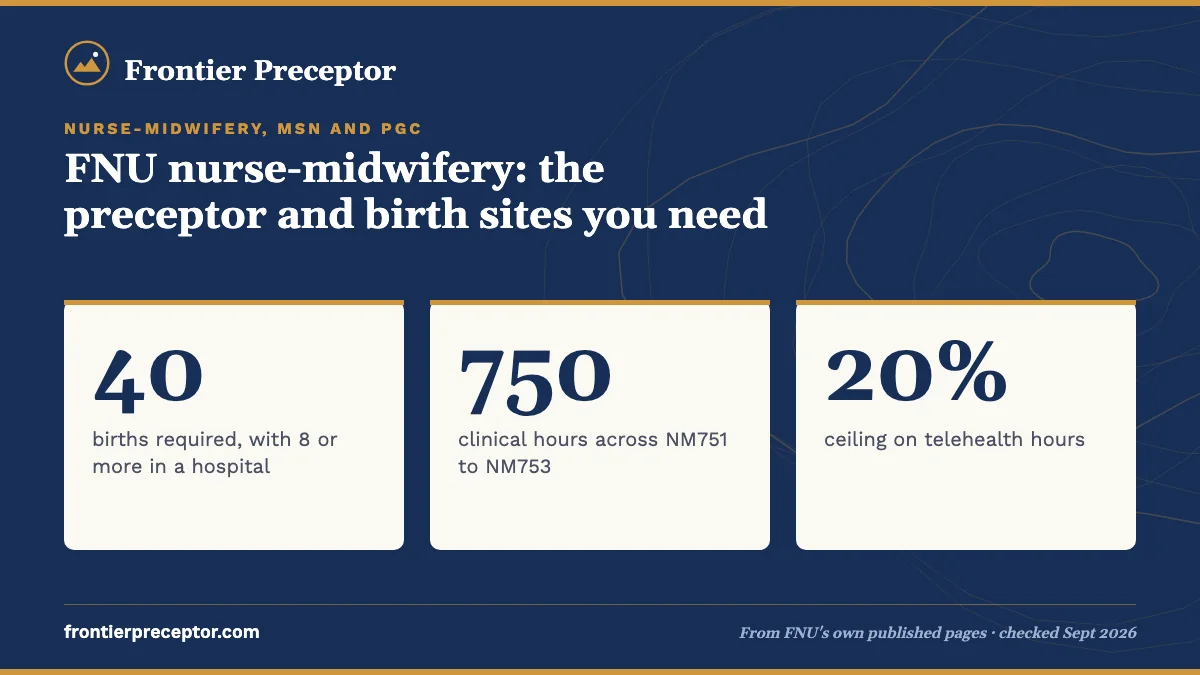
The midwifery track in numbers
FNU's MSN in nurse-midwifery is 55 credits. The full-time Program of Study runs 9 terms with Clinical Bound in term 7, and the part-time sequence runs 12 terms with Clinical Bound in term 10. FNU's program files still call the track CNEP, the name of the distance midwifery program it launched in 1989.
The post-graduate certificate in nurse-midwifery is 42 credits. Full-time, it takes 7 terms and Clinical Bound falls in term 5. The October 2025 part-time table runs to term 10 with Clinical Bound in term 8, although an older sheet labels it 9 terms, so confirm your own sequence with Academic Advising.
Terms are 11 weeks with a two-week break, and FNU has four starts a year. Every new student begins with Frontier Bound, a three-day orientation on the Versailles, Kentucky campus, where Clinical Outreach and Placement switches on your access to the Community Map. In your first term, FNU names your Regional Clinical Faculty member (RCF), and your degree audit sets out a projected Clinical Bound term.
What your 750 hours have to include
Midwifery students who start clinical courses in 2025 or later complete at least 750 clinical hours over 19 weeks of clinical, and FNU recommends planning three terms for it. In practice the counts shape your site plan more than the hours do, because your sites must produce all of these:
- 40 births, of which at least 8 happen in a hospital
- 40 newborn assessments and 40 labor management experiences
- 10 preconception visits, 30 new antepartum visits and 140 return antepartum visits
- 20 breastfeeding support visits
- 40 postpartum visits from 2 hours to 13 days, and 30 more from 2 to 8 weeks
- 40 primary care visits (FNU's website calls them common health problems)
- 30 family planning, 35 gynecologic and 15 perimenopausal or postmenopausal visits
FNU's clinical experience page describes the typical midwifery plan as two clinics and two hospitals. The births and labor counts page explains how each experience is recorded.
NM750 to NM753: the clinical sequence
After your last didactic course, MSN and PGC midwifery students follow the same clinical block. FNU does not publish hours per course, but the catalog sets a minimum number of clinical hours per week for each practicum.
| Course | Credits | What it is | Weekly minimum |
|---|---|---|---|
NM750 | 1 (lab) | Clinical Bound: Transition to Clinical, five days on campus | Not a practicum |
NM751 | 4 | Midwifery Clinical Practicum I (course detail) | 20 hours |
NM752 | 6 | Clinical Practicum II | 28 hours |
NM753 | 5 | Clinical Practicum III | 24 hours |
NM717 | 1 | Final Comprehensive Review (didactic) | Not a practicum |
The weekly minimum is a site question as well as a scheduling one. Your RCF accepts a CSAF only if the site can offer the weekly hours the first clinical course requires. The catalog puts the midwifery ceiling at 40 hours a week, depending on call schedule, while FNU's website says 32, so ask your RCF which figure applies to you.
Who can precept you, and where births can happen
In FNU's catalog, a CNM or CM is the ideal primary preceptor. FNPs, WHNPs, MDs and DOs are permitted as well, and the catalog cites ACME rules requiring in-the-room supervision for every procedure, birth and suturing by an FNU-credentialed CNM, CM or NP, or by a board-certified MD or DO. Every preceptor needs a valid, unencumbered US license and a year in the advanced-practice or medical role. FNU accepts BSN-prepared midwives as preceptors, though it prefers an MSN.
Birth settings carry their own rules. A hospital is required. Births at a birth center or at home are recommended but optional, and a birth center must be accredited by CABC. Home-birth practices go through a separate review by the Clinical Director together with the Director of Clinical Credentialing, sites that offer twin or breech births are ineligible, and a home or birth-center site that offers TOLAC or VBAC needs the VBAC Ineligible Home and Birth Center Experience Attestation.
You cannot rotate with a relative, or at a practice a family or household member owns or runs. The preceptor requirements page sets out the rules for every track.
A birth center or home-birth practice alone cannot finish this track. At least 8 of your 40 births must be in a hospital, so secure a hospital site early instead of adding it last.
Telehealth, certifications and New York
Telehealth plays a small part in midwifery. FNU caps it at 20% of program hours and 30% of any one visit type, and births and labor are excluded. For every telehealth visit you must meet nursing licensure rules in the state where the patient lives; the telehealth page compares the caps across tracks.
Midwifery compliance adds two items to what every track uploads to CastleBranch: neonatal resuscitation certification through an American Academy of Pediatrics course or one the AAP has approved, kept current with every lesson finished, and current fetal heart monitoring education. BLS stays current throughout, and ACLS does not replace it.
New York has its own rule. FNU's approval there covers only six MSN nurse-midwifery students per academic year who are New York residents, and they train in upstate, rural and underserved areas. PGC midwifery students cannot do clinicals in New York at all, apart from federal government facilities. The New York page has the full wording.
What FNU does to help you find sites
FNU is clear that students secure their own clinical sites, and just as clear that it supports them. Clinical Advisors on the Clinical Outreach and Placement team are assigned by track, meet students one-on-one and in small groups, and help you search the Community Map, FNU's database of 20,000-plus active clinical sites and preceptors spread across all 50 states.
Your RCF is one of more than 50 faculty who generally live in the region they cover. The RCF reviews your plan, visits your primary site and grades your clinical work, and RCFs run regional Case Days where you can meet midwives near you. Once your RCF accepts a site, Clinical Credentialing signs the affiliation agreement, exchanges insurance certificates and credentials the preceptor, which FNU says can take several months.
FNU also says rotations can be competitive in some regions, and that some students travel or relocate for part of their clinicals. For a midwifery student that usually means finding a hospital birth site and a CNM or CM preceptor who can both take you in the same terms.
Why midwifery students choose us
Midwifery placements are where thoroughness counts most. We look for CNM or CM preceptors and hospital birth sites near where you live, and we check each lead against FNU's rules before you spend time on it: preceptor role, hospital births, birth-center accreditation, family ties and New York.
When a preceptor agrees, we help you gather the details that go on the CSAF and the site contacts Clinical Credentialing will ask for, and we stay on call if a preceptor withdraws partway through. Your RCF and Clinical Credentialing make every approval decision, and each lead reaches them already screened on all five of those points. Share your projected Clinical Bound term in the form below, or read how it works first.
Questions FNU students ask
Could a nurse practitioner, rather than a CNM, be my primary midwifery preceptor?
Possibly, but it is not FNU's first choice. The catalog names a CNM or CM as the ideal primary preceptor and accepts FNPs, WHNPs, MDs and DOs as alternatives. If no CNM or CM practices near you, raise it with your RCF before you submit a CSAF, since your RCF decides whether the plan works for the track.
Do home births count toward the 40 births FNU requires?
Births at an approved out-of-hospital site can be part of your 40, and FNU recommends out-of-hospital experience without requiring it. The home-birth practice must clear a review by FNU's Clinical Director and its Director of Clinical Credentialing, and it cannot be one that offers twin or breech births. Whatever you attend elsewhere, at least 8 of the 40 must still be hospital births.
Can I do midwifery clinicals at the hospital where I work as a nurse?
Sometimes. FNU tells MSN and PGC students to check their course syllabus and program guidelines, and the facility's own employment policy also decides it. Where it is allowed, FNU requires strict separation between your employment role and your student role. Practicing in an advanced-practice role outside your preceptor's supervision is grounds for automatic dismissal, so keep the two roles clearly apart.
What happens if my midwifery site doesn't have enough births?
The catalog expects you to add a site when one cannot provide enough patient volume, and it warns that this may mean relocating from your community, possibly out of state. Any change of site is agreed with the RCF covering the region you live in. Track your birth count through NM751 and NM752 so a shortfall shows up while there is still time to add a hospital.
When should I start looking for a midwifery preceptor at FNU?
Start early, as FNU advises; credentialing a new site can take several months. FNU staff describe RCF sign-off on the plan coming roughly four to six months ahead of Clinical Bound, so count back from the Clinical Bound term your degree audit projects. For a full-time MSN student, that is term 7.
Related pages
Last checked 2026-09-23
We check these pages against FNU's own published sources. Your Clinical Advisor, your RCF and FNU's current guidelines have the final word.
Your site submitted before Clinical Bound.
Tell us your FNU track, your county and your Clinical Bound date. We look for a preceptor and site that fit FNU's rules for your track, and help you get the CSAF and credentialing details right.
- Matched to your track: CNM/CM, NP, or the right mix FNU allows
- Ready for the CSAF, the RCF and Clinical Credentialing
- In person near you, or telehealth within FNU's caps
Start your placement plan
A placement advisor replies with what an FNU-ready preceptor and site look like for you.