BLS and NRP at FNU: which cards you need and why ACLS won't do
Every FNU MSN and PGC student needs current BLS for adults, pediatrics and infants, and nurse-midwifery students also need neonatal resuscitation certification. ACLS is not a substitute for BLS, and FNU requires neither ACLS nor PALS for any track. Both cards go into CastleBranch and must stay current through the practicum.
Cards ready, preceptor not?
Tell us your track and your projected Clinical Bound term.
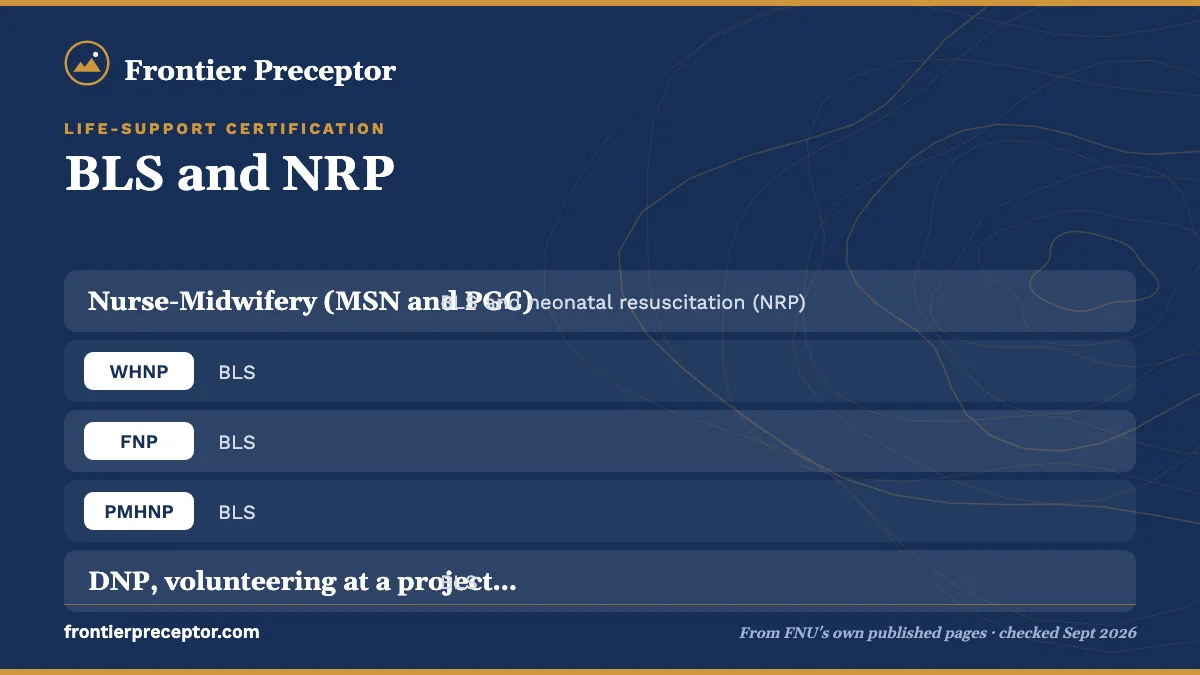
What each track needs
FNU's life-support requirements are short and specific. The catalog sets them out by track, and they are the same for MSN and PGC students in each specialty.
| Track | Required | Notes |
|---|---|---|
| Nurse-Midwifery (MSN and PGC) | BLS and neonatal resuscitation (NRP) | Also current fetal heart monitoring education |
| WHNP | BLS | Also current fetal heart monitoring education |
| FNP | BLS | Nothing further listed |
| PMHNP | BLS | Nothing further listed |
| DNP, volunteering at a project site | BLS | Completed through DNP850 |
ACLS and PALS are not required for any track, and neither can replace BLS. Fetal heart monitoring education is a separate compliance item for midwifery and WHNP students rather than a resuscitation card, but it sits on the same checklist and the same deadline. Vaccines and the health form are covered on immunization requirements.
BLS: the card FNU accepts
The catalog asks for “Certification in Basic Cardiac Life Support (BCLS/BLS) for adults, pediatrics, and infants.” The course must come from the American Heart Association, which FNU prefers, from an approved AHA course provider, or from the American Red Cross.
Two checks prevent a rejected upload. First, confirm the card covers all three age groups; a course limited to adults does not match FNU's wording. Second, confirm who issued it. A card from an AHA-approved training center counts, but a certificate from an online vendor that is none of those three does not fit the catalog's list.
BLS must stay current through clinical, not only on the day you upload it. If your card will expire during the 751, 752 or 753 course, renew it before the practicum starts rather than mid-rotation, when a lapse would leave you out of compliance partway through a course.
Why ACLS does not replace BLS
The catalog closes the BLS requirement with a plain line: “ACLS is not a substitute.” Many applicants hold ACLS through an emergency, ICU or labor and delivery job and assume it covers the basics. FNU treats them as separate certifications, and an ACLS card on its own will not clear the BLS item in CastleBranch.
The reason sits in FNU's own wording. The requirement is BLS for adults, pediatrics and infants, the core resuscitation skills across every age group you may see in family, women's health, psychiatric or midwifery practice. ACLS is an advanced course built on top of BLS rather than a replacement for the BLS card itself. If your employer runs the two together, keep both cards and upload the BLS one.
PALS is not required either. Holding it does no harm, but it does not stand in for BLS any more than ACLS does.
NRP for nurse-midwifery students
Nurse-midwifery students must also maintain current neonatal resuscitation certification “through the American Academy of Pediatrics (AAP) or an AAP approved course,” and the catalog adds that all lessons must be completed. The Clinical Bound prerequisites list describes the certification as offered by the American Academy of Pediatrics and the American Heart Association.
The requirement fits the rest of the midwifery plan. Every midwifery student needs 40 births and 40 newborn assessments, with at least eight births in a hospital, so neonatal resuscitation is a skill you may need on any labor and delivery shift. See midwifery births for the full counts.
If your NRP course has an online part and a hands-on part, finish both before you upload, since FNU asks for every lesson to be complete. WHNP students do not need NRP, but, like midwifery students, they must keep fetal heart monitoring education current.
Timing: getting cards into CastleBranch
Both cards are part of clinical compliance in CastleBranch. Clinical Credentialing emails you in Week 1 of the term before your Clinical Bound term, and the items are due in Week 5. Missing items block registration for Clinical Bound and every course taken with it.
Plan backward from two dates. The first is Week 5 of the term before Clinical Bound, when the card must be valid to upload. The second is the end of your last practicum course, when it must still be valid. A card that covers both avoids a renewal in the middle of a clinical term, when time off to sit a course is hardest to find.
For DNP students volunteering at a project site, BLS sits on the compliance list completed through DNP850, which must be on file before registration for DNP851.
Pairing your certifications with the right site
Certification is yours to book, and we plan the placement around it. A placement advisor seeks out a preceptor and site suited to your track, including, for midwifery students, a hospital birth site where those NRP skills are put to daily use, and puts together with you the details the CSAF and Clinical Credentialing will look for.
FNU approves each site through your RCF and Clinical Credentialing, and with your cards current in CastleBranch and the CSAF complete, that review has what it needs. Contact the placement desk when your search starts.
Questions FNU students ask
Will FNU accept my ACLS card instead of BLS?
No. The catalog says ACLS is not a substitute for BLS. FNU requires BLS certification for adults, pediatrics and infants from the American Heart Association, an approved AHA course provider or the American Red Cross. If you hold ACLS through work, you still need a current BLS card in CastleBranch.
Is Red Cross BLS accepted at FNU?
Yes. The catalog names the American Red Cross alongside the American Heart Association and approved AHA course providers. FNU says the AHA is preferred, so if you are taking a new course anyway, an AHA course is the safer choice. Either way, the card must cover adults, pediatrics and infants.
Is an online-only BLS course accepted by FNU?
FNU's catalog does not address course format directly. It names the sources it accepts: the American Heart Association, an approved AHA course provider or the American Red Cross. A certificate from any other online vendor does not fit that list. If you are unsure about a blended course from one of those three, ask Clinical Credentialing before booking.
Do FNP or PMHNP students need NRP?
No. FNU's catalog lists neonatal resuscitation certification only for nurse-midwifery students. FNP, PMHNP and WHNP students need BLS only, though WHNP students also need current fetal heart monitoring education. None of the tracks requires ACLS or PALS, but an individual clinical site can still set extra requirements, so ask before you commit.
Does my BLS have to be current for the whole practicum?
Yes. FNU's rule is that BLS stays current through clinical, not just at the compliance deadline. Check the expiry date on your card against the end of your final practicum course, and renew before clinicals start if it would lapse partway through. The same applies to NRP for midwifery students.
Which NRP course does FNU accept?
The catalog asks for neonatal resuscitation certification through the American Academy of Pediatrics or an AAP-approved course, with all lessons completed. The Clinical Bound prerequisites list describes it as offered by the AAP and the American Heart Association. If you are unsure whether a provider qualifies, ask Clinical Credentialing before you book.
Related pages
Last checked 2026-09-23
We check these pages against FNU's own published sources. Your Clinical Advisor, your RCF and FNU's current guidelines have the final word.
Your site submitted before Clinical Bound.
Tell us your FNU track, your county and your Clinical Bound date. We look for a preceptor and site that fit FNU's rules for your track, and help you get the CSAF and credentialing details right.
- Matched to your track: CNM/CM, NP, or the right mix FNU allows
- Ready for the CSAF, the RCF and Clinical Credentialing
- In person near you, or telehealth within FNU's caps
Start your placement plan
A placement advisor replies with what an FNU-ready preceptor and site look like for you.