FNU midwifery births: 40 births, 8 in a hospital, 40 labors
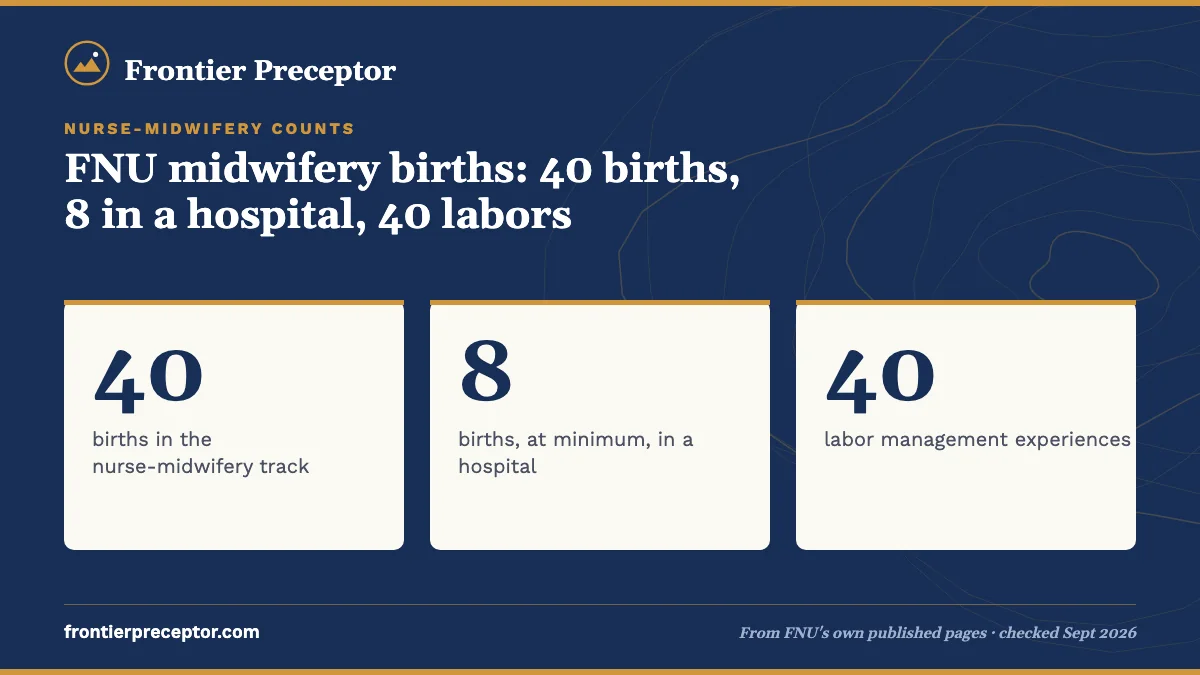
FNU's nurse-midwifery track asks for 40 births, at least eight of them in a hospital, plus 40 labor management experiences and 40 newborn assessments. Those sit alongside the 750 clinical hours and ten other visit counts. Because births depend on a labor and delivery setting, they tend to decide which sites you need, so plan them first.
Short on a birth site?
Tell us where you live and your Clinical Bound term. A placement advisor will reply by email.
The intrapartum numbers
The catalog and FNU's clinical experience page agree on the core intrapartum counts. Births, labors you manage and newborns you assess are three separate lines on your record, each with its own target of 40.
| Requirement | Number | Condition FNU attaches |
|---|---|---|
| Births | 40 | At least 8 in a hospital clinical setting |
| Labor management experiences | 40 | Excluded from the telehealth allowance |
| Newborn assessments | 40 | Counted separately from births |
Hospital birth experience is a requirement, not a preference. Out-of-hospital births are recommended but not required. What stays fixed is the hospital floor: at least eight of your 40 births must take place in a hospital, whatever else your plan includes.
These numbers are for the whole practicum, not for one course. FNU does not publish how many births belong to NM751, NM752 or NM753, so your syllabus and RCF set the pace.
The rest of the midwifery list
Births are the hardest numbers to schedule, but they are only part of the requirement. FNU's clinical experience page lists ten more visit types, covering care from preconception through menopause, all to be met within the same practicum.
| Visit type | Required |
|---|---|
| Preconception care | 10 |
| New antepartum | 30 |
| Return antepartum | 140 |
| Breastfeeding support | 20 |
| Postpartum, 2 hours to 13 days | 40 |
| Postpartum, 2 to 8 weeks | 30 |
| Common health problems (the catalog calls these primary care visits) | 40 |
| Family planning | 30 |
| Non-postpartum gynecologic | 35 |
| Perimenopausal or postmenopausal | 15 |
Early postpartum visits can often be seen in the hospital where you attend births, while prenatal, family planning and gynecologic visits tend to come from a clinic or office. That matches FNU's own description of a typical midwifery plan: up to four sites, usually two clinics and two hospitals.
Birth settings FNU will and will not approve
Every birth site goes through the same CSAF, RCF review and credentialing as any other clinical site. Some settings carry extra conditions on top of that.
- Hospitals: required. Your plan must include a hospital birth site that can give you at least eight births.
- Birth centers: must hold CABC accreditation.
- Home birth practices: need a review by both the Clinical Director and the Director of Clinical Credentialing.
- Home birth sites that offer twin or breech births: ineligible.
- Home birth sites that offer TOLAC or VBAC: come with an extra form, the VBAC Ineligible Home and Birth Center Experience Attestation.
If you hope to include a home birth or birth center practice, raise it with your RCF early, because those sites pass an extra review before they can join your plan. A hospital-based plan avoids that step but still needs a CNM or CM, or another approved clinician, who will supervise you in the room.
Who must be in the room
The catalog applies ACME rules that require in-the-room supervision for every procedure, birth and suturing. The supervising clinician must be FNU-credentialed and be an NP, CNM, CM, or board-certified MD or DO.
FNU's preferred primary preceptor is a CNM or CM. FNPs, WHNPs, MDs and DOs may also precept midwifery students, and CNM preceptors can be approved without a master's degree; FNU's preceptor page says it allows a BSN for midwives but prefers an MSN. Any preceptor must hold an unencumbered US license and have a year's relevant experience in the role.
Some procedures stay off your list whatever your background, vacuum deliveries among them. The full rules on who can precept are on the preceptor requirements page.
Building a site mix that reaches 40
Birth volume differs a great deal from one hospital to the next, and FNU expects you to add sites when one cannot supply enough patients. Midwifery students may use up to four sites unless the RCF approves more. Weekly hours follow the call schedule: the catalog caps clinic and office time at 40 hours a week, while FNU's website gives 32.
Distance is part of the picture. FNU says most students complete clinicals near home, but that travel or a temporary move is sometimes necessary, and the catalog warns a move may be out of state. In FNU's 2026 Preceptor Scholarship report, a Texas midwifery student describes a 330-mile trip each way, every other week, because there are no local CNMs.
Telehealth cannot close a birth gap. Midwifery students may count up to 20% of hours by telehealth, but births and labor are excluded; see telehealth hours for the rest. New York residents face a separate limit of six MSN midwifery students a year, explained on the New York page.
Certifications to finish before your first birth
Midwifery adds two items to the standard clinical compliance list. Both are tracked in CastleBranch before Clinical Bound, and missing items block registration for Clinical Bound.
- Neonatal resuscitation certification from the American Academy of Pediatrics or a course it approves, with every lesson finished.
- Current fetal heart monitoring education, which WHNP students also need.
- BLS for adults, children and infants, kept current through clinical. ACLS does not substitute.
- The rest of the standard list, from the clinical background check to the FNU Student Health Verification Form, each no older than 12 months during the practicum.
Our BLS and NRP page covers providers and timing in more detail. Credentialing's first email arrives in Week 1 of the term before your Clinical Bound term, and materials are due by Week 5, so the neonatal resuscitation course needs to be booked well before that window opens.
Birth sites first: how we search
Because births drive the rest of the plan, our midwifery searches start with hospital labor and delivery settings where a CNM or CM can supervise you in the room, then look for clinic sites to carry prenatal, family planning and gynecologic visits. We keep FNU's setting rules in view, so any home birth lead that takes breech or twin births is screened out before it reaches you.
We also help you gather what the CSAF and FNU's credentialing team will want to know about each birth site and preceptor, and if a birth site falls through partway, we search again. Approval stays with your RCF and FNU's credentialing team, and each birth site we bring is picked to meet the standard they apply. Tell us where you live and which term your Clinical Bound falls in.
Questions FNU students ask
Does a birth I only observed count toward the 40?
No. Under the catalog, a visit you only watched is not counted toward required experiences, and births are one of those experiences. The exception FNU lists covers PMHNP therapy visits, not midwifery. Log only births you took part in under in-the-room supervision, and ask your RCF if you are unsure how a particular birth should be recorded.
Can all 40 of my births happen in a hospital?
Under the published rule, yes. FNU requires hospital birth experience with at least eight hospital births, and recommends out-of-hospital births without requiring them. A hospital-only plan meets the written requirement if your RCF accepts the sites. FNU notes some students want a birth center experience; any birth center must hold CABC accreditation.
Can an obstetrician supervise my births instead of a midwife?
Within limits. The catalog lets MDs and DOs precept midwifery students, and board-certified MDs and DOs are among the clinicians who may supervise births in the room. FNU still prefers a CNM or CM as your primary preceptor, so talk to your RCF before submitting a CSAF for a plan built mostly on physicians.
Does FNU require continuity of care in the midwifery track?
FNU's public materials set no separate continuity-of-care rule beyond the visit counts and the hospital birth minimum. That does not rule one out in your course. The program guidelines are not public, so check your practicum syllabus in Canvas and ask your RCF before building your plan around it.
Can I do a vacuum delivery if I have assisted with them as a nurse?
No. The catalog lists procedures students may not perform even if they already know how, and vacuum deliveries are on it, along with ultrasound and colposcopy. The list applies to you as an FNU student whatever your RN experience or your preceptor's view. Ask your RCF for the complete list before your first clinical day.
Related pages
Last checked 2026-09-23
We check these pages against FNU's own published sources. Your Clinical Advisor, your RCF and FNU's current guidelines have the final word.
Your site submitted before Clinical Bound.
Tell us your FNU track, your county and your Clinical Bound date. We look for a preceptor and site that fit FNU's rules for your track, and help you get the CSAF and credentialing details right.
- Matched to your track: CNM/CM, NP, or the right mix FNU allows
- Ready for the CSAF, the RCF and Clinical Credentialing
- In person near you, or telehealth within FNU's caps
Start your placement plan
A placement advisor replies with what an FNU-ready preceptor and site look like for you.