NM751, NM752 and NM753: FNU's nurse-midwifery practicum
FNU's nurse-midwifery practicum is three clinical courses, NM751 (4 credits), NM752 (6) and NM753 (5), taken after the five-day NM750 Clinical Bound. Across them you complete 750 clinical hours, 40 births and the rest of the midwifery counts. FNU publishes the hours for the track, not for each course.
Planning NM751 to NM753?
Tell us where you live and your projected Clinical Bound term. A placement advisor will reply by email.
The courses as FNU lists them
FNU's October 2025 programs of study give the MSN and the post-graduate certificate the same midwifery clinical block. The PGC sheets title the practicum courses slightly differently, shown in brackets below.
| Course | Title | Credits | Type |
|---|---|---|---|
NM750 | NM CB: Transition to Clinical (the five-day Clinical Bound) | 1 | Lab |
NM751 | Midwifery Clinical Practicum I (PGC: Nurse-Midwifery Clinical I) | 4 | Clinical |
NM752 | NM Clinical Practicum II (PGC: Nurse-Midwifery Clinical II) | 6 | Clinical |
NM753 | NM Clinical Practicum III (PGC: Nurse-Midwifery Clinical III) | 5 | Clinical |
NM717 | NM Final Comprehensive Review | 1 | Didactic |
Before this block come the midwifery didactic courses, NM700 through NM706, and for MSN students a shared core that includes PC705, PC707 and PC716. Clinical Bound falls in term 7 of the full-time MSN sequence and term 10 of the part-time one. In the PGC it falls in term 5 full-time and term 8 part-time.
Hours: the track total and the weekly floor
For students starting clinical courses in 2025 or later, the midwifery practicum is 750 clinical hours and 19 weeks of clinical, the same total as FNU's other tracks. FNU's public course listings do not assign hours to NM751, NM752 or NM753 individually, so plan from the track total and the weekly floors below.
What the catalog does set is a minimum number of hours a week in each course, which your sites must be able to offer.
| Course | Minimum clinical hours per week |
|---|---|
NM751 | 20 |
NM752 | 28 |
NM753 | 24 |
The weekly ceiling for midwifery depends on your call schedule: the catalog says 40 hours of clinic or office time, while FNU's website says 32. Ask your RCF which figure applies, especially if a hospital site expects long call shifts. The clinical hours page explains what counts toward the total.
The midwifery counts across all three courses
Visit counts apply to the practicum as a whole. FNU does not publish which course each count belongs to, so choose sites that can feed every line from the start rather than saving whole categories for NM753.
| Area | Required counts |
|---|---|
| Labor and birth | 40 births (at least 8 in a hospital), 40 labor management experiences, 40 newborn assessments |
| Before and during pregnancy | 10 preconception, 30 new antepartum, 140 return antepartum |
| After birth | 20 breastfeeding support, 40 postpartum (2 hours to 13 days), 30 postpartum (2 to 8 weeks) |
| Gynecology and primary care | 30 family planning, 35 non-postpartum gynecologic, 15 perimenopausal or postmenopausal, 40 common health problems |
Birth settings carry rules of their own, from CABC accreditation for birth centers to the exclusion of home birth sites that take breech or twin births. Those details sit on the midwifery births page.
Preceptors for the midwifery practicum
- FNU wants a CNM or CM as your main preceptor where one is available, with FNPs, WHNPs and physicians (MD or DO) also allowed.
- The catalog's baseline for any preceptor is an unencumbered US license to practice and a year of relevant experience in an advanced practice or medical role.
- The general rule asks for a master's degree or higher, but CNM preceptors may be approved without one. FNU accepts a BSN for midwives and prefers an MSN.
- Procedures, births and suturing need in-the-room supervision by an FNU-credentialed NP, CNM, CM, or board-certified MD or DO.
- A family or household member may not precept you, and sites owned or run by one of them, or part-owned by you, are excluded.
- Each preceptor completes a DDAT once a week. Midwifery students add a mid-course MDAT and an end-of-course EDAT in every practicum course.
Preceptor orientation includes FNU's The Gift of Precepting course and its preceptor guide, so a first-time preceptor has material to work from. See who can precept for the rules across all tracks.
Sites, telehealth and state limits
You may use up to four clinical sites unless your RCF approves more, and FNU describes the typical midwifery mix as two clinics and two hospitals. Telehealth may cover no more than 20% of program hours and 30% of any visit type, and births and labor are excluded from it.
Clinicals must take place in the continental US or Hawaii; FNU treats US territories as international sites and does not approve them. You need an RN license, or compact eligibility, for every state your sites are in. If one site cannot give you the volume, the catalog expects you to add another, which may mean relocating.
New York has a midwifery-specific carve-out. Six MSN nurse-midwifery students who are New York residents may do clinicals in upstate, rural and underserved areas each academic year. PGC midwifery students may not do clinicals there, apart from federal facilities. The New York page covers the detail.
What must be cleared before your first clinical day
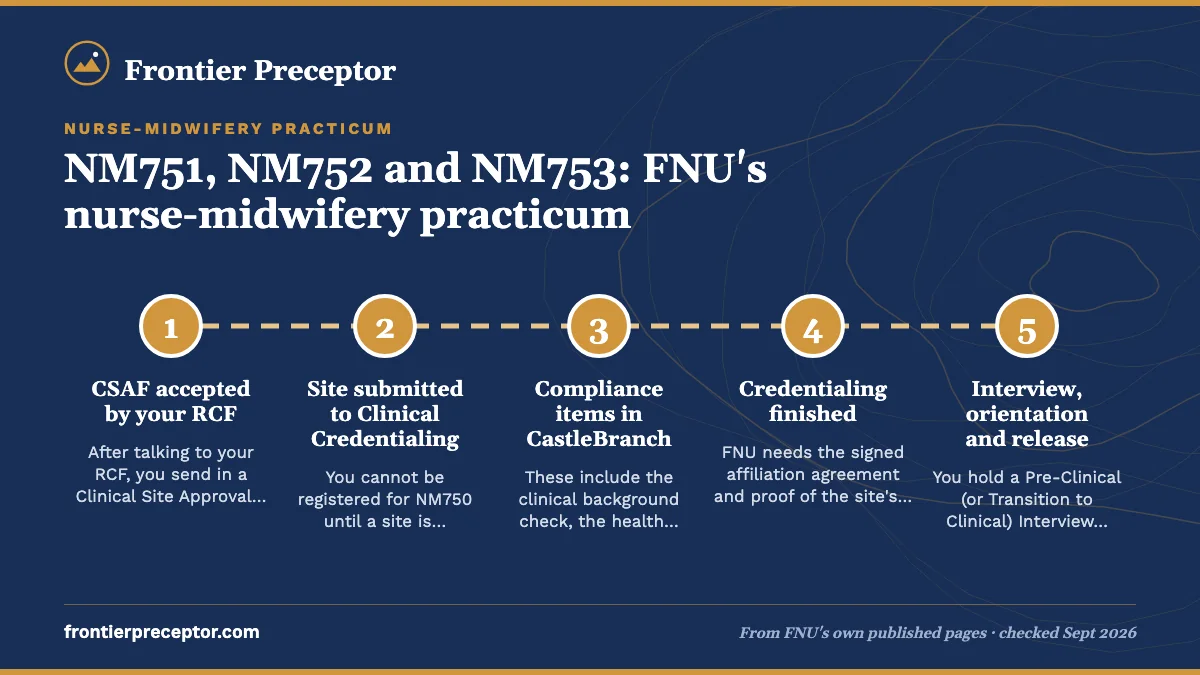
- CSAF accepted by your RCFAfter talking to your RCF, you send in a Clinical Site Approval Form for each site through the Community Map. Once the RCF accepts at least one site, you get a Clinical Bound date.
- Site submitted to Clinical CredentialingYou cannot be registered for
NM750until a site is identified and submitted to credentialing. The catalog also asks for a complete plan covering all visit types and hours. - Compliance items in CastleBranchThese include the clinical background check, the health verification form, BLS, neonatal resuscitation certification and fetal heart monitoring education. Items are requested in Week 1 of the term before Clinical Bound and due in Week 5.
- Credentialing finishedFNU needs the signed affiliation agreement and proof of the site's liability insurance, your preceptor fully credentialed, and any required Pre-Clinical Site Visit booked or done.
- Interview, orientation and releaseYou hold a Pre-Clinical (or Transition to Clinical) Interview with the RCF, meet each preceptor for orientation, attend Clinical Bound, then wait for the RCF's final release.
FNU treats any clinical start before site and preceptor credentialing are complete as grounds for dismissal, even when a preceptor is ready to go.
Searching for the midwifery sequence
For midwifery students, we search for a birth site first and then for the clinic time that carries prenatal, family planning and gynecologic visits, keeping inside FNU's four-site limit. We look for CNM or CM preceptors where they practice and tell you plainly when an area has few. We then help you put together the preceptor and site details each CSAF and Clinical Credentialing ask for, and where a hospital lists onboarding requirements of its own, we pass those on so you can plan for them.
Site approval runs on FNU's timeline through your RCF and Clinical Credentialing, so we start early and keep the paperwork moving. If a preceptor leaves between NM751 and NM753, a new search starts with you right away. Send a request with your projected Clinical Bound term and the area you can travel within.
Questions FNU students ask
How many clinical hours is NM751?
FNU does not publish a total for NM751 or for either of the other practicum courses. It publishes the 750-hour track total, the 19 weeks of clinical and a weekly minimum of 20 hours during NM751. Your course syllabus in Canvas and your RCF are the right places to check what that course expects.
Do I need a new CSAF if I change sites between NM752 and NM753?
Yes. Each clinical site needs its own Clinical Site Approval Form, so a new site means a new CSAF, RCF acceptance and credentialing before you start there. The catalog says site changes are made in consultation with the RCF for the region where you live. Credentialing can take several months, so raise a change early.
Is the midwifery practicum the same for MSN and PGC students?
The courses and credits match: NM750 through NM753, then NM717. The PGC programs of study use slightly different course titles, and PGC students reach Clinical Bound in fewer terms. The main clinical difference is New York, where only MSN midwifery residents may train. Our MSN versus PGC comparison covers the rest.
Can an FNP or WHNP be my main preceptor in the midwifery practicum?
FNU allows FNPs and WHNPs to precept midwifery students, though its first preference for a primary preceptor is a CNM or CM. An FNU-credentialed NP can supervise births and procedures in the room. If no CNM or CM practices near you, tell your RCF early; the catalog lets the Clinical Director, together with the Department Chair and the credentialing director, approve exceptions.
What is NM717, and does it need a clinical site?
NM717 is the NM Final Comprehensive Review, a one-credit didactic course listed with the clinical block in FNU's programs of study. It carries no clinical hours, so it needs no site or preceptor and does not affect your CSAF planning. Check Canvas for when it falls in your own sequence.
Related pages
Last checked 2026-09-23
We check these pages against FNU's own published sources. Your Clinical Advisor, your RCF and FNU's current guidelines have the final word.
Your site submitted before Clinical Bound.
Tell us your FNU track, your county and your Clinical Bound date. We look for a preceptor and site that fit FNU's rules for your track, and help you get the CSAF and credentialing details right.
- Matched to your track: CNM/CM, NP, or the right mix FNU allows
- Ready for the CSAF, the RCF and Clinical Credentialing
- In person near you, or telehealth within FNU's caps
Start your placement plan
A placement advisor replies with what an FNU-ready preceptor and site look like for you.