FNU MSN or post-graduate certificate: what changes on the clinical side
Which route you can take depends mostly on your degree: the MSN is for registered nurses with a bachelor's, and the post-graduate certificate is for nurses who already hold a master's in nursing. Clinically the two are nearly identical. The real differences are how soon you reach Clinical Bound, one New York rule for midwifery, and some older figures that still circulate.
Get your placement plan
Tell us your FNU track and where you live. A placement advisor replies with what a FNU-ready preceptor and site look like for you.
The short answer
If you hold a BSN, FNU admits you to the MSN directly. An RN with an associate degree is considered for the MSN only with a bachelor's in another field and a portfolio. If you already have a master's or higher in nursing from an accredited program, the post-graduate certificate (PGC) is the route built for you.
Once you reach clinicals, FNU's requirements for the two are almost entirely the same. Both take the same Clinical Bound course and the same three practica, owe the same 750 hours, meet the same visit counts and work under the same preceptor rules. The practical difference is time: with less coursework ahead of it, a PGC student's Clinical Bound arrives sooner, and so does the deadline for a preceptor.
Every MSN and PGC track has a full-time and a part-time Program of Study. FNU says these are organized around how long you choose to take, not strictly around full-time or part-time status.
Side by side
Figures come from FNU's October 2025 Programs of Study and current admissions pages. Credits are listed in the order nurse-midwifery, FNP, WHNP and PMHNP.
| MSN | PGC | |
|---|---|---|
| Who can apply | RN with a BSN, or an ADN plus a non-nursing bachelor's and a portfolio | Nurse with a master's or higher in nursing |
| Credits | 55, 52, 49, 48 | 42, 39, 36, 35 |
| Clinical Bound, full-time | Term 7 of 9 (midwifery) or term 6 of 8 | Term 5 of 7 (midwifery) or term 4 of 6 |
| Clinical Bound, part-time | Term 10 of 12 | Term 8 of 10 (midwifery) or term 7 of 9 |
| Clinical courses | Same block: NM750 to NM753, FNP750 to FNP753, WH750 to WH753, MH750 to MH753 | Same block |
| Clinical hours (starting 2025 or later) | 750 over 19 weeks | 750 over 19 weeks |
| New York clinicals | Six New York-resident nurse-midwifery students a year; NP tracks only at federal government facilities | None, except federal government facilities |
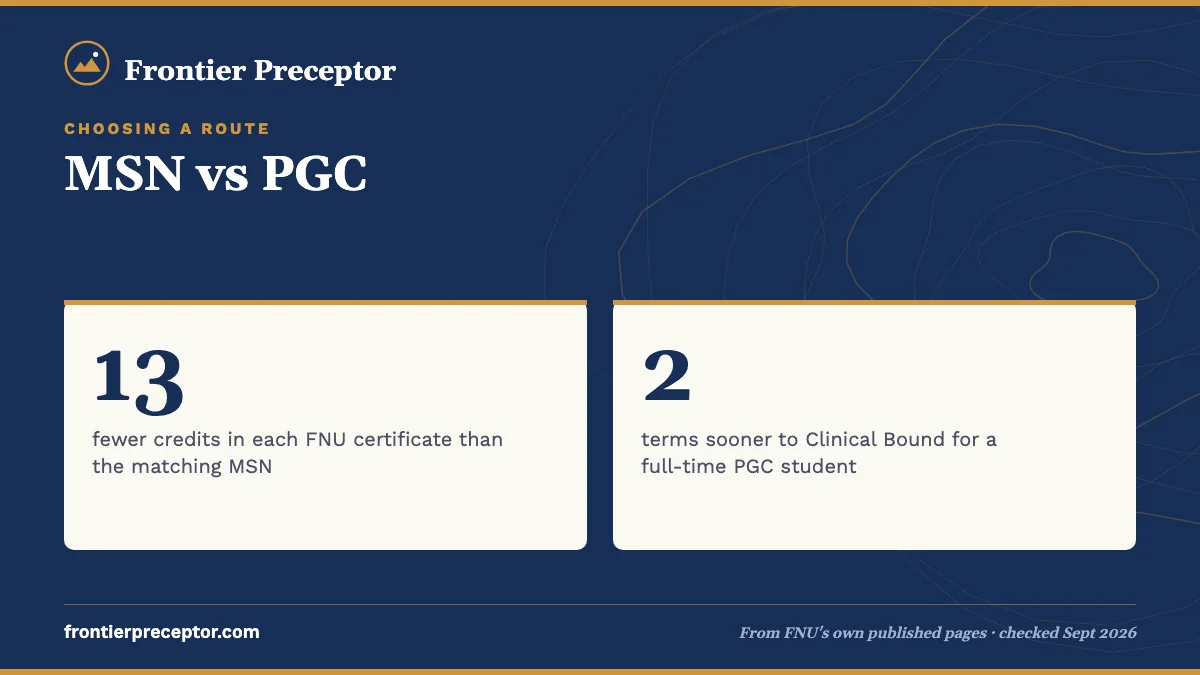
The 13-credit gap on every track is the MSN core: PC701, PC705, PC707 and PC716. A PGC student without equivalent graduate coursework may have PC705, PC707 and PC716 added, which narrows the gap.
What a shorter didactic phase does to your search
The clock is where the credential shows. A full-time FNP, WHNP or PMHNP student on the MSN spends five terms in coursework before Clinical Bound; on the PGC, three. Because FNU staff place the RCF's sign-off four to six months out from Clinical Bound, and credentialing a site can stretch over months, a PGC student's working window for finding a preceptor is much shorter.
On both routes the Program of Study lists CSAF submission as a didactic-phase milestone, well ahead of the Clinical Bound term, and FNU's advice to find preceptors early applies to both. Registration for Clinical Bound stays blocked until at least one site is identified and in Clinical Credentialing's hands.
MSN students gain time but not an exemption. A five-term runway is easy to spend on coursework, and a student who reaches registration without a complete clinical plan may be moved to an Academic Hiatus. The placement timeline page walks through the dates.
What stays identical
These parts of FNU's clinical experience do not depend on whether you enrolled in the MSN or the PGC:
- Frontier Bound, the three-day orientation, and Clinical Bound, the five-day skills intensive, both in Versailles, Kentucky
- An RCF assigned in your first term, and a projected Clinical Bound term on your degree audit
- The CSAF submitted through the Community Map, RCF acceptance, then Clinical Credentialing
- Weekly hour floors for the three practica: 20, then 28, then 24
- Your track's visit counts, preceptor rules and site limits
- Telehealth limits by track: percentage caps for midwifery, WHNP and FNP, and an hour cap for PMHNP
- Compliance through CastleBranch, including BLS for every track and neonatal resuscitation for midwifery
- Professional liability insurance, which FNU provides for clinical students during the practicum
Where the credential does change things
New York is the clearest case. FNU's limited approval there extends to six MSN nurse-midwifery students a year, all New York residents, who train in the state's upstate, rural and underserved areas. A PGC midwifery student living in New York has no such path and trains in another state, as do all FNP, WHNP and PMHNP students on either route. The New York page has the exact wording.
History is the other. Before 2025 the MSN required 675 clinical hours over 16 weeks and the PGC 540 over 14, and earlier PMHNP cohorts had different telehealth caps for each credential. Those differences are gone for anyone starting clinicals in 2025 or later, but older advice still repeats them.
Tuition is charged per credit, so the PGC's lower credit count affects cost, and the PMHNP rate differs from the other tracks. FNU's tuition page has the current figures.
Full-time or part-time matters as much
For clinical planning, the pace you pick can matter as much as the credential. A part-time MSN student reaches Clinical Bound in term 10, a full-time PGC student on an NP track in term 4. FNU estimates full-time study at about 40 hours a week and part-time at about 30, and practicum weeks carry a minimum of 20 to 28 clinical hours, with up to 40 allowed.
If your work schedule cannot bend, factor that into the pace now rather than at Clinical Bound. FNU allows academic hiatus by petition, but caps it at two hiatus terms within any 365-day span. If your projected Clinical Bound term moves for any reason, FNU expects you to notify four people: your RCF, each preceptor, your Clinical Credentialing Coordinator and your Academic Advisor.
Once your route is set
Our service starts working for you once you know your track. The choice between MSN and PGC is one to settle with FNU Admissions. For the certificate route in detail, see the post-graduate certificate page.
Once you are enrolled, we search for preceptors and sites that fit your track near where you live, help you get ready what the CSAF and Clinical Credentialing need, and stay on call if a preceptor withdraws. Each site needs approval from FNU's RCF and Clinical Credentialing, and ours reach them measured against your track's rules. Tell us your likely Clinical Bound term as well, since it sets how much time the search has. Choose "Not sure yet" on the contact form if you are still between routes.
Questions FNU students ask
Is it easier to find a clinical placement in FNU's PGC than in the MSN?
No. The clinical requirements are the same, so a preceptor who works for an MSN student works for a PGC student on the same track, and the reverse. What differs is lead time. A full-time PGC student reaches Clinical Bound two terms sooner, so the same search has to happen in a shorter window.
Which is faster at FNU, the MSN or the post-graduate certificate?
The certificate, because it drops the MSN core. FNU's older Programs of Study label the full-time NP-track PGC as 18 months over 6 terms and the matching MSN as 24 months over 8. The clinical phase does not shrink: both routes owe 750 hours.
Can I apply to FNU's post-graduate certificate with an ADN?
No. The certificate is open only to nurses who already hold an accredited master's or higher in nursing. An RN with an associate degree can be considered for FNU's MSN only if they also hold a bachelor's degree in another discipline and submit a portfolio. FNU's current Programs of Study list no separate ADN bridge.
Do I need labor and delivery experience for FNU's midwifery MSN?
FNU's MSN admissions criteria list no specialty experience such as labor and delivery. They ask for one year of registered nursing experience, and with less than a year the committee may consider other significant health care experience, including work as a doula, childbirth educator or lactation consultant. FNU builds those skills later, at Clinical Bound and in the practica.
Can I go on to a DNP after either route?
Yes. FNU's DNP page says MSN and PGC graduates may consider its Post-Master's DNP. A Companion DNP for FNU graduates also appears on FNU's tuition page, and its Program of Study counts 9 credits completed in the FNU MSN, but because it is absent from the current Programs of Study list, check with Admissions before counting on it.
Related pages
Last checked 2026-09-23
We check these pages against FNU's own published sources. Your Clinical Advisor, your RCF and FNU's current guidelines have the final word.
Your site submitted before Clinical Bound.
Tell us your FNU track, your county and your Clinical Bound date. We look for a preceptor and site that fit FNU's rules for your track, and help you get the CSAF and credentialing details right.
- Matched to your track: CNM/CM, NP, or the right mix FNU allows
- Ready for the CSAF, the RCF and Clinical Credentialing
- In person near you, or telehealth within FNU's caps
Start your placement plan
A placement advisor replies with what an FNU-ready preceptor and site look like for you.