WH751, WH752 and WH753: FNU's women's health NP practicum
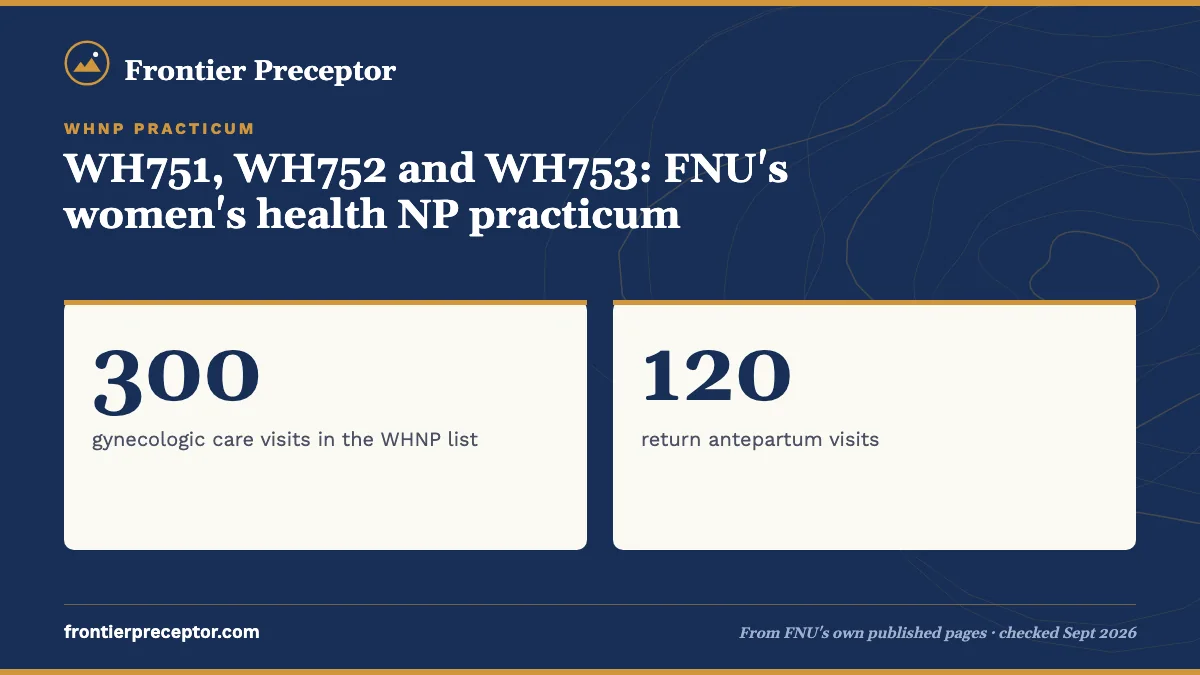
FNU's Women's Health Care NP students begin clinicals with the five-day WH750 Clinical Bound, then complete WH751 (4 credits), WH752 (6) and WH753 (5). The practicum carries 750 clinical hours and a visit list weighted toward gynecology and prenatal care, with 300 gynecologic visits alone. FNU does not break the hours down by course.
Planning WH751 to WH753?
Tell us where you live and your projected Clinical Bound term. A placement advisor will reply by email.
WH750 to WH753 in FNU's programs of study
The WHNP clinical block has the same shape as FNU's other tracks: a one-credit Clinical Bound lab, three practicum courses worth 15 credits between them, and a final review. The PGC sheets use "WHNP" in two titles where the MSN uses "WH".
| Course | Title | Credits | Type |
|---|---|---|---|
WH750 | WH CB: Transition to Clinical (PGC: WHNP CB), the five-day Clinical Bound | 1 | Lab |
WH751 | WH Clinical Practicum I (PGC: WHNP Clinical Practicum I) | 4 | Clinical |
WH752 | WHNP Clinical Practicum II | 6 | Clinical |
WH753 | WHNP Clinical Practicum III | 5 | Clinical |
WH717 | WHNP Final Comprehensive Review | 1 | Didactic |
The WHNP didactic sequence, WH700, NM702, NM703, NM701 and WH707 plus PC719, includes three courses shared with the midwifery track. MSN students also take PC701, PC705, PC707 and PC716. WHNP students reach Clinical Bound after five full-time MSN terms or nine part-time ones; PGC students reach it in term 4 (full-time) or term 7 (part-time).
Hours and weekly limits
WHNP students who begin clinical courses in 2025 or later need 750 clinical hours and 19 weeks of clinical. FNU has not published how many of those hours fall in WH751, WH752 or WH753, so treat the total as one target across the three courses.
The catalog does set weekly minimums: 20 hours a week in WH751, 28 in WH752 and 24 in WH753. FNU's website adds limits of 10 clinic hours a day and 40 a week. A women's health practice with short clinic days, or a preceptor who works part-time, may not reach the WH752 floor alone, so ask about schedules before a CSAF goes in.
Time spent observing at a specialty site is not counted toward WHNP hours, and observed-only visits are left out of your required numbers. See what counts toward hours for the full rules.
The WHNP visit list
Six lines make up the WHNP requirement. The gynecologic target of 300 is the largest on the list, so it tends to decide your main site. The counts belong to the practicum as a whole; FNU does not say which of WH751, WH752 or WH753 each should come from, so start feeding every line early.
| Visit type | Required |
|---|---|
| New antepartum | 30 |
| Return antepartum | 120 |
| Postpartum, under 8 weeks | 25 |
| Gynecologic care | 300 |
| Perimenopausal or postmenopausal | 25 |
| Primary care | 100 |
The 100 primary care visits deserve the same attention as the gynecologic ones. Ask a prospective women's health site how many of its visits would count as primary care, and plan a second site if the answer is few. The prenatal and postpartum lines can come from the same practice if it runs an obstetric clinic.
Who can precept WHNP students
The catalog names a Women's Health Nurse Practitioner as the preferred primary preceptor. CNMs, CMs, FNPs, other WHNPs, MDs and DOs may also precept, and MD- or DO-supervised visits still count toward your required numbers.
- All preceptors need an unencumbered US license and at least one year of relevant advanced practice or medical experience.
- A master's or higher in a nursing-related field is the norm for nurse preceptors, though CNMs may be approved without one.
- Relatives cannot precept you, and FNU excludes sites a relative or household member owns or runs, as well as any you part-own.
- Each preceptor completes a weekly DDAT, and WHNP students send the MDAT midway through each course and the EDAT close to its end.
If there is no WHNP within reach, talk to your RCF before naming a CNM or physician as your primary preceptor. The preceptor requirements page explains how FNU handles exceptions.
Site count, telehealth and states
Here FNU's own sources disagree. The catalog allows WHNP students no more than three clinical sites, while FNU's clinical experience page says four. The August 2026 catalog revision is the more recent source, so plan on three unless your RCF confirms a fourth.
Telehealth may account for up to 20% of program hours, with no more than 30% of any visit type. The telehealth page shows what that means against 300 gynecologic visits.
Clinicals must be in the continental US or Hawaii, and you need an RN license or compact eligibility for every state you train in. WHNP students may not do clinicals in New York apart from federal government facilities there. If a site's volume falls short, the catalog expects you to add one, which may mean relocating.
Cleared before your first WH751 shift
Each item below has an owner. Until every one is done, you cannot see patients as a WHNP student.
| Item | Who handles it |
|---|---|
| A Clinical Site Approval Form for each site, submitted through the Community Map | You submit it after talking to your RCF, who accepts it |
| A complete clinical plan covering all visit types and hours | You build it with your RCF; it is needed before WH750 registration |
| BLS, fetal heart monitoring education, background check, health form, HIPAA items, health insurance | You upload them to CastleBranch, due in Week 5 of the term before Clinical Bound |
| Affiliation agreement and proof of the site's liability insurance | Clinical Credentialing |
| Preceptor credentialing | Clinical Credentialing; FNU emails your preceptor Preceptor Login instructions once you submit their details |
| Pre-Clinical Site Visit, if required | Your RCF |
| Pre-Clinical or Transition to Clinical Interview | You and your RCF |
| Orientation meeting | You and each preceptor |
| Final release after Clinical Bound | Your RCF |
Seeing patients at a site before its credentialing is finished counts as grounds for dismissal, however informal the arrangement.
How we search for the WHNP sequence
For WHNP students, we look first for a women's health or gynecologic practice with a WHNP who can serve as primary preceptor and a patient load that can move you toward 300 gynecologic visits. Where prenatal or primary care volume looks thin, we look for a second site that fits inside the site limit your RCF confirms.
We pull together with you the preceptor and site information that FNU's CSAF and credentialing team need, and your RCF and that team give the final approval. Share your details with your projected Clinical Bound term, and a placement advisor will explain what a search in your area involves.
Questions FNU students ask
Can a CNM be my primary preceptor in the WHNP practicum?
FNU allows CNMs and CMs to precept WHNP students, but the catalog's preferred primary preceptor for this track is a WHNP. A CNM can still supervise part of your hours, including prenatal and postpartum visits. If a CNM would be your main preceptor, agree it with your RCF before the CSAF goes in.
Do visits with an OB-GYN count toward my WHNP numbers?
Yes. The catalog counts MD- and DO-supervised visits toward WHNP required visits. An OB-GYN still needs FNU credentialing like any preceptor, and the site needs an affiliation agreement. FNU publishes no cap on physician time for WHNP, but it says that share depends on the program, so confirm it with your RCF.
Do WHNP students need fetal heart monitoring education?
Yes. FNU's clinical compliance list requires current fetal heart monitoring education for WHNP and nurse-midwifery students, tracked in CastleBranch before Clinical Bound. WHNP students need BLS but not neonatal resuscitation certification, which only midwifery students must hold. ACLS does not replace BLS; see our BLS and NRP guide.
Can I add a prenatal clinic as a second WHNP site?
Yes, if your RCF accepts it and it fits within your site limit, which the catalog sets at three. A prenatal clinic can help with the 30 new and 120 return antepartum visits and the 25 postpartum visits. Like any site, it needs its own CSAF and FNU credentialing before you see patients there.
Related pages
Last checked 2026-09-23
We check these pages against FNU's own published sources. Your Clinical Advisor, your RCF and FNU's current guidelines have the final word.
Your site submitted before Clinical Bound.
Tell us your FNU track, your county and your Clinical Bound date. We look for a preceptor and site that fit FNU's rules for your track, and help you get the CSAF and credentialing details right.
- Matched to your track: CNM/CM, NP, or the right mix FNU allows
- Ready for the CSAF, the RCF and Clinical Credentialing
- In person near you, or telehealth within FNU's caps
Start your placement plan
A placement advisor replies with what an FNU-ready preceptor and site look like for you.