FNU telehealth hours: the cap in each track
FNU lets clinical students count some telehealth time, but every track has a ceiling. Nurse-midwifery and WHNP students may count up to a fifth of their hours, FNP students a tenth, and PMHNP students who began clinicals in 2025 or later up to 450 hours. In every track, your licensure has to satisfy the state where the patient lives, not only the state where you sit.
Looking for telehealth time?
Tell us your track and the states where you hold an RN license. A placement advisor will reply by email.
The cap in each track
The limits come from the track sections of FNU's catalog. Midwifery, WHNP and FNP add a second limit on each visit type, so a site with a heavy virtual schedule can reach the visit ceiling before the hour ceiling.
| Track | Hours cap | Visit-type cap | Cap in hours on a 750-hour plan |
|---|---|---|---|
| Nurse-midwifery | 20% of program hours | 30% of each visit type; births and labor excluded | 150 (our arithmetic) |
| WHNP | 20% of program hours | 30% of each visit type | 150 (our arithmetic) |
| FNP | 10% of hours | 10% of each population-focused visit type | 75 (our arithmetic) |
| PMHNP, clinicals starting 2025 or later | 450 hours, MSN and PGC | None published | 450 |
| PMHNP, earlier cohorts | 405 hours (MSN) or 500 hours (PGC) | None published | Set by your cohort |
For the percentage caps, the hour figures are our multiplication against the 750-hour total, not numbers FNU publishes. If your total differs because you began clinical courses before 2025, ask your RCF how the cap applies to your plan.
Licensing follows the patient
FNU's admission criteria say that for rotations providing telehealth, you must meet state licensing requirements where the patients reside. The track rules put it more firmly: every Board of Nursing licensure requirement in the patient's state applies to you. A preceptor in your own state who sees patients across a state line can therefore bring another board's rules into your rotation.
For in-person clinicals, FNU asks you to hold an unencumbered RN license, or be compact-eligible, in each state you train in. Telehealth adds your patients' states to that list. Before a telehealth site goes on a CSAF, find out where its patients live and check each state against your license; the RN license page covers compact licenses.
One question stays open. FNU restricts clinicals in New York, and publishes no rule on whether a student living elsewhere may count telehealth visits with New York patients. Ask Clinical Credentialing before you count any.
FNP: in the same office as your preceptor
The FNP rule is the tightest. Telehealth may account for at most 10% of your hours, the same 10% ceiling applies to each population-focused visit type, and you must be in the same office location as your preceptor. Joining video visits from home while your preceptor works elsewhere does not meet that condition.
In effect, FNP telehealth happens inside an approved in-person site, on days when the preceptor runs virtual visits from the office. At 75 hours on a 750-hour plan, even a clinic with a busy virtual schedule adds only a small slice. The per-type cap bites too: with 70 geriatric chronic illness visits required, no more than seven could come by video.
The FNP course page sets out the rest of that track's preceptor and site rules, including the 40% share allowed with physicians and PAs.
PMHNP: 450 hours and which cohort you are in
PMHNP students whose clinical courses begin in 2025 or later have a 450-hour telehealth allowance, in both the MSN and the PGC. Earlier cohorts had different caps: 405 hours for the MSN and 500 for the PGC. The 450-hour figure is the largest current telehealth allowance in any FNU track.
Because the cap is set in hours rather than as a share, the rest of your 750, at least 300 hours by our arithmetic, happens in person. Two other PMHNP rules sit beside it. The CSAF your RCF accepts must include a preceptor with psychiatric prescribing authority, and no more than 135 hours may be spent with a therapy provider.
PMHNP therapy visits are also the one case where an observed-only visit may count toward required experiences. The PMHNP course page covers the full visit list and preceptor mix.
Midwifery and WHNP: 30% of each visit type
Both tracks allow telehealth for up to 20% of program hours and cap each visit type at 30%. For midwifery students, births and labor are excluded from that allowance, so those counts come from in-person care.
The per-type cap matters most where targets are large. A WHNP student needs 300 gynecologic care visits; by our arithmetic, no more than 90 could come through telehealth. A midwifery student's 140 return antepartum visits could include at most 42 by video. Smaller targets leave very little room: 30% of the 15 perimenopausal or postmenopausal visits in the midwifery list is four, rounding down.
If a telehealth rotation is part of your plan, keep a running tally by visit type in the Clinical Log rather than only an hour total. That way you can see a type approaching its cap before it does.
Getting a telehealth rotation approved
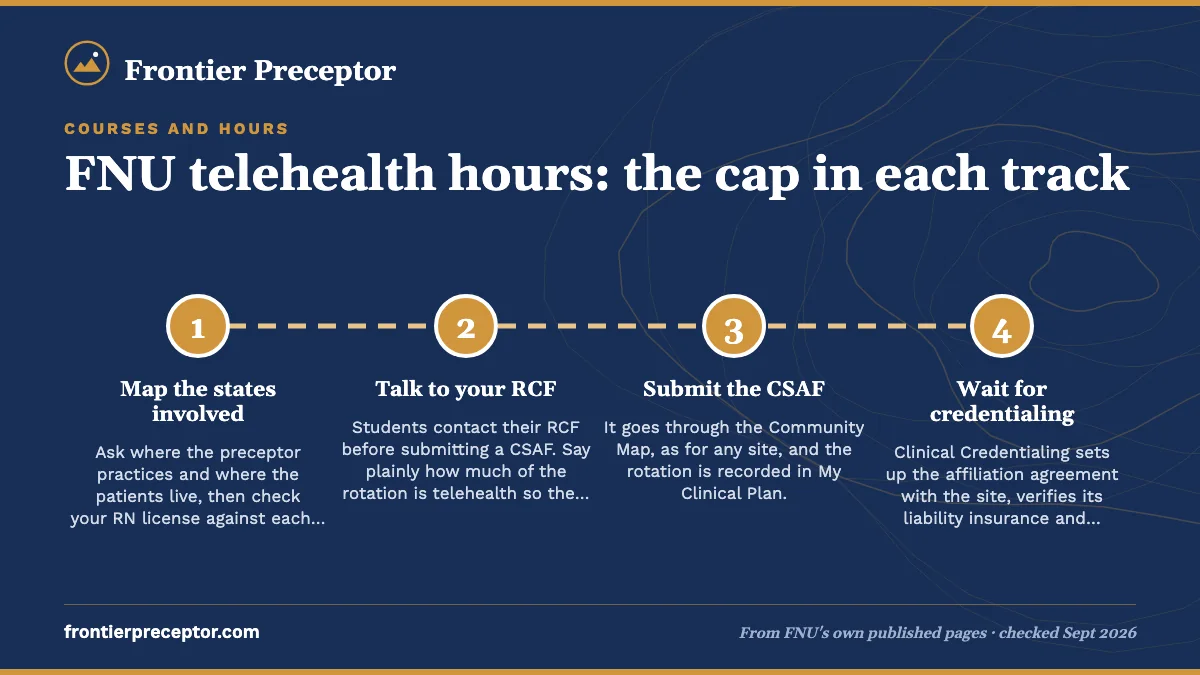
A telehealth rotation is still a clinical site in FNU's eyes. It goes through the same steps as any in-person site, and every step must be complete before you log an hour.
- Map the states involvedAsk where the preceptor practices and where the patients live, then check your RN license against each state.
- Talk to your RCFStudents contact their RCF before submitting a CSAF. Say plainly how much of the rotation is telehealth so the RCF can weigh it against your cap.
- Submit the CSAFIt goes through the Community Map, as for any site, and the rotation is recorded in My Clinical Plan.
- Wait for credentialingClinical Credentialing sets up the affiliation agreement with the site, verifies its liability insurance and credentials the preceptor. Starting clinical before that is complete is grounds for dismissal.
Our page on virtual clinical options looks at what telehealth can realistically cover in each track.
Blending telehealth into an in-person plan
Every FNU track caps telehealth, so every plan needs in-person hours, and our searches start there, with preceptors near you. Where a course allows it, we can also look for telehealth time inside your track's cap, and we ask where a preceptor's patients live so you can check licensing before a CSAF goes in.
We help you assemble what FNU's CSAF and credentialing steps ask about each telehealth preceptor and site. Your RCF decides whether a telehealth rotation fits your plan and Clinical Credentialing clears the site, and each telehealth lead reaches them with its patient states already mapped. If a telehealth arrangement ends early, we look for replacement time with you. If you want us to look, send your details with your track and the states where you hold an RN license.
Questions FNU students ask
Can I count telehealth hours with patients in several states?
Only if you meet licensure rules in each patient's state. FNU ties telehealth to the state where the patient resides, so a practice with patients across state lines can require more than your home license. A multistate compact license may cover some of those states. Check each one with Clinical Credentialing before you log the hours.
Will my RCF's site visit be virtual if my rotation is telehealth?
FNU says the Clinical Site Visit around your halfway point may be virtual or in person, and the RCF also makes a Pre-Clinical Site Visit to your primary site. FNU does not say how either works for a fully virtual rotation, so ask your RCF when you first discuss the site.
What if my preceptor's clinic moves mostly to video visits mid-term?
Your cap does not move, so telehealth beyond it will not count toward your total. Keep a running figure in your Clinical Log, tell your RCF early, and look at adding in-person time at the same or another site. For FNP students, video visits count only when you are in the same office as the preceptor.
Can telehealth fill a visit type my local site lacks?
Partly. A WHNP student short on perimenopausal or postmenopausal visits could add telehealth visits, but only up to 30% of that type. FNP students can use it for no more than 10% of each population-focused type, and midwifery students cannot use it for births or labor. Beyond the cap, you need another in-person site.
Related pages
Last checked 2026-09-23
We check these pages against FNU's own published sources. Your Clinical Advisor, your RCF and FNU's current guidelines have the final word.
Your site submitted before Clinical Bound.
Tell us your FNU track, your county and your Clinical Bound date. We look for a preceptor and site that fit FNU's rules for your track, and help you get the CSAF and credentialing details right.
- Matched to your track: CNM/CM, NP, or the right mix FNU allows
- Ready for the CSAF, the RCF and Clinical Credentialing
- In person near you, or telehealth within FNU's caps
Start your placement plan
A placement advisor replies with what an FNU-ready preceptor and site look like for you.