Pennsylvania clinicals for FNU students: collaboration, the compact and a student license rule
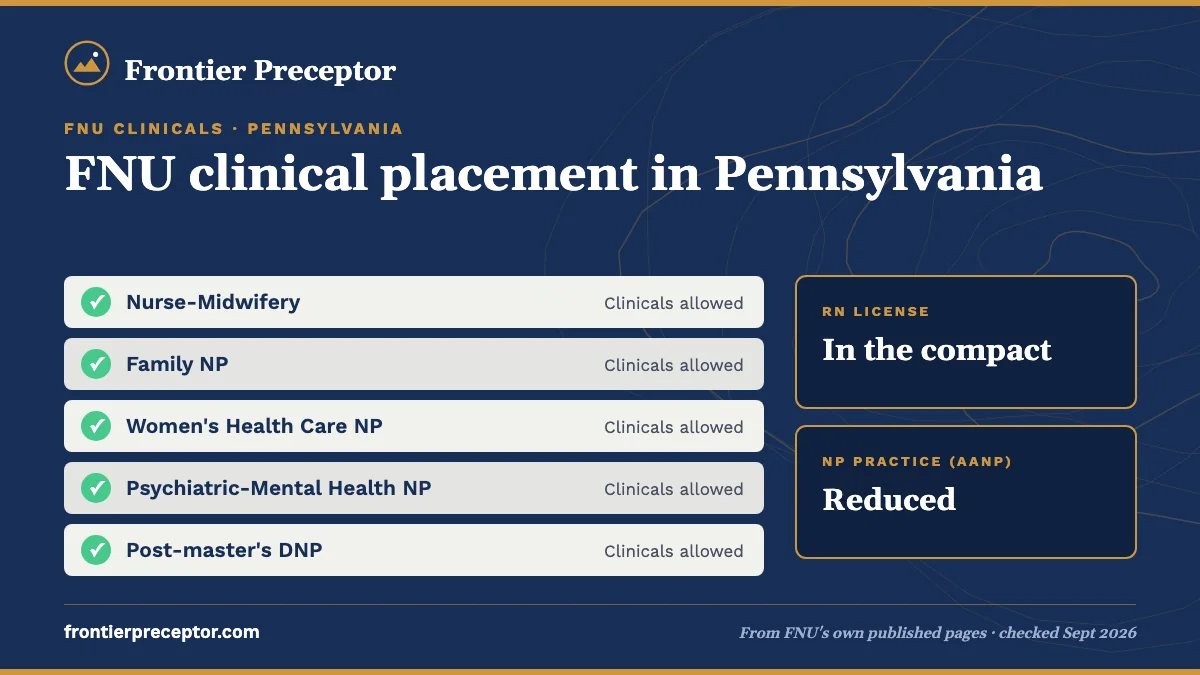
All FNU tracks can train in Pennsylvania. The state put the Nurse Licensure Compact into effect in July 2025, its NPs practice under written physician agreements for their whole careers, and a board rule lets RNs licensed elsewhere do required graduate clinicals without a Pennsylvania license.
Looking for a Pennsylvania preceptor?
Share your track and region. A placement advisor will be in touch.
The Pennsylvania picture
| Topic | Pennsylvania |
|---|---|
| Licensing body | Pennsylvania State Board of Nursing |
| Nurse Licensure Compact | In effect since July 7, 2025 |
| APRN Compact | Not enacted |
| AANP practice environment | Reduced: a career-long written agreement with physicians |
| Approval for out-of-state programs | No board rule or guidance found |
| FNU tracks allowed | All; FNU lists Pennsylvania as meeting educational requirements |
The Board's Distance Education Application is for programs the Board itself approves, so it doesn't describe FNU's situation. Clinical Credentialing handles state board requirements, so direct any doubt about a site to your Credentialing Coordinator.
A collaborative state and your preceptor
AANP rates Pennsylvania reduced practice. NPs hold written agreements with physicians throughout their careers, and prescriptive authority needs collaborative agreements with at least two physicians. An NP preceptor here therefore works inside a practice with physician partners on paper.
That structure can widen your options within FNU's limits. FNP students can put up to 40 percent of their practicum with physicians or PAs. PMHNP students have no cap on time with psychiatrists and may log as many as 135 hours with a licensed therapist. Midwifery students should still aim for a CNM or CM as primary preceptor. See FNP preceptors for how FNU weighs a mixed team.
Section 21.118: practicing as a student without a Pennsylvania license
Under 49 Pa. Code § 21.118, an RN currently licensed in another US jurisdiction or Canada who is enrolled in an accredited graduate nursing program may practice nursing in the clinical settings the program requires without a Pennsylvania license. The student can't be paid beyond stipends, scholarships or program awards, and anyone who also wants to work as an RN in Pennsylvania must apply for licensure by endorsement and a temporary practice permit.
FNU's own compliance list wants a license valid in every clinical state (compact eligibility counts), with an exception for sites that accept any US license. Most students from compact states won't need the exemption. For New York residents, whose license is single-state, it may matter, so ask Clinical Credentialing whether FNU accepts this route before relying on it. A Board rulemaking on nursing education reached final form on September 8, 2026, and keeps § 21.118 in substantially the same form.
From Philadelphia to Pittsburgh
About 4.2 million Pennsylvanians live in the Philadelphia-Camden-Wilmington metro area and 2.4 million around Pittsburgh, with Allentown-Bethlehem-Easton and Harrisburg-Carlisle next in size. The big systems include UPMC, Penn Medicine, Jefferson Health, Geisinger and Penn State Health. Their names tell you where to ask, not who will say yes. Beyond the metros, our rural clinicals guide covers searching smaller towns.
Near the northern border? FNU's rules put New York sites out of reach for anyone living outside New York, whatever the track; only federal facilities are exempt.
Midwifery and the hospital requirement
The FNU birth count travels with you: 40 births (eight or more in hospital) alongside 40 newborn assessments and 40 labor management experiences. Birth centers must be CABC-accredited, and midwifery students keep neonatal resuscitation certification current. Ask your RCF about Pennsylvania's midwifery practice rules and anything state-specific at a site.
Why Pennsylvania students choose us
A placement advisor searches around the region you name and flags which license each candidate site would need before you reach out. We prepare your CSAF's preceptor and site details together, and the sign-off at the end belongs to your RCF and Clinical Credentialing.
Questions FNU students ask
Do I need a Pennsylvania RN license for FNU clinicals in Pittsburgh?
No, if your compact home state issued you a multistate license; Pennsylvania joined the compact in July 2025. Section 21.118 also lets RNs licensed elsewhere do required graduate clinicals unpaid without a Pennsylvania license, but FNU's compliance rules decide what it accepts, so check with Clinical Credentialing first.
I live in New York. Can I do my FNU clinicals in Pennsylvania?
Yes, Pennsylvania is open to all FNU tracks, and FNP, WHNP, PMHNP and PGC midwifery students living in New York must train outside the state anyway. Your New York license isn't multistate, so ask Clinical Credentialing whether FNU accepts Section 21.118 or wants a Pennsylvania license. See our New York page.
Can I do FNU hours in Binghamton if I live in Scranton?
Only at a federal facility. Living in Pennsylvania puts every other New York site off limits under FNU's rules, and FNU's NP tracks can't train in New York even for residents. Plan your Scranton-area search within Pennsylvania or another open state.
Is Pennsylvania changing its rules for nursing students?
A Board rulemaking on nursing education programs, IRRC number 16A-5141, was delivered in final form on September 8, 2026, with a public meeting set for October 15, 2026. The final text keeps the § 21.118 student license provision in substantially the same form. Watch for changes before your clinical term.
Related pages
Last checked 2026-09-23
We check these pages against FNU's own published sources. Your Clinical Advisor, your RCF and FNU's current guidelines have the final word.
Your site submitted before Clinical Bound.
Tell us your FNU track, your county and your Clinical Bound date. We look for a preceptor and site that fit FNU's rules for your track, and help you get the CSAF and credentialing details right.
- Matched to your track: CNM/CM, NP, or the right mix FNU allows
- Ready for the CSAF, the RCF and Clinical Credentialing
- In person near you, or telehealth within FNU's caps
Start your placement plan
A placement advisor replies with what an FNU-ready preceptor and site look like for you.