My Clinical Plan: mapping sites and preceptors across the practicum
My Clinical Plan is where FNU students submit clinical rotations and where the Regional Clinical Faculty member accepts them. Before Clinical Bound registration, it has to show how your sites and preceptors will cover 750 hours and every visit type your track requires. Building it well is mostly arithmetic plus early conversations with your RCF.
A gap in your clinical plan?
Tell us your track and which visit types are missing.
What My Clinical Plan is
The catalog says students “secure and submit clinical rotations to My Clinical Plan,” and the RCF accepts sites there. Think of it as the running map of your practicum: which sites and preceptors you have, and how together they meet the hours and visit types your track requires.
It works alongside two other pieces. The Clinical Site Approval Form is submitted through the Community Map for each site, and your RCF reviews and accepts it. After acceptance, Clinical Credentialing handles the agreement with the site and the preceptor's credentialing. My Clinical Plan is where those accepted rotations add up to a whole practicum.
FNU's public pages show no screenshots or field lists, and the Clinical Advisor job description refers to “the clinical app” without naming a product. Your step-by-step instructions are in CB101 in Canvas, and your Clinical Advisor or RCF can walk you through the screens behind the FNU login.
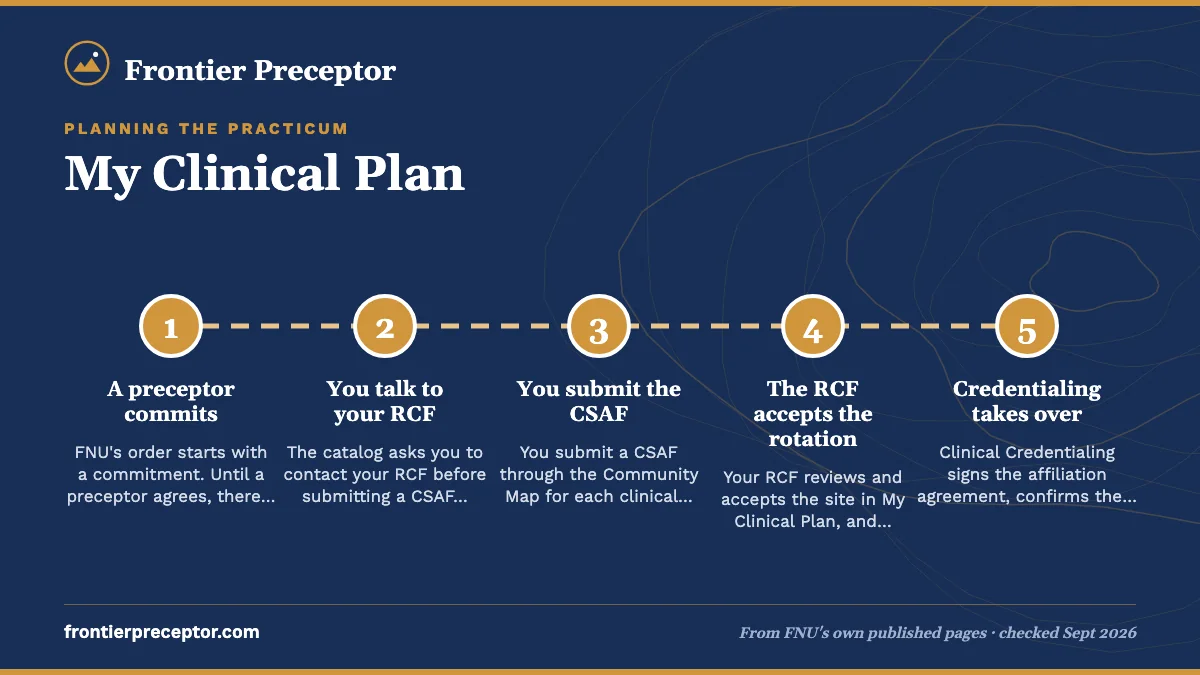
How a rotation gets onto your plan
- A preceptor commitsFNU's order starts with a commitment. Until a preceptor agrees, there is nothing to submit.
- You talk to your RCFThe catalog asks you to contact your RCF before submitting a CSAF, which is the moment to check the site fits the rest of your plan.
- You submit the CSAFYou submit a CSAF through the Community Map for each clinical site, following the CB101 instructions.
- The RCF accepts the rotationYour RCF reviews and accepts the site in My Clinical Plan, and assigns your Clinical Bound date once at least one site is accepted.
- Credentialing takes overClinical Credentialing signs the affiliation agreement, confirms the site's insurance and credentials the preceptor, which the catalog says can take several months.
What a complete plan has to cover
The catalog calls for a complete clinical plan covering all visit types and hours before you can register for Clinical Bound. For students starting clinical courses in 2025 or later, that means:
- 750 clinical hours and 19 weeks of clinical, which FNU suggests planning across three terms.
- Enough weekly hours for each course: at least 20 a week in the 751 course, 28 in 752 and 24 in 753, the same in every track.
- No more than 40 clinic or office hours a week. For nurse-midwifery the catalog ties this to the call schedule, and FNU's website lists 32 for midwifery and a 10-hour daily cap for the NP tracks.
- Every required visit type for your track, such as 300 gynecologic visits for WHNP or 300 medication management visits for PMHNP.
- For nurse-midwifery, a hospital birth site, with at least 8 of the 40 births in a hospital.
Where the catalog and the website disagree on a number, the newest dated source is the Summer 2026 catalog, but your RCF's reading is the one your plan is judged against. Full hour and visit lists are on clinical hours.
Site and preceptor limits by track
| Track | Maximum sites | Preceptor mix | Telehealth cap |
|---|---|---|---|
| Nurse-Midwifery | 4 unless the RCF approves more (typically 2 clinics and 2 hospitals) | Primary preceptor ideally a CNM or CM | 20% of hours |
| FNP | 4 | Up to 40% of hours with an MD, DO or PA; specialty sites no more than 20%, one specialty rotation | 10% of hours |
| WHNP | 3 in the catalog, 4 on the website | Primary preceptor should be a WHNP | 20% of hours |
| PMHNP | 4 | Up to 135 hours with a therapy provider; a psychiatric prescriber on the accepted CSAF before Clinical Bound | 450 hours |
Limits like these decide how many sites you need, not only whether each one is acceptable. A PMHNP plan built on one busy adult practice might cover medication management and still need a separate source of child and adolescent visits. Who may precept is covered on preceptor requirements, and virtual care on telehealth hours.
Building the mix across three courses
Most plans need more than one site. The catalog expects students to use more than one site when a single site cannot provide enough patient volume, and warns that “This may require relocating,” possibly out of state. With a site limit of three or four, each addition has to earn its place.
A practical way to build it: start with the site that can carry the most weekly hours in the 751 course, then list the visit types it will not supply. For an FNP student in an adult-heavy practice, that might be pediatric visits; for a midwifery student at a birth center, it is the hospital births. Those gaps become the brief for your second or third preceptor.
Then check the plan course by course against the weekly minimums. The 752 course asks for more hours a week than the other two, so a site that manages 20 hours comfortably in 751 may not be enough on its own in 752.
When the plan changes mid-practicum
Plans change: a preceptor leaves, a practice closes, or your RCF judges that a site is not giving you enough. The catalog says students who need to change a clinical site must do so in consultation with the RCF in the region where they currently live. If the RCF or preceptor finds progress or supervision inadequate, the student may be moved to a site the RCF or Clinical Director designates, at the student's expense.
Any new site goes through the same path as the first: preceptor commitment, CSAF, RCF acceptance and credentialing, and you cannot start there until credentialing is finished. If you are mid-course and suddenly short a preceptor, the preceptor dropped out page covers what to do first.
Closing the gaps in your plan
Students often come to us with one accepted site and a list of missing visit types. A placement advisor searches for a preceptor who can fill that specific gap within your track's site and preceptor limits, and helps you prepare the CSAF details and preceptor documents Clinical Credentialing will need.
Your RCF decides whether a site belongs in My Clinical Plan, and the lead we bring is chosen for the exact gap your plan shows. To start, share your plan's gaps and your Clinical Bound term.
Questions FNU students ask
Is My Clinical Plan the same as the CSAF?
No. The CSAF is the approval form you submit through the Community Map for each clinical site. My Clinical Plan is where your rotations are recorded and accepted by the RCF, so it shows the whole practicum rather than a single site. Expect to file one CSAF per site while keeping one plan for the practicum.
How far ahead does my RCF approve the clinical plan?
FNU staff describe the RCF approving the clinical plan about four to six months before Clinical Bound. The exact Clinical Site Preparation Timeline sits behind the FNU login, so check it through Banyan Tree 2.0 or CB101 and confirm dates with your RCF, who is assigned to you at the start of your first term.
Can I submit a plan with only one site?
You can submit one site first, and your RCF assigns a Clinical Bound date once at least one site is accepted. The catalog still wants a complete plan covering all visit types and hours before Clinical Bound registration, so a single site works only if it truly covers every requirement for your track.
How many clinical sites can I use at FNU?
The catalog caps nurse-midwifery, FNP and PMHNP at four sites, and midwifery can go above four only with RCF approval. For WHNP the catalog says no more than three while FNU's Clinical Experience page says four, so confirm with your RCF. FNP specialty sites are limited to 20% of time and one specialty rotation.
What happens if my plan is not complete before Clinical Bound?
The catalog says students without a complete clinical plan may need to take an Academic Hiatus, and FNU limits students to two academic hiatus terms in any 365 days. If your projected Clinical Bound term moves as a result, notify your RCF, preceptors, Clinical Credentialing Coordinator and Academic Advisor.
Related pages
Last checked 2026-09-23
We check these pages against FNU's own published sources. Your Clinical Advisor, your RCF and FNU's current guidelines have the final word.
Your site submitted before Clinical Bound.
Tell us your FNU track, your county and your Clinical Bound date. We look for a preceptor and site that fit FNU's rules for your track, and help you get the CSAF and credentialing details right.
- Matched to your track: CNM/CM, NP, or the right mix FNU allows
- Ready for the CSAF, the RCF and Clinical Credentialing
- In person near you, or telehealth within FNU's caps
Start your placement plan
A placement advisor replies with what an FNU-ready preceptor and site look like for you.