South Dakota clinicals for Frontier students
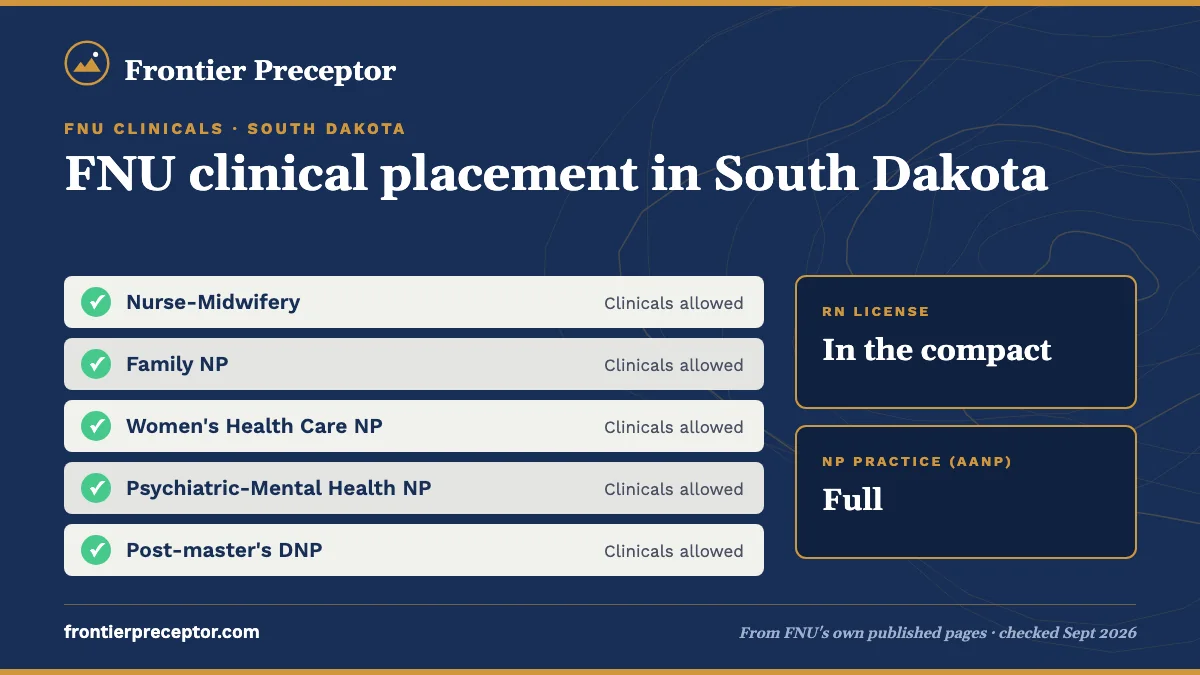
All FNU clinical tracks can train in South Dakota, where any compact state's multistate RN license is accepted. South Dakota's Board of Nursing doesn't approve schools based elsewhere: the placement agreement is between FNU and your site, though the Board expects FNU to have faculty licensed to oversee APRN students in the state.
Need a preceptor in South Dakota?
Share your town and track, and a placement advisor will be in touch.
What stands out in South Dakota
South Dakota is full practice in AANP's rating, on one condition: a new NP first completes 1,040 hours under a written collaborative agreement with a physician, a certified NP or a certified nurse midwife. South Dakota joined the RN compact on January 19, 2018, and signed its APRN Compact law on February 5, 2024.
Nurse-midwifery, FNP, WHNP and PMHNP students on either the MSN or PGC route can train here, and FNU says its programs meet South Dakota's educational requirements for all four licenses. Its bar for the graduate APRN program is 500 or more clinical hours in the role and population focus, and each FNU MSN and PGC track requires 750.
Who can precept you here
The 1,040-hour rule shapes the pool. An NP still inside that window practices under a collaborative agreement, and FNU separately asks every preceptor for at least a year in the advanced practice role. Ask how long a prospective preceptor has held an APRN license early in the conversation.
South Dakota's preceptor standard in ARSD 20:48:07:34 (licensed at or above the student's level, and an APRN preceptor in a comparable role and focus) is written for programs the Board approves, which FNU is not. FNU applies its own track rules instead. An FNP student can log as much as 40% of practicum hours with physicians or NCCPA-certified PAs, and a PMHNP student can count no more than 135 hours with a therapy provider. Who can precept FNP students goes further.
The Board leaves agreements to FNU and your site
The South Dakota Board of Nursing's guidance for out-of-state programs (revised June 2020) says it does not approve them. Placing a student in a direct-care setting is arranged between the program and the in-state preceptor or agency, which for you means the affiliation agreement FNU's Clinical Credentialing team signs with your site. You file nothing with the Board.
What the Board does look for is one program faculty member with a South Dakota license or a privilege to practice in the state. For APRN students, that is a South Dakota APRN license, and ARSD 20:48:07:49 applies the same rule to faculty teaching APRN students in the state.
That expectation sits with FNU, not you. Confirm with your Clinical Advisor that FNU has it covered before you commit to a South Dakota site.
Sioux Falls, Rapid City and the towns between
By 2025 Census estimates, the Sioux Falls metro has 314,638 people, 305,114 of them in South Dakota; the rest live across the Minnesota line, where Minnesota licensing would apply. Rapid City's metro has 156,934 and the Aberdeen micropolitan area 41,583. Monument Health, Avera Health and Sanford Health are the large systems to use as leads, not as sites known to host FNU students.
Away from those centers you're in the rural communities FNU's mission names first. FNU allows up to four sites for FNP, PMHNP and midwifery (three for WHNP in the catalog), so a small-town clinic can pair with a second site in a larger center. The Community Map lists South Dakota preceptors FNU has worked with.
License, telehealth and midwifery notes
A multistate RN license from any compact state works for South Dakota clinicals. With only a non-compact single-state license, you'll need a South Dakota license too. Telehealth patients count only if you meet licensing rules where each one lives, within your track's cap. Five states have enacted the APRN Compact so far, short of the seven it needs to operate.
For South Dakota's nurse-midwifery practice rules, your RCF is the person to ask. What FNU sets doesn't change by state: 40 births (a minimum of eight in hospital), 40 labor management experiences and current NRP. The nurse-midwifery preceptor page covers who can precept.
Why South Dakota students choose us
A placement advisor searches around your town for a preceptor who fits your track, is past the 1,040-hour collaborative window and meets FNU's year-in-role rule, then assembles the site and preceptor details for the CSAF and Clinical Credentialing with you. FNU's RCF and Credentialing decide on approval, from a complete file. Start with the request form.
Questions FNU students ask
Does South Dakota require FNU to get Board approval for my clinicals?
No. Out-of-state nursing programs aren't approved by the Board, it says; placement agreements are made between the program and the in-state preceptor or agency. It does expect FNU to have faculty with a South Dakota APRN license or privilege overseeing APRN students; your Clinical Advisor can tell you how FNU handles that.
Can a newly licensed South Dakota NP precept me?
Not during their first year, because FNU wants every preceptor to have a year or more in the advanced practice role. South Dakota NPs also spend their first 1,040 hours under a written collaborative agreement, so look for someone well past that point and confirm it before the CSAF goes in.
Does FNU's program meet South Dakota's APRN licensure rules?
Yes, according to FNU's state-by-state licensure page, which marks South Dakota as met for CNM, FNP, PMHNP and WHNP. Alongside at least 500 clinical hours, the Board asks for graduate courses in physiology or pathophysiology, health and physical assessment, and pharmacology.
Can I split FNU clinicals between South Dakota and a neighboring state?
Yes. Only New York limits where FNU students train, and each site goes through its own CSAF, RCF acceptance and credentialing. You need an RN license valid in every state where you see patients, so a multistate compact license makes a two-state plan simpler. Stay within your track's site limit.
Related pages
Last checked 2026-09-23
We check these pages against FNU's own published sources. Your Clinical Advisor, your RCF and FNU's current guidelines have the final word.
Your site submitted before Clinical Bound.
Tell us your FNU track, your county and your Clinical Bound date. We look for a preceptor and site that fit FNU's rules for your track, and help you get the CSAF and credentialing details right.
- Matched to your track: CNM/CM, NP, or the right mix FNU allows
- Ready for the CSAF, the RCF and Clinical Credentialing
- In person near you, or telehealth within FNU's caps
Start your placement plan
A placement advisor replies with what an FNU-ready preceptor and site look like for you.