FNU clinicals in Kansas: hours, preceptors and licensing
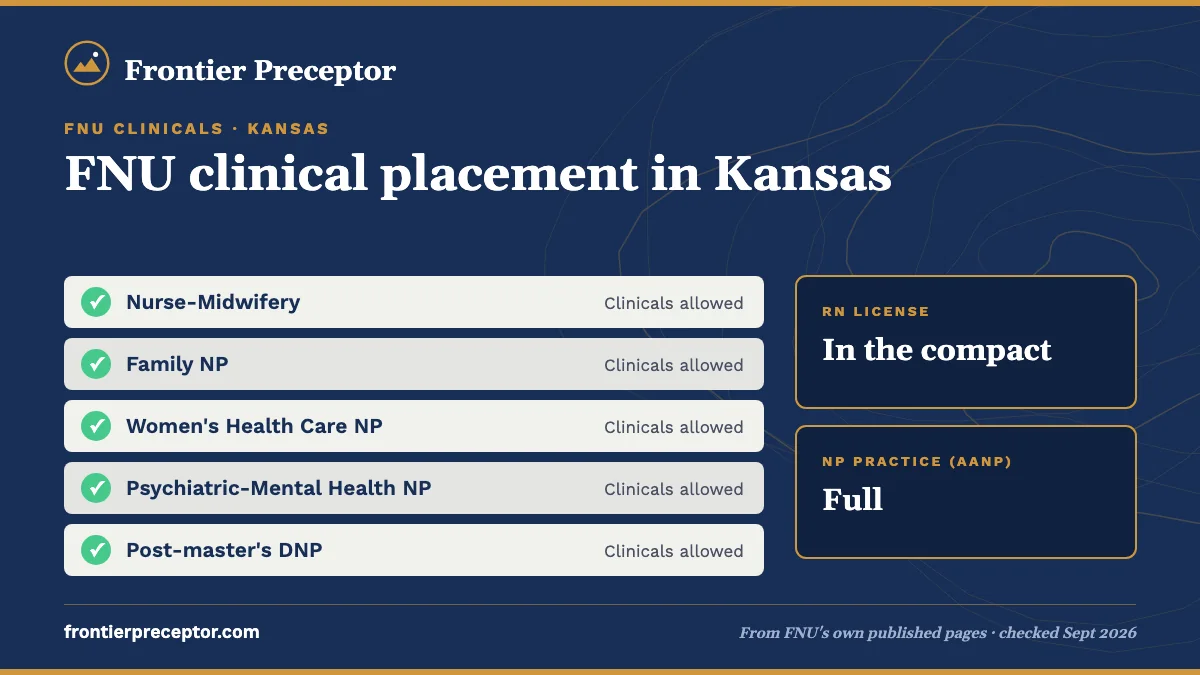
Every FNU track can train in Kansas, a compact state since July 1, 2019 that AANP rates full practice. Kansas checks your program's clinical hours when you apply for APRN licensure, and for students admitted after March 1, 2025 the figure is 750. FNU's MSN and PGC tracks require 750 clinical hours, so the hour count lines up.
Planning Kansas clinicals?
Tell us your track, your Kansas city and your projected Clinical Bound term.
The 750-hour check, stated plainly
Online APRN programs based outside Kansas face no formal approval step with the Kansas State Board of Nursing before Kansas students enroll. KSBN's look at the program waits until one of its graduates files for a Kansas APRN license.
What KSBN checks at APRN licensure
- 3 or more credit hours for each of three advanced subjects: pathophysiology, health assessment and pharmacology
- at least 45 credit hours in the program
- national accreditation
- a role-specialty clinical hour floor of 500 (admitted before March 1, 2025) or 750 (admitted after that date)
FNU requires 750 clinical hours over 19 weeks in every MSN and PGC track for all students beginning clinical courses from 2025 on. That matches the 750 figure. FNU's state license page also lists its programs as meeting Kansas's educational requirements. Our clinical hours page explains how FNU counts them.
Kansas expects a Kansas APRN as preceptor
KSBN's guidance for out-of-state APRN programs (K.A.R. 60-17-104) says the preceptor should get an orientation, sign an agreement, and be licensed as a Kansas APRN in whatever role the student is studying. It adds that clinical supervision of APRN students requires a Kansas APRN license.
FNU already covers the orientation and agreement pieces: preceptor orientation at FNU means The Gift of Precepting CE course plus FNU's preceptor guide, and Clinical Credentialing signs an affiliation agreement with the site. The license point needs care, because FNU's own rules also allow physicians in some tracks, for instance letting a physician or PA supervise part of an FNP student's hours, capped at 40%. See who can precept an FNU student.
Before you plan hours around a Kansas physician or PA, ask your Clinical Advisor how FNU applies KSBN's Kansas-APRN guidance to your track.
Your license, and your RCF's visits
KSBN says an APRN student in a Kansas clinical setting practices on an RN license Kansas recognizes, multistate or Kansas single-state, as a student of advanced practice nursing under K.S.A. 65-1124. A multistate license from Missouri, Nebraska or Iowa covers you.
Faculty who teach online don't need a Kansas license. Kansas doesn't require faculty to visit students during clinicals, and faculty who do visit come as a visitor or lay person. FNU's Regional Clinical Faculty make a Pre-Clinical Site Visit and a Clinical Site Visit near your halfway point, and FNU says those visits may be virtual or in person.
Kansas City, Wichita, Topeka and beyond
The Kansas City metro, which spans the Missouri line, is home to about 938,000 Kansans; Wichita holds about 664,000, Topeka about 233,000 and Manhattan about 136,000. Large systems range from Wesley Healthcare and Ascension Via Christi to Stormont Vail Health and The University of Kansas Health System. They show where to look, not who hosts FNU students. Both sides of Kansas City are compact states; see Missouri for that side's practice rules.
Kansas has no preceptor incentive and no state-specific midwifery rule on record. Midwifery students work to FNU's own birth requirement: 40 in all, with at least eight in hospital.
A placement advisor searches for Kansas-licensed APRNs in your role and prepares the details your CSAF needs with you, so the site is ready for review. The approval decision rests with your RCF and Clinical Credentialing.
Questions FNU students ask
I was admitted after March 1, 2025. Will my FNU hours meet Kansas's check?
On hours, yes: KSBN looks for 750 role-specialty clinical hours for students admitted after that date, and FNU's MSN and PGC tracks require 750. KSBN makes its decision when you apply for a Kansas APRN license, reviewing credit hours and accreditation too, so keep your transcripts and clinical records.
Does Kansas require FNU approval before I enroll or train there?
KSBN says out-of-state online APRN programs have no formal approval requirement with the Board ahead of Kansas students enrolling. It reviews the program at APRN licensure instead. FNU's catalog notes some states want advance notice for clinicals, so still tell your Clinical Advisor early about a Kansas site.
Does my RCF need a Kansas license to visit my Kansas site?
Not according to KSBN. Program faculty who teach online don't need a Kansas license, Kansas doesn't require faculty visits during clinicals, and any faculty visit happens in the capacity of a visitor or lay person. FNU says its Clinical Site Visit may be virtual or in person.
Do I need a Kansas RN license for FNU clinicals in Kansas?
Not with an active multistate license, which Kansas recognizes for APRN students in its clinical settings. You'd need a Kansas license only if a non-compact state such as Illinois issued your current, single-state license. FNU verifies whichever license you use through Nursys Quick Confirm before Clinical Bound.
Related pages
Last checked 2026-09-23
We check these pages against FNU's own published sources. Your Clinical Advisor, your RCF and FNU's current guidelines have the final word.
Your site submitted before Clinical Bound.
Tell us your FNU track, your county and your Clinical Bound date. We look for a preceptor and site that fit FNU's rules for your track, and help you get the CSAF and credentialing details right.
- Matched to your track: CNM/CM, NP, or the right mix FNU allows
- Ready for the CSAF, the RCF and Clinical Credentialing
- In person near you, or telehealth within FNU's caps
Start your placement plan
A placement advisor replies with what an FNU-ready preceptor and site look like for you.