FNU clinicals in Delaware start with the Board's notice rule
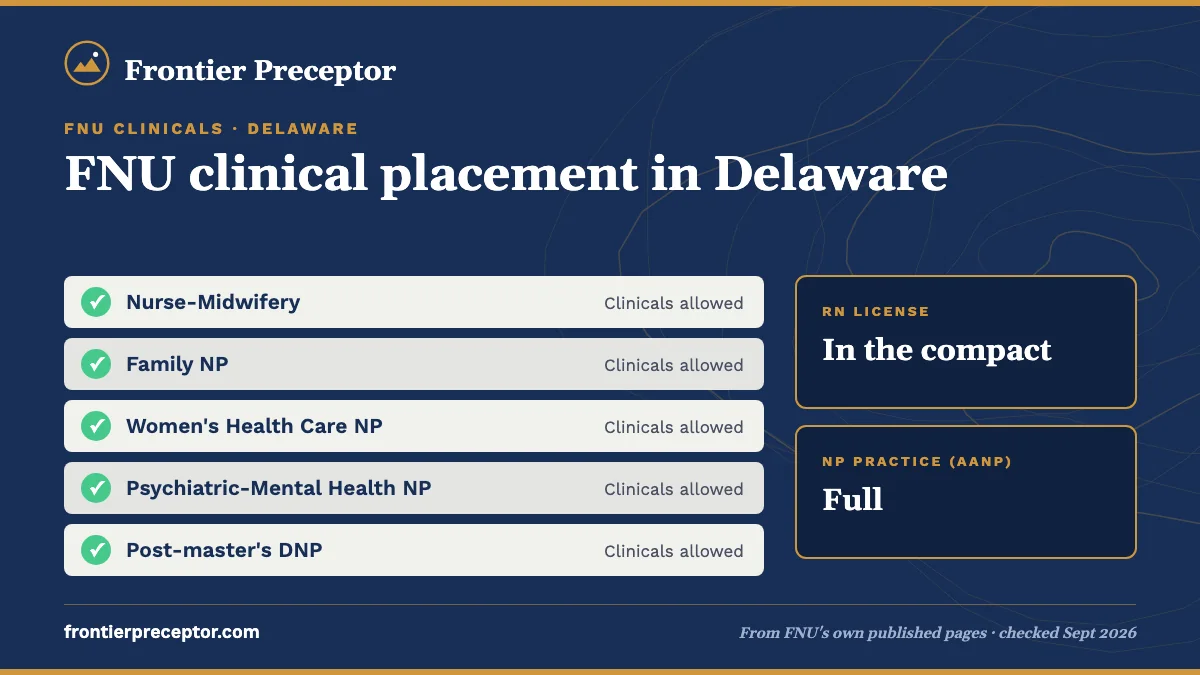
Delaware requires out-of-state schools to notify its Board of Nursing, and send a set of documents, before using a Delaware clinical facility. How that reaches a graduate program like FNU's is unclear, so build in lead time and confirm the steps with your Clinical Advisor. Licensing is simpler: Delaware is a compact state with full NP practice.
Planning Delaware clinicals?
Tell us your FNU track and where in Delaware you live.
What Delaware asks of out-of-state schools
An out-of-state school that wants to use Delaware clinical facilities must notify the Board of Nursing before using them (24 Del. Admin. Code 1900-2.4.1.9.4.1.5). Before using a Delaware facility, the school must also submit:
- proof of program approval by its state board, or national accreditation
- copies of the school's written agreement with each clinical agency
- its requirements for clinical faculty and preceptors
- the name and assigned site of each faculty member and preceptor
- copies of current Delaware or compact (multistate) licenses for faculty and preceptors
A companion provision numbered 1900-2.4.1.9.4.1.4 says facilities used for clinical experience must be approved by the Board before students are assigned, based on forms the school submits, and Board representatives may visit. The standards apply to "all nursing education programs" without separating pre-licensure, RN-BSN and graduate programs, which is why their reach to FNU is unclear.
What the notice rule means for your timeline
These are school-side filings. Affiliation agreements and state board requirements are the work of FNU's Clinical Credentialing coordinators, and the catalog cautions that certain states want advance notice and approval before students arrive for clinicals. Delaware's written rule reads like one of those cases.
Because the filing names preceptors and their sites, settle your preceptor early. Ask your Clinical Advisor how far ahead FNU needs a Delaware site, and whether a later preceptor change means a new submission. FNU already says credentialing a site can take several months; see our timeline page.
Don't agree a first clinical day with a Delaware preceptor until your Clinical Advisor confirms the Board's notice is handled.
Who can precept you under Delaware's definitions
Delaware's rules define a preceptor as a nurse with a BSN or higher and a valid license. Rule 1900-2.4.1.5.17 says any online program's faculty teaching in a Delaware clinical facility, preceptors and clinical instructors included, must hold a license or privilege to practice at a level equal to or higher than the one the student is preparing for.
FNU layers its own preceptor rules on top: one year of relevant advanced practice, a US license that is valid and unencumbered, and a nursing-related master's or higher, a degree FNU may waive for a CNM. An FNP student may log up to 40% of hours with physicians and PAs, and a PMHNP student up to 135 hours with a therapist. Delaware's definition is written around nurses, so ask your Clinical Advisor how those hours fit.
AANP rates Delaware as full practice, with no transition period or other condition on record for NPs there.
Wilmington, Dover and the Seaford area
The 2025 Census estimates count about 588,000 Delawareans in the Philadelphia-Camden-Wilmington metro, about 194,800 in the Dover metro and about 277,100 in the Seaford micropolitan area. Seaford, the one micropolitan area of the three, is a natural place to look for the smaller-community practice FNU's mission emphasizes.
ChristianaCare, Bayhealth and Beebe Healthcare are Delaware systems to know, and Nemours Children's Health, whose pediatric system crosses state lines, has its Delaware hospital in Wilmington. They're starting points, not sites that have agreed to take FNU students. The Division of Public Health sits within the Department of Health and Social Services.
Delaware has no preceptor incentive on record, so FNU's own perks carry the ask: an honorarium, The Gift of Precepting CE course and DynaMed access. Sites across the line in Maryland, Pennsylvania or New Jersey follow those states' rules; see our Maryland page.
Licensing, and the APRN Compact Delaware already signed
Delaware's compact membership took effect January 19, 2018, which means another compact state's multistate RN license is valid for clinicals here. Without one, you need a Delaware license from the Board, part of the Division of Professional Regulation. FNU checks it through Nursys Quick Confirm before Clinical Bound.
August 4, 2021 is when Delaware signed the APRN Compact into law. Delaware is one of five states to enact it, alongside North Dakota, South Dakota, Utah and Wyoming; it needs seven before it operates, so today your student clinicals are unaffected by it. For telehealth, meet licensing rules where each patient lives; see our RN license page.
Midwifery students, and why Delaware students choose us
Check Delaware's midwifery practice rules with your Clinical Advisor. In Delaware, as elsewhere, FNU asks midwifery students for 40 births with a hospital minimum of 8, prefers a CNM or CM as the primary preceptor, and accepts birth centers only with CABC accreditation. See the nurse-midwifery preceptor page.
A placement advisor finds Delaware preceptors and sites matched to your FNU track and gets the CSAF and credentialing details ready with you. FNU files the school-side Board notice and decides on every site, and your part arrives complete. To start, reach the placement desk or fill in the form below.
Questions FNU students ask
Does FNU have to notify Delaware before I start clinicals?
Delaware's rule says out-of-state schools must notify the Board of Nursing before using Delaware clinical facilities, and it applies to all nursing education programs. How it applies to FNU's graduate tracks is unclear, so ask your Clinical Advisor how FNU handles it and how much lead time to allow.
Do Delaware preceptors need a Delaware license?
The notice rule asks the school to send copies of current Delaware or compact (multistate) licenses for faculty and preceptors, so a preceptor licensed to practice in Delaware fits. FNU separately requires a valid, unencumbered US license and one year of relevant advanced practice experience.
Does the APRN Compact let me skip a Delaware license?
No. Until seven states enact the APRN Compact it stays inactive, and only five have done so. It concerns advanced practice licenses in any case. For clinicals, what matters is your RN license, and in Delaware another compact state's multistate license meets it.
Can I live in Delaware and do FNU clinicals in Maryland or Pennsylvania?
Yes. FNU's only residence-based rule is New York's, and students can train across a state line. You'd follow the other state's rules and need an RN license valid there. Maryland has an NP preceptor tax credit with its own conditions; Delaware has none on record.
Related pages
Last checked 2026-09-23
We check these pages against FNU's own published sources. Your Clinical Advisor, your RCF and FNU's current guidelines have the final word.
Your site submitted before Clinical Bound.
Tell us your FNU track, your county and your Clinical Bound date. We look for a preceptor and site that fit FNU's rules for your track, and help you get the CSAF and credentialing details right.
- Matched to your track: CNM/CM, NP, or the right mix FNU allows
- Ready for the CSAF, the RCF and Clinical Credentialing
- In person near you, or telehealth within FNU's caps
Start your placement plan
A placement advisor replies with what an FNU-ready preceptor and site look like for you.