FNU clinicals in Massachusetts while the compact waits
Every FNU track can plan clinicals in Massachusetts, but a multistate license won't carry you here yet. The compact became Massachusetts law in November 2024. Its Board of Registration in Nursing treats it as not yet in effect until implementation finishes, a step the Board is aiming to reach in May 2027.
Planning clinicals in Massachusetts?
Tell us your track and the part of the state you live in. A placement advisor will reply.
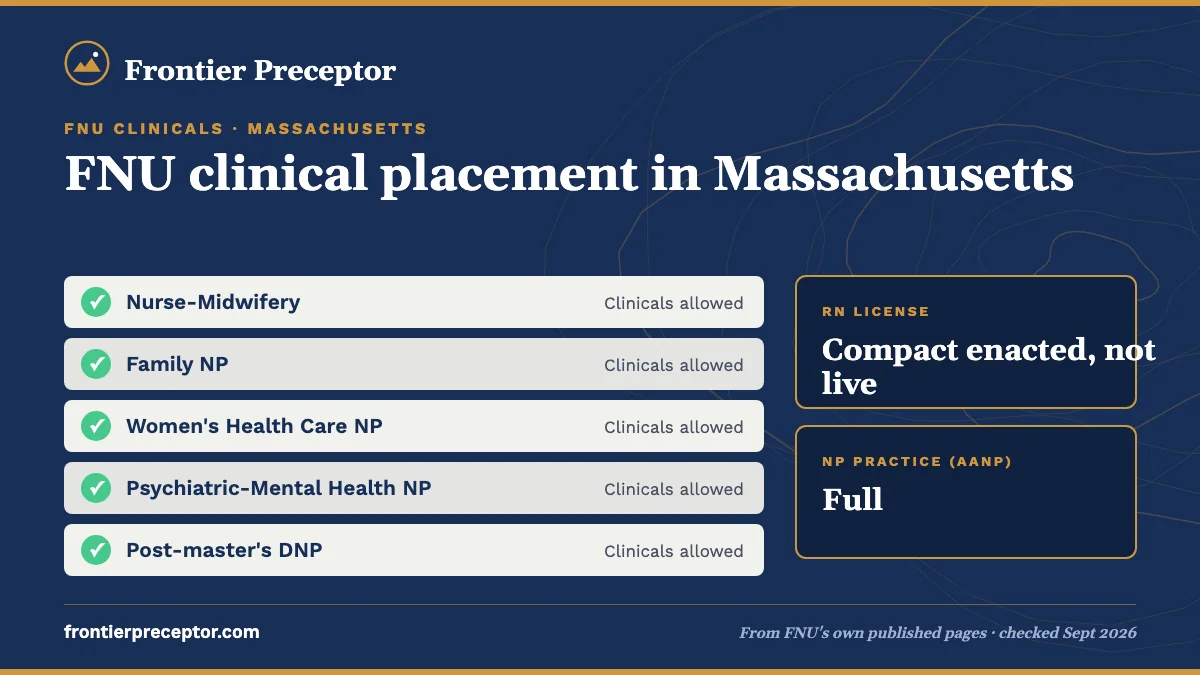
Massachusetts at a glance
- Licensing body: the Massachusetts Board of Registration in Nursing.
- Nurse Licensure Compact: enacted November 2024, not yet in effect. In May 2026 the Board got conditional FBI approval for background checks, while NCSBN's table still shows the implementation date as to be determined.
- APRN Compact: not enacted.
- AANP practice environment: full practice, reached after two supervised years with a qualifying physician or APRN; equivalent experience may bring an exemption.
- FNU: according to its state license page, the MSN and PGC programs meet Massachusetts's licensure education requirements.
Why you need a Massachusetts license for now
Until implementation is complete, the Board tells nurses to use the current Massachusetts license application, and multistate licenses from other states don't yet give a privilege to practice here. FNU requires an unencumbered license valid in each state where clinicals happen, so a Massachusetts site means holding a Massachusetts RN license, verified through Nursys Quick Confirm, before you start.
This catches commuters. A nurse living in Rhode Island or New Hampshire with a multistate license can't use it for a Boston-area rotation today. The same logic applies to telehealth: FNU requires licensure where the patient lives, so Massachusetts patients mean a Massachusetts license. Start the application early and read our RN license guide.
The Board's placement approval, and the open question
Under 244 CMR 6.03(2), nursing programs whose parent institution's principal place of business is outside Massachusetts must get Board approval for any clinical learning experiences held in the state. The Board describes these steps:
- Part A, parent institution approvalSubmitted every year, at least six months before any clinical placement.
- Part B, student clinical placement approvalFiled for each placement no later than 30 days before it starts; changes at least two weeks before, with the Board told within seven days of any change.
- Approval letterStudents can't begin until the Board issues it. Ratios apply: faculty to students 1:10 or less, preceptor to students 1:2 or less.
The open question is scope. Its criteria are written for programs preparing graduates for the NCLEX-RN or NCLEX-PN, and the Board's page is silent on graduate and APRN programs. Ask your Clinical Advisor or Credentialing Coordinator whether FNU files anything for your site and how much lead time to allow.
Supervised years and who precepts
A Massachusetts NP must first complete two years supervised by a qualifying physician or APRN before practicing fully. FNU needs only a year of advanced practice experience, which means an NP partway through the supervised period may still qualify under FNU's preceptor rules. For WHNP students, FNU says the primary preceptor should be a WHNP; PMHNP students can count as many as 135 hours with a licensed, master's-level therapist.
Boston, Worcester and the western counties
About 4.6 million residents live in the Massachusetts part of the Boston-Cambridge-Newton metro area. Worcester, the Massachusetts share of Providence-Warwick, and Springfield follow. For outreach, the large systems are Boston Medical Center Health System, Mass General Brigham, Baystate Health, UMass Memorial Health and Beth Israel Lahey Health; none is a confirmed host.
Midwifery students need a hospital for at least eight of their 40 births, so a hospital-based practice is worth asking about early. Massachusetts midwifery practice rules aren't verified here, so put state-specific questions to your RCF.
Why Massachusetts students choose us
A placement advisor searches near where you live, sorts candidates by whether they'd need the Massachusetts license you may still be waiting on, and assembles the preceptor and site details for your CSAF with you. The Board, your RCF and Clinical Credentialing make their decisions from a complete, well-timed file.
Questions FNU students ask
Will my New Hampshire multistate license cover FNU clinicals in Massachusetts?
Not yet. Massachusetts enacted the Nurse Licensure Compact in November 2024, but the Board says multistate licenses from other states don't confer a privilege to practice until implementation is complete, targeted for May 2027. For a rotation before then, apply for a Massachusetts license, since FNU requires one valid in each clinical state.
Does the Massachusetts 30-day placement filing apply to FNU?
It isn't clear. 244 CMR 6.03(2) requires Board approval for each out-of-state program placement at least 30 days ahead, but the criteria describe programs preparing graduates for the NCLEX, and the Board's page doesn't mention graduate or APRN programs. Ask Clinical Credentialing whether it files for your site.
Can I start clinicals in Massachusetts right after Clinical Bound?
Only once every piece is in place: your Massachusetts RN license, an affiliation agreement, a credentialed preceptor and your RCF's final release. FNU treats starting before credentialing is complete as grounds for dismissal. If a Board filing turns out to apply, its lead times add to that.
Can I count telehealth visits with Massachusetts patients?
Only if you're licensed where the patient lives, which in Massachusetts means a Massachusetts license until the compact takes effect. FNU also caps telehealth by track: one-fifth of hours in midwifery and WHNP, one-tenth in FNP, and 450 hours for PMHNP students who began clinicals in 2025 or later.
Related pages
Last checked 2026-09-23
We check these pages against FNU's own published sources. Your Clinical Advisor, your RCF and FNU's current guidelines have the final word.
Your site submitted before Clinical Bound.
Tell us your FNU track, your county and your Clinical Bound date. We look for a preceptor and site that fit FNU's rules for your track, and help you get the CSAF and credentialing details right.
- Matched to your track: CNM/CM, NP, or the right mix FNU allows
- Ready for the CSAF, the RCF and Clinical Credentialing
- In person near you, or telehealth within FNU's caps
Start your placement plan
A placement advisor replies with what an FNU-ready preceptor and site look like for you.