Finding an Ohio preceptor as an FNU student
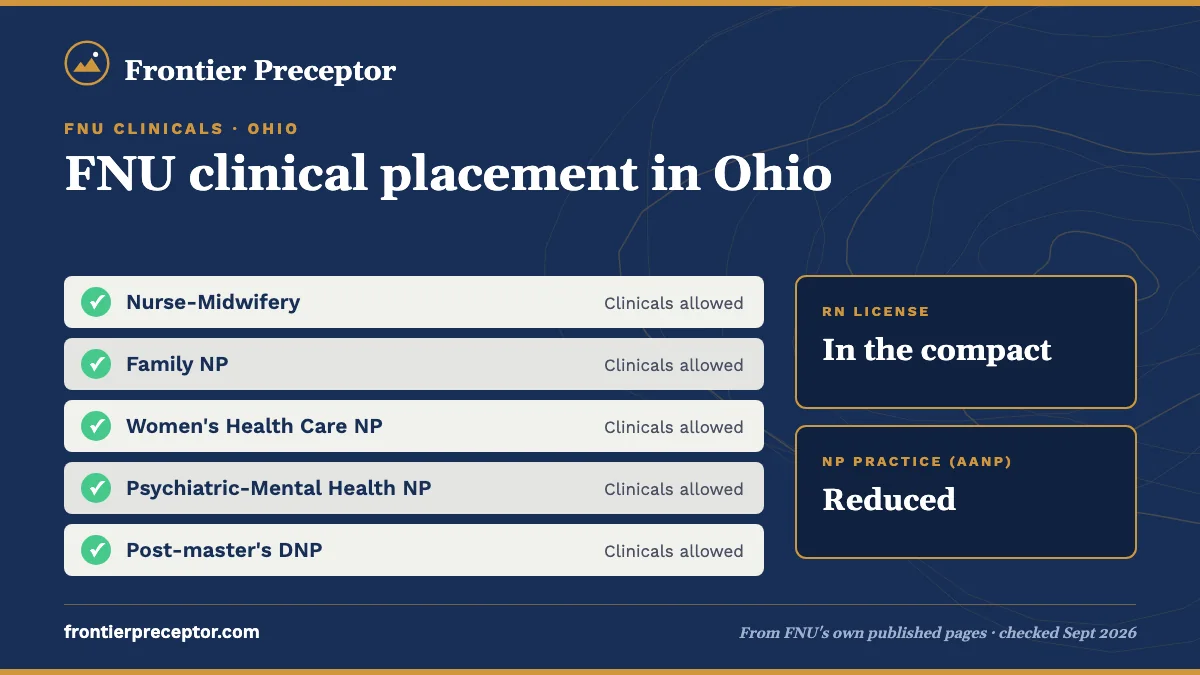
Ohio law sets no board approval or notice step for nursing programs based in other states, so FNU students on every track can train there through FNU's usual process. Two Ohio details shape your plan: the state joined the compact only in 2023, and its student exemption expects an APRN to supervise APRN students.
Need an Ohio preceptor?
Tell us your track, your metro or county, and your Clinical Bound term. A placement advisor will reply.
Ohio in brief for FNU planning
Ohio appears on FNU's licensure page as a state whose requirements the MSN and PGC tracks satisfy, and the catalog sets no Ohio-specific limit on any track.
- Board: Ohio Board of Nursing
- Nurse Licensure Compact: implemented January 1, 2023
- APRN Compact: not enacted
- AANP practice environment: reduced
- Out-of-state programs: no Ohio Board approval or notice step in the Revised Code
- State preceptor incentive: none on record
Ohio's student exemption and who supervises you
Section 4723.32 of the Ohio Revised Code exempts certain nursing students from Ohio's licensing requirements. Division (F) applies to APRN students in a program that qualifies them for a national certification exam; they work under the program's auspices and "under the supervision of an advanced practice registered nurse" who is serving as faculty, teaching assistant or preceptor.
That wording matters if part of your plan sits with someone other than an APRN. FNU's FNP rules allow physicians and PAs to cover as much as 40% of the hours, and PMHNP plans may include psychiatrists and up to 135 therapist hours. Before building an Ohio plan around a physician, PA or therapist, ask your RCF and Clinical Credentialing how FNU reads Ohio's text.
Division (A) gives pre-licensure students in programs approved by another NCSBN member board a similar exemption, and nothing in the Revised Code asks out-of-state programs to notify the Ohio Board. Ohio Department of Higher Education authorization is still to be checked; FNU says its NC-SARA approval means it needs only home-state authorization to teach students in other SARA states.
Standard care arrangements and your preceptor
AANP rates Ohio as reduced practice. NPs must hold a career-long standard care arrangement with a collaborating physician or podiatrist, and Ohio limits the settings in which they can prescribe Schedule II drugs.
In practice, every Ohio NP preceptor you approach has a named collaborator. At minimum, FNU wants every preceptor to hold an unencumbered US license plus at least a year of advanced practice experience; the preceptor requirements page lists what each track accepts beyond that.
Where Ohio students search
The four Ohio metros covered here each top 800,000 people in the 2025 Census estimates. They show where the clinical volume sits; none of the systems named here has agreed to take FNU students.
| Metro | People in Ohio |
|---|---|
| Columbus | about 2.24 million |
| Cleveland | about 2.17 million |
| Cincinnati, OH-KY-IN | about 1.76 million of 2.31 million |
| Dayton-Kettering-Beavercreek | about 827,000 |
Large systems include Cleveland Clinic, University Hospitals in Cleveland, OhioHealth in Columbus, Bon Secours Mercy Health in Cincinnati and The Ohio State University Wexner Medical Center. The Cincinnati metro also reaches into Kentucky and Indiana, both compact states, which widens the map for southwest Ohio students; our Kentucky page covers the Kentucky side.
Licensing: a compact state since 2023
Ohio implemented the Nurse Licensure Compact on January 1, 2023, later than Kentucky, West Virginia or Indiana. As the Ohio Board describes it, the compact gives a nurse one multistate license from their primary state of residence that works across the other compact states, and the Board reports on nurses practicing in Ohio under multistate licenses issued elsewhere.
So an Ohio resident with a multistate license can take a site in Kentucky or Indiana, and a West Virginia resident can train in Ohio on a West Virginia multistate license. Telehealth visits need licensure that matches where each patient lives. The RN license page covers Nursys verification.
Nurse-midwifery and WHNP students in Ohio
AANP's rating covers NP practice, not CNM practice, so take midwife-specific questions to your RCF or the Ohio Board of Nursing. FNU's own rules apply unchanged: midwifery students log 40 births, eight or more in a hospital, preferably under a CNM or CM as main preceptor, while WHNP students should have a WHNP as their primary preceptor.
Both tracks keep fetal heart monitoring education current in CastleBranch. The WHNP preceptor page sets out the visit counts WHNP students plan around.
Why Ohio students choose us
We search your part of Ohio for a preceptor who suits your track, flag where Ohio's APRN-supervision wording may need a question to FNU, and put together the CSAF's site and preceptor information with you. FNU's RCF and Clinical Credentialing make every approval decision, and the file they see is whole. If a preceptor pulls out mid-practicum, we restart the search; send us your details.
Questions FNU students ask
Does the Ohio Board of Nursing need to approve FNU before my clinicals?
No approval or notice step appears in the Ohio Revised Code for programs based in other states. The student exemption in section 4723.32 applies to APRN students whose program qualifies them for national certification, supervised by an APRN acting for the program. Clinical Credentialing still handles FNU's side, including the affiliation agreement with your site.
Can an Ohio physician precept part of my FNP hours?
FNU's FNP rules let a physician or NCCPA-certified PA supervise up to 40% of your hours. The student exemption in Ohio, however, speaks of supervision by an APRN acting as a preceptor, faculty member or teaching assistant. Ask your RCF and Clinical Credentialing how FNU applies that in Ohio before you commit physician hours to your plan.
I live in the Cincinnati area. Can I train at a Kentucky site?
Yes, if your license covers it and FNU approves the site. The Cincinnati metro spans Ohio, Kentucky and Indiana, all three are compact states, and an Ohio multistate license covers sites in each. St. Elizabeth Healthcare is among Kentucky's large systems. The CSAF, RCF review and credentialing are the same as for an Ohio site.
Is there an Ohio incentive for preceptors who take FNU students?
No statewide program is on record. When you approach an Ohio clinician, lead with what FNU provides: an honorarium whose amount depends on program and hours, ANCC-approved CE through The Gift of Precepting, DynaMed access you can arrange through the FNU library, and RCF support throughout the rotation.
Related pages
Last checked 2026-09-23
We check these pages against FNU's own published sources. Your Clinical Advisor, your RCF and FNU's current guidelines have the final word.
Your site submitted before Clinical Bound.
Tell us your FNU track, your county and your Clinical Bound date. We look for a preceptor and site that fit FNU's rules for your track, and help you get the CSAF and credentialing details right.
- Matched to your track: CNM/CM, NP, or the right mix FNU allows
- Ready for the CSAF, the RCF and Clinical Credentialing
- In person near you, or telehealth within FNU's caps
Start your placement plan
A placement advisor replies with what an FNU-ready preceptor and site look like for you.