FNU clinicals in Kentucky, where Frontier began
Kentucky is where FNU began and where you come for Frontier Bound and Clinical Bound, yet you still secure your own preceptor and site here. Every track can train in Kentucky, a Kentucky or multistate RN license covers you, and NPs work in AANP's reduced practice category.
Looking for a Kentucky preceptor?
Tell us your track, your county and your Clinical Bound term. A placement advisor will reply.
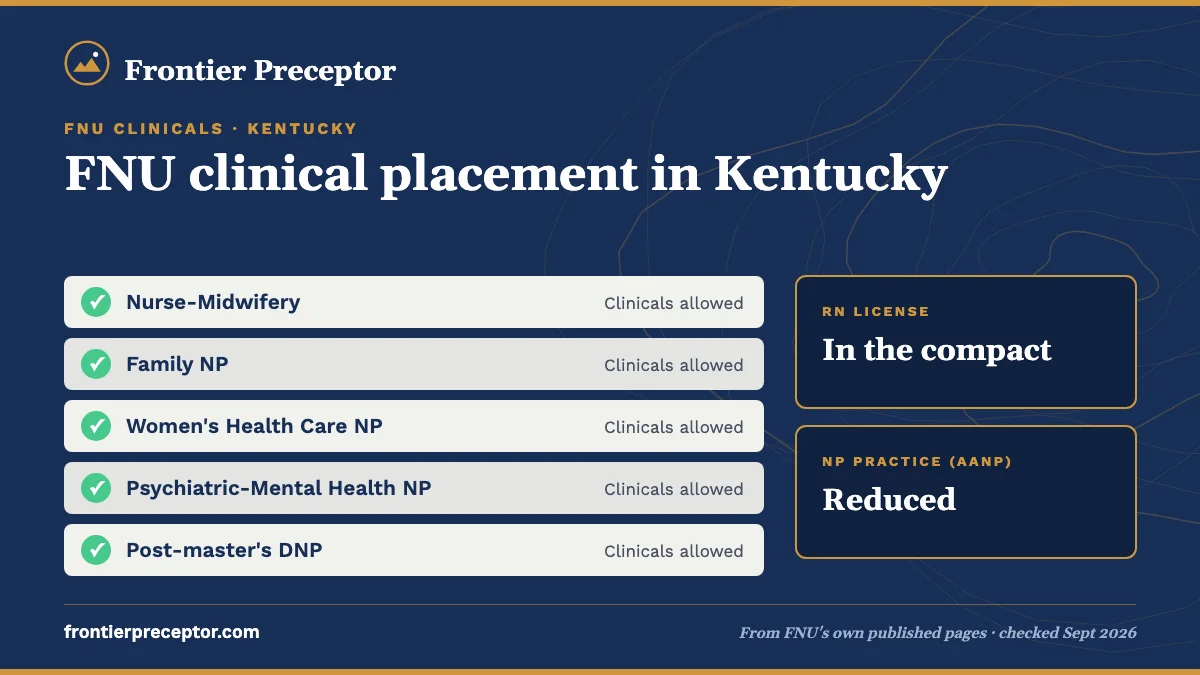
Kentucky at a glance for an FNU student
Every FNU track can train in Kentucky, and DNP students can use Kentucky project sites. On FNU's State License Requirements page, Kentucky is listed as a state where the MSN and PGC tracks satisfy the education needed to license as a CNM, FNP, PMHNP or WHNP.
| Item | Kentucky |
|---|---|
| Board | Kentucky Board of Nursing (KBN) |
| Nurse Licensure Compact | Implemented January 19, 2018 |
| APRN Compact | Not enacted |
| AANP practice environment | Reduced |
| KBN approval for out-of-state programs | Not required, per KBN |
| State preceptor incentive | None found |
| FNU campus | Versailles, for Frontier Bound and Clinical Bound |
Living in FNU's home state doesn't change the model: you line up the preceptor, file the Clinical Site Approval Form (CSAF) from the Community Map, and from there it's with your RCF and Clinical Credentialing. The placement process page has each step.
From Leslie County to Versailles
FNU's roots go back to 1925, when Mary Breckinridge founded the Frontier Nursing Service in Leslie County and brought the first nurse-midwives to the United States, with nurses reaching mountain families on horseback. The Frontier Graduate School of Midwifery took its first class on November 1, 1939, as part of FNS's work with mothers and children in rural Kentucky.
The historic campus was in Hyden. FNU purchased the Versailles land in 2017 and had moved all in-person Bound sessions there by May 2022. Both campus visits therefore happen in your own state: the 3-day orientation before coursework and the five-day, four-night Clinical Bound session before your practicum.
That history explains FNU's emphasis on rural and underserved communities, but it doesn't make Kentucky a placement pipeline: you secure your own site here too.
Reduced practice: physician agreements and a first-year rule
AANP rates Kentucky as reduced practice. Qualifying NPs keep two agreements with a physician to prescribe controlled and non-controlled substances unless the Board exempts them, and newly licensed NPs face employer-setting requirements in their first year.
So ask a prospective preceptor when they were licensed; an NP inside that first year is unlikely to meet FNU's one-year experience rule. Ask too whether the physician behind their agreements sees patients on site: an FNP plan can place as much as 40% of its hours with physicians or PAs. The preceptor requirements page has each track's limits.
KBN's overview for online APRN programs adds that preceptors in Kentucky clinical settings need an active, unencumbered Kentucky APRN license, plus a Kentucky RN license unless they live in a compact state. It targets programs based elsewhere, but raise it with Clinical Credentialing if an out-of-state preceptor offers remote supervision.
What KBN approves, and where FNU sits
KBN says out-of-state nursing programs don't need its approval, even those with no Kentucky presence that run clinicals in the state. It approves prelicensure programs that originate in Kentucky, and among graduate programs only those leading to licensure fall under it.
FNU isn't out-of-state here. It's based in Versailles, its tracks lead to APRN licensure, and an older, undated FNU portal page lists the Kentucky Board among boards that have approved FNU. Meeting state board requirements is part of Clinical Credentialing's job, so KBN questions go to your coordinator.
KBN also cites a KRS 314.101 exemption for nurses from another state rotating in Kentucky through a SARA institution or one licensed by the Kentucky Council on Postsecondary Education. FNU asks for more: a license valid in Kentucky or compact eligibility, checked through Nursys Quick Confirm. Plan around FNU's rule, not the exemption.
Where Kentucky students search, in the metros and beyond
Most FNU students train near home. Use these 2025 Census metros and systems as a map of where to look; none has signed on to take FNU students.
- Louisville/Jefferson County: about 1.40 million people, 1.12 million of them in Kentucky and the rest in Indiana
- Lexington-Fayette: about 535,000
- Cincinnati, OH-KY-IN: about 475,000 Kentucky residents in a metro of 2.31 million
- Bowling Green: about 197,000
Systems include UK HealthCare (University of Kentucky), Norton Healthcare, UofL Health, St. Elizabeth Healthcare and Baptist Health, which covers Kentucky and Southern Indiana.
Away from those metros, FNU warns that rotations "can be competitive, especially in certain regions." Start with the Community Map, which lists sites FNU students have used, and your RCF, who generally lives in your region. For tactics that work outside the cities, see rural clinicals.
Licensing for Kentucky clinical sites
Multistate licenses have been valid in Kentucky since January 19, 2018. Whether your multistate license was issued here or by another compact state you call home, it's good for Kentucky sites.
Five of Kentucky's neighbors are compact states too: Tennessee, Ohio, Indiana, West Virginia and Virginia. That helps in the Louisville and Cincinnati metros, which cross state lines. Telehealth hours depend on a license that fits each patient's state and must stay under your track's cap; the RN license page covers verification and timing.
Nurse-midwifery students in Kentucky
American nurse-midwifery started in Kentucky, but Kentucky students meet the same bar as everyone else. You need 40 births, at least eight in hospital settings, plus 40 managed labors and 40 newborn assessments. FNU prefers a CNM or CM as your main preceptor, accepts only CABC-accredited birth centers, and requires a supervisor in the room for births, procedures and suturing.
For Kentucky's own CNM practice rules, put license or scope questions about a midwife preceptor to KBN or your RCF. Secure the hospital birth site early; the births page breaks down the counts.
Why Kentucky students choose us
When the Community Map and your own network haven't produced a Kentucky preceptor, we take the search on, looking near where you live for a fit with your track and collecting the CSAF and credentialing-file details alongside you. Your RCF and Clinical Credentialing decide on every site. If a preceptor withdraws later, we pick the search straight back up; start with the contact form.
Questions FNU students ask
Does FNU place Kentucky students because the campus is in Versailles?
No. Students secure their own clinical site in every state. Living in Kentucky puts both Bounds in your own state, but your preceptor search, the CSAF and Clinical Credentialing's review work as they do everywhere. Clinical Advisors and the Community Map are the help FNU offers.
Can a Kentucky NP in their first year of practice precept me?
Usually not. FNU's catalog wants a year of relevant advanced practice experience, and a newly licensed Kentucky NP is still under first-year employer-setting requirements. The track's Clinical Director can approve exceptions with the Department Chair and credentialing leadership, but a more experienced preceptor is the safer ask.
Do I need a Kentucky license if I live in Ohio or Tennessee?
No, as long as your home-state license is multistate: Ohio, Tennessee and Kentucky are all in the compact. Students living outside the compact need a Kentucky license, except at sites that accept any US license, such as military or Indian Health Service facilities.
Is there a Kentucky incentive for preceptors who take FNU students?
Kentucky has no preceptor incentive on record, so the benefits come from FNU. Your preceptor receives an honorarium once your practicum ends, scaled to program and hours, plus The Gift of Precepting (6 CE hours), 10% off non-matriculating FNU courses and a record of precepting hours for recertification.
Related pages
Last checked 2026-09-23
We check these pages against FNU's own published sources. Your Clinical Advisor, your RCF and FNU's current guidelines have the final word.
Your site submitted before Clinical Bound.
Tell us your FNU track, your county and your Clinical Bound date. We look for a preceptor and site that fit FNU's rules for your track, and help you get the CSAF and credentialing details right.
- Matched to your track: CNM/CM, NP, or the right mix FNU allows
- Ready for the CSAF, the RCF and Clinical Credentialing
- In person near you, or telehealth within FNU's caps
Start your placement plan
A placement advisor replies with what an FNU-ready preceptor and site look like for you.