Clinicals in Alabama for FNU students
When an APRN program from another state plans Alabama clinicals, the Alabama Board of Nursing expects to hear from that program first. Every FNU track can train here. NPs in the state practice within a formal physician collaboration, and Alabama's preceptor tax credit covers only in-state programs.
Planning Alabama clinicals?
Tell us your track, nearest city and Clinical Bound term. A placement advisor will reply.
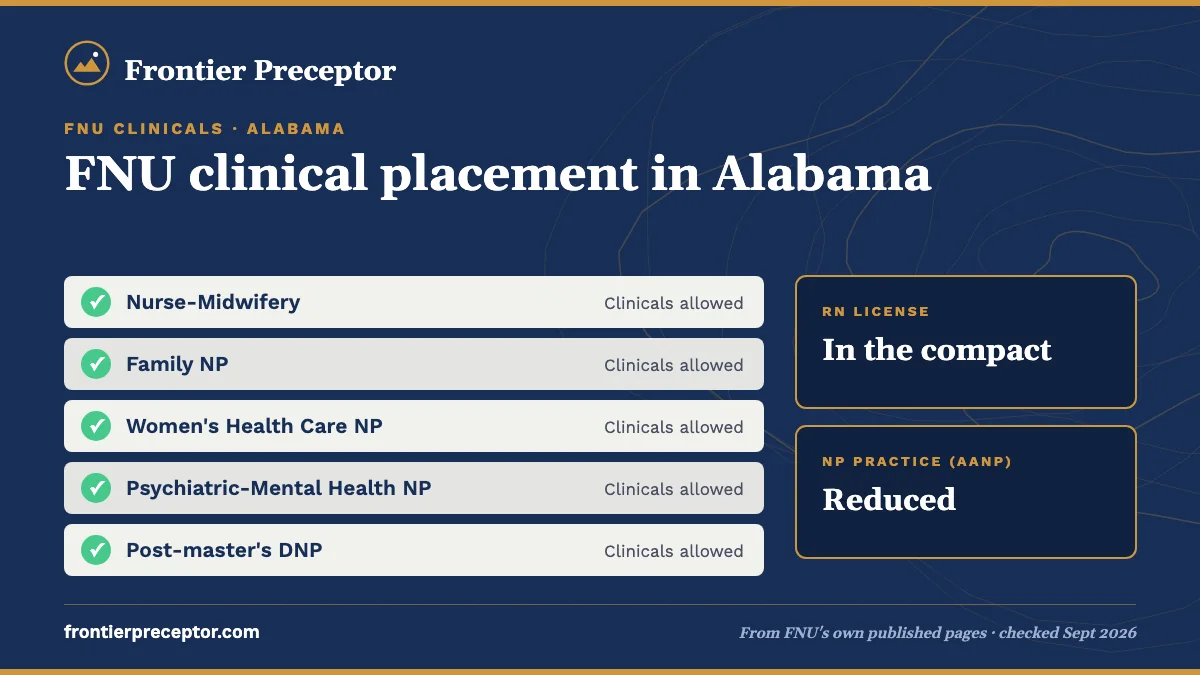
Alabama at a glance
Nurse-midwifery, FNP, WHNP and PMHNP students, in the MSN or a PGC, can all do clinicals in Alabama. FNU's state license page lists Alabama as meeting educational requirements for CNM, FNP, PMHNP and WHNP licensure. Nursing here is overseen by the Alabama Board of Nursing (ABN); the state's Nurse Licensure Compact membership dates from January 1, 2020, and AANP classes Alabama as reduced practice.
As everywhere at FNU, you find and secure the preceptor and site, with help from Clinical Advisors, the Community Map and your RCF, and Clinical Credentialing signs the affiliation agreement. What's different in Alabama is the state step alongside it.
The ABN filing for out-of-state APRN programs
An ABN rule, 610-X-3-.09 in the state's Administrative Code, obliges a prelicensure or advanced practice program based outside Alabama to send the ABN a letter of intent and approval documents at least 15 days before clinical learning experiences in Alabama. That packet identifies you by name and license number, gives the same two details for your clinical supervisor and names the facility; a statement from that facility's CNO or Director of Nursing rounds it out.
Each program also pays a yearly out-of-state program fee, good for one calendar year and non-refundable. Per the ABN, Alabama clinicals stay closed to its students until Board approval is granted and that fee paid.
This filing belongs to FNU, not you, and an older, undated FNU portal page listed the ABN among boards that had approved FNU. Because your preceptor and facility are named in it, a late change can matter, so confirm with your Clinical Advisor how the Alabama timing fits your start. See Clinical Credentialing on lead times.
Collaborative practice and two boards
AANP describes Alabama NPs as tied to a physician through a collaborative agreement the state regulates, one that extends to at least one practice element. Oversight of NP practice is shared by two boards, Nursing and Medical Examiners. Any NP preceptor you line up practices inside such an agreement, with a collaborating physician in the background.
FNU's bar for the NP doesn't move: one year of relevant advanced practice experience on top of a valid, unencumbered US license. Physicians and PAs may supervise as much as 40% of an FNP student's hours, so a collaborating physician may round out a plan. See FNP preceptors for the detail.
Birmingham, Huntsville, Mobile and Montgomery
The 2025 Census estimates put Birmingham first among Alabama metros at roughly 1.2 million residents, ahead of Huntsville (about 556,000), Mobile (412,000) and Montgomery (389,000). Big employers to research start with UAB Medicine and Huntsville Hospital Health System; Mobile adds Infirmary Health and USA Health, while Montgomery has Baptist Health. They're examples of where clinicians practice, not sites that have agreed to take FNU students.
Beyond those metros, the state's own preceptor tax program targets medically underserved rural areas, which fits FNU's rural mission. Rural clinicals has search ideas.
APTIP: a credit your FNU preceptor can't claim
Administered through the Alabama Statewide AHEC Program Office, the Alabama Preceptor Tax Incentive Program grants a state income tax credit to uncompensated community-based preceptors in medically underserved rural areas, per 160-hour rotation and up to 12 rotations a year. NPs and CNMs are among the eligible clinicians. It counts only rotations for programs physically located in Alabama, so precepting an FNU student doesn't qualify. The Department of Revenue says the credit applies from tax year 2024 and expires September 29, 2031.
Licensing for Alabama clinicals, and midwifery
For post-licensure students (RN to BSN, MSN, DNP) in Alabama clinicals, the ABN asks for one of two credentials: a valid, unencumbered RN license issued by Alabama, or any multistate license a party state issued. Past 30 teaching days a year in Alabama, faculty also have to hold an Alabama license or a multistate one. For telehealth, each patient's state counts, and Alabama hasn't enacted the APRN Compact. RN licenses for clinicals explains the compact.
APTIP names CNMs, but Alabama's midwifery practice rules aren't covered here. Plan births to FNU's standard of 40, at least 8 in hospital, and raise Alabama-specific questions with your Clinical Advisor.
Why Alabama FNU students choose us
We look for Alabama preceptors who fit your track and collect with you the preceptor and facility details the CSAF needs, the same facts the ABN filing draws on, so they're settled long before the 15-day deadline. If a preceptor drops, we stay on it. FNU and the ABN make the decisions, and your side of the file reaches them complete. Contact the placement desk.
Questions FNU students ask
What happens if my Alabama preceptor changes close to my start?
Because the ABN filing lists the facility and clinical supervisor and is due at the Board no later than 15 days ahead of clinicals, a late change can shift timing on top of FNU's own RCF and credentialing steps. Tell your RCF and Clinical Advisor at once. Next moves are laid out on our preceptor dropped out page.
Can I use a Georgia multistate license for Alabama clinicals?
Yes, if Georgia is your compact home state and the license is multistate. For post-licensure students, the ABN takes either an unencumbered RN license from Alabama or a party state's multistate license. A license limited to a non-compact home state leaves Alabama uncovered. Your license number goes into the ABN filing, and FNU verifies it through Nursys Quick Confirm.
Can an Alabama CNM precept my FNU midwifery clinicals?
Yes, and FNU wants a CNM or CM as the midwifery primary preceptor where possible. FNU accepts BSN-prepared midwives, though it prefers an MSN, and the catalog requires in-the-room supervision for procedures, births and suturing. APTIP's credit for CNMs covers only Alabama-based programs, so it won't apply to your rotation.
Does reduced practice in Alabama limit who can precept me?
Not under FNU's rules. An Alabama NP with an unencumbered license and a year in advanced practice can be proposed as your preceptor, even though a physician collaboration agreement frames their practice. The agreement shapes the practice itself. Your RCF reviews each preceptor and site, and Clinical Credentialing credentials the preceptor before you start.
Related pages
Last checked 2026-09-23
We check these pages against FNU's own published sources. Your Clinical Advisor, your RCF and FNU's current guidelines have the final word.
Your site submitted before Clinical Bound.
Tell us your FNU track, your county and your Clinical Bound date. We look for a preceptor and site that fit FNU's rules for your track, and help you get the CSAF and credentialing details right.
- Matched to your track: CNM/CM, NP, or the right mix FNU allows
- Ready for the CSAF, the RCF and Clinical Credentialing
- In person near you, or telehealth within FNU's caps
Start your placement plan
A placement advisor replies with what an FNU-ready preceptor and site look like for you.