Mississippi clinicals for Frontier Nursing University students
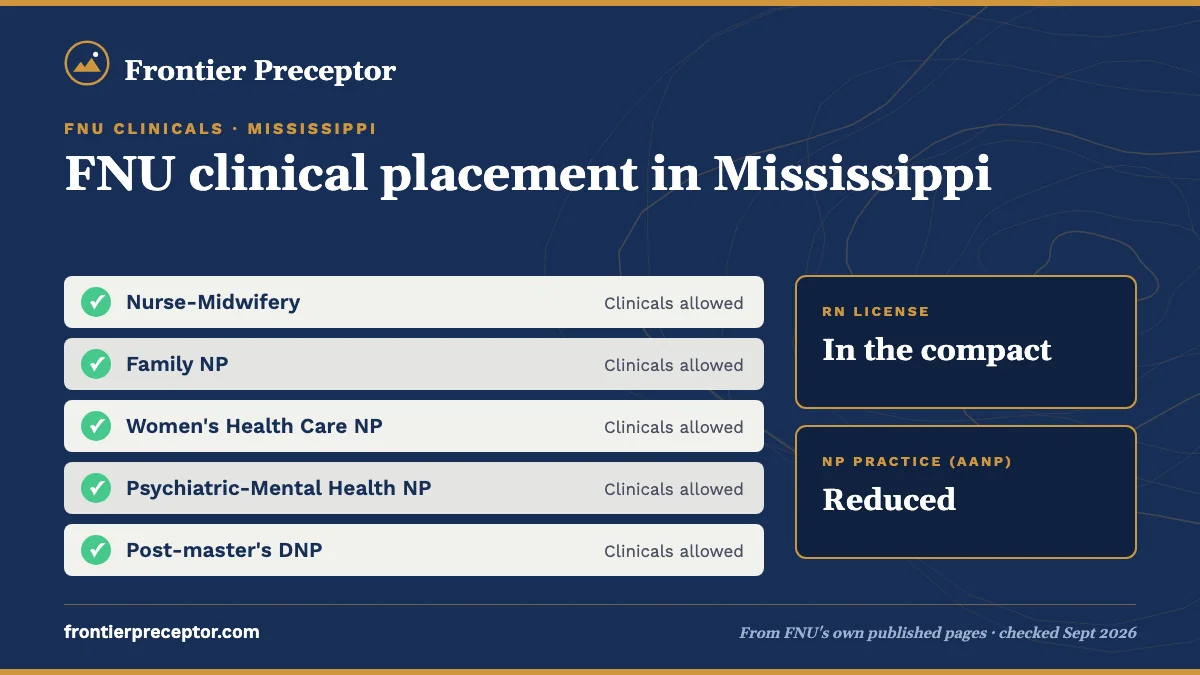
In Mississippi, the higher-education board, not the Board of Nursing, reviews out-of-state nursing programs that bring students in for clinicals. Every FNU track can train here, NPs practice in a board-approved collaboration with a physician or dentist, and a compact RN license covers you.
Looking for a Mississippi preceptor?
Give us your track, nearest town and Clinical Bound term. A placement advisor will reply.
Mississippi for FNU students, briefly
Mississippi's entry on FNU's state license page says the MSN and PGC programs satisfy its education requirements for licensure in all four specialties, and no FNU rule closes the state to any track. Licensing nurses and approving practical nursing programs falls to the Mississippi Board of Nursing; RN degree programs instead follow standards set by the state's higher-education trustees, known as IHL. Mississippi joined the Nurse Licensure Compact on January 19, 2018, and AANP rates it reduced practice.
Your part is FNU's usual one: secure a preceptor and site, submit the CSAF through the Community Map, and work toward 750 hours plus visit counts once your RCF and Clinical Credentialing have approved the site.
The IHL review for out-of-state programs
IHL says out-of-state undergraduate and graduate nursing degree programs that offer clinical experiences in Mississippi are expected to meet Mississippi standards. It treats clinical practicums in the state as domiciled, which triggers physical presence, so the program must be reviewed by IHL Nursing Education. The review may take up to three months, and IHL's procedures manual (August 2024, Appendix S) says programs controlled outside Mississippi should request it at least four months before starting.
The program must also participate in SARA or obtain non-SARA distance-education authorization through MCCA. FNU is an approved NC-SARA institution, which answers that part; the IHL review is separate. Confirm with your Clinical Advisor where FNU stands with IHL and what lead time your site needs, and read the placement timeline with that in mind.
Collaborative practice with a physician or dentist
AANP describes Mississippi NP practice as collaborative: the relationship needs board approval, and the partner is a Mississippi-licensed physician or dentist. The NP who precepts you therefore works inside an approved collaboration, and the scope you see in clinic reflects it.
Who can supervise you is still FNU's call: a preceptor with a year of relevant advanced practice behind them and no encumbrance on their US license, with physician and PA time capped at 40% of FNP hours. PMHNP students need a preceptor with psychiatric prescribing authority on the CSAF their RCF accepts, and may add up to 135 hours with a licensed therapist. Preceptor requirements has each track.
Jackson, the Coast, Hattiesburg and the Memphis edge
Jackson had about 610,000 people in the 2025 Census estimates, Gulfport-Biloxi about 431,000 and Hattiesburg about 158,000, and the Memphis metro adds about 278,000 people on the Mississippi side of the line. Systems students contact range from the University of Mississippi Medical Center to Forrest Health, and include Singing River Health System and Baptist Memorial Health Care, which runs Mississippi Baptist Medical Center in Jackson, as well as North Mississippi Health Services. None is a confirmed FNU site; they show where to start asking.
Beyond those metros, smaller practices and clinics are where FNU's rural and underserved focus leads, and rural clinicals covers that search. The Mississippi State Department of Health is the state health agency. Mississippi has no preceptor incentive on record; what a preceptor gets comes from FNU, chiefly its honorarium and continuing education.
Your RN license under IHL standards and the compact
IHL's standards require post-licensure students in APRN clinical courses to hold an unencumbered RN license to practice in the state where they do clinicals, and out-of-state programs are expected to keep the same standard. The Board adds a compact point: a nurse whose declared primary state of residence is a compact state, and who stays in good standing, may practice in other compact states, and employers can't require a remote-state license. The APRN Compact isn't enacted in Mississippi, and RN licenses for clinicals walks through the compact rules.
Mississippi's CNM practice rules aren't part of this page. Midwifery students should build to FNU's standards, ideally a CNM or CM as primary preceptor and at least 8 of 40 births in hospital, and check local points with their Clinical Advisor.
Why Mississippi students choose us
We search for Mississippi preceptors who fit your track, including across a state line when that's closer, and line up what the CSAF and Credentialing will ask for alongside you. With an IHL review in the picture, we put timing on the table from the first conversation. Every site decision belongs to FNU, and an early, complete file gives it the most room. Get in touch.
Questions FNU students ask
Does the Mississippi Board of Nursing approve FNU for clinicals?
Not in the way many students expect. In Mississippi, IHL rather than the Board of Nursing oversees nursing degree programs and reviews out-of-state programs that offer clinicals in the state. The Board licenses nurses and approves practical nursing programs. Ask your Clinical Advisor where FNU's IHL review stands for your term before you ask a preceptor to hold dates.
Can a Memphis-area preceptor work if I live in north Mississippi?
Possibly. FNU has no home-state rule, and the Memphis metro spans Tennessee, Mississippi and Arkansas. A site in Tennessee means you need a license valid in Tennessee, and Mississippi's IHL review is about clinicals inside Mississippi; Clinical Credentialing handles the other state's requirements. Talk to your RCF before committing, since site changes run through the RCF for your region.
Do Mississippi NPs need their collaborating physician's sign-off to precept me?
FNU doesn't say so. Its rules focus on the preceptor's own license standing and advanced practice experience. The collaboration a Mississippi NP holds with a physician or dentist is part of how their practice runs, so it's reasonable to ask how the practice handles students. Your RCF and Clinical Credentialing make the formal decisions on site and preceptor.
How early should I line up a Mississippi site?
Earlier than FNU's own steps alone suggest. Credentialing can take several months, and IHL's manual asks out-of-state programs to request review at least four months before starting, with the review itself taking up to three. Whether FNU already has that review for your dates is a question for your Clinical Advisor. If time is short, see need a preceptor fast.
Related pages
Last checked 2026-09-23
We check these pages against FNU's own published sources. Your Clinical Advisor, your RCF and FNU's current guidelines have the final word.
Your site submitted before Clinical Bound.
Tell us your FNU track, your county and your Clinical Bound date. We look for a preceptor and site that fit FNU's rules for your track, and help you get the CSAF and credentialing details right.
- Matched to your track: CNM/CM, NP, or the right mix FNU allows
- Ready for the CSAF, the RCF and Clinical Credentialing
- In person near you, or telehealth within FNU's caps
Start your placement plan
A placement advisor replies with what an FNU-ready preceptor and site look like for you.