Louisiana clinicals for FNU students: plan around the Board's timeline
All FNU tracks can train in Louisiana, but the Louisiana State Board of Nursing regulates out-of-state graduate programs directly. Its rule asks for approval six months before clinicals, Louisiana-licensed faculty and weekly faculty contact with you and your preceptor, so talk timing with your Clinical Advisor before you settle on a site.
Planning Louisiana clinicals?
Tell us your track, parish and Clinical Bound term. A placement advisor will reply.
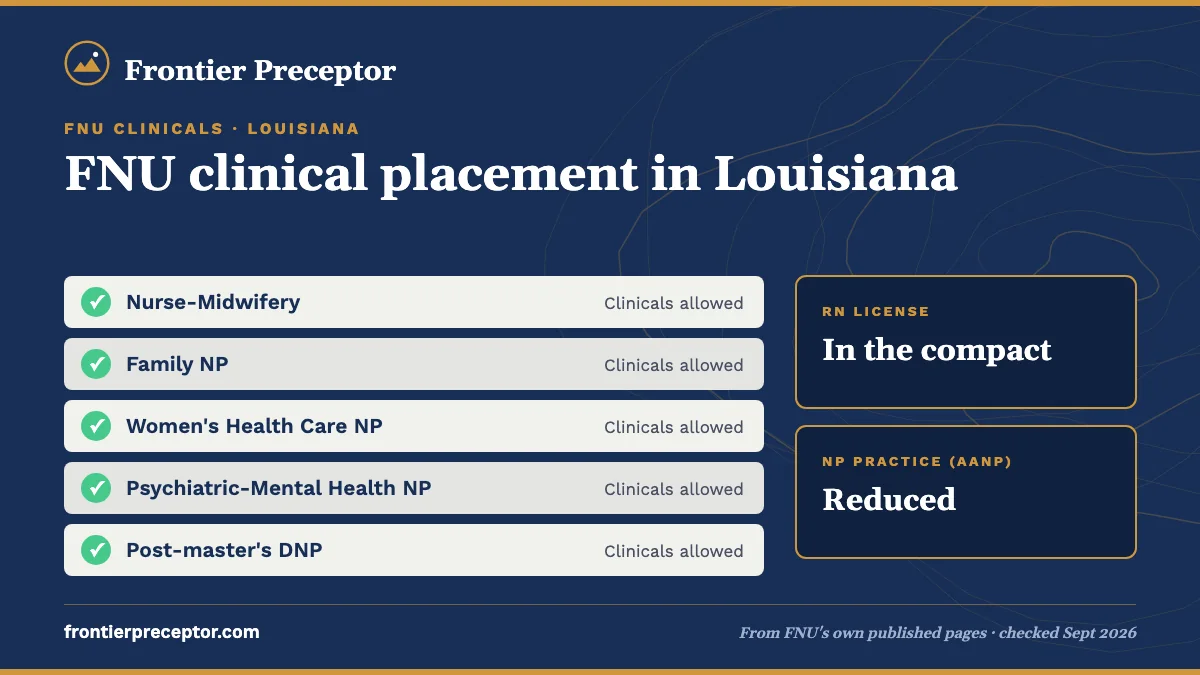
What Louisiana means for your FNU plan
On FNU's state license page, Louisiana's entry says the MSN and PGC programs meet its education requirements for licensure in all four specialties, so every track can do clinicals here. The Louisiana State Board of Nursing is the board for registered nurses; practical nurses answer to a separate board. Louisiana's Nurse Licensure Compact implementation dates to July 1, 2019, and AANP rates the state reduced practice.
FNU's model is unchanged: the search for a preceptor and site is yours, the RCF reviews your CSAF, and the affiliation agreement is handled by Clinical Credentialing. Your target is 750 hours plus visit counts, and 40 births with at least 8 in hospital if you're in nurse-midwifery.
Six months' notice under LAC 46:XLVII.3539
LAC 46:XLVII.3539 requires Board approval before any undergraduate or graduate nursing program whose administrative control is in another state can offer courses or clinical experiences in Louisiana. The program submits a request letter naming the clinical agencies and units, with its curriculum, syllabi, catalog, a clinical facility survey form, faculty qualification forms and exam pass data, at least six months before the offering starts. It also needs home-state approval, regional accreditation, and national nursing accreditation the Board recognizes. Approval lasts up to three years and can be renewed by petition.
For graduate students, the Board's clinical experience spreadsheet is due no later than two weeks into the experience. Louisiana did appear on an older, undated FNU portal list of boards that had approved FNU, but its current status isn't confirmed. Confirm with your Clinical Advisor whether your agency and unit are covered and what lead time applies.
Louisiana-licensed faculty and weekly contact
The same rule says every faculty member of an out-of-state program who provides instruction in Louisiana must hold a current Louisiana license as an RN and/or APRN, a graduate degree in nursing and at least two years of clinical nursing practice. In precepted graduate clinicals, program faculty must confer with the preceptor and student at least weekly and visit the site at least once per semester or quarter.
At FNU your Regional Clinical Faculty member is the faculty contact who visits and grades, and the catalog describes RCF contact with students every two weeks and preceptors monthly. Ask your RCF how Louisiana's weekly conference will work for your rotation, and tell your preceptor it's part of the arrangement.
Collaborative agreements and who precepts
AANP's Louisiana fact sheet describes reduced practice, meaning a physician and the NP work under a regulated collaborative agreement that governs one or more elements of practice. Your NP preceptor works within it, while FNU asks for at least a year of relevant advanced practice experience and an unencumbered license. The collaborating physician can matter for FNP students, since FNU permits no more than 40% of their hours with physicians or PAs, and PMHNP students have no time cap with a psychiatrist preceptor.
Louisiana has no preceptor incentive on record, which leaves FNU's own honorarium and CE course as your talking points when you ask a preceptor.
New Orleans to Shreveport
Louisiana's largest metros in the 2025 Census estimates are New Orleans-Metairie (about 971,000), Baton Rouge (889,000), Lafayette (424,000) and Shreveport-Bossier City (383,000). Ochsner Health and LCMC Health are major systems, as are Willis-Knighton Health, Baton Rouge General and FMOL Health; they are examples of where clinicians practice rather than sites committed to FNU students. Because the Board's request letter names agencies and units, tell your Clinical Advisor exactly which agency and unit you'd use.
Outside those metros, rural clinics and community practices match FNU's rural and underserved focus. The state's public health agency is the Office of Public Health, part of the Louisiana Department of Health.
Licensing, midwifery and why students choose us
Either a Louisiana RN license or a multistate one from the compact state you live in covers you; telehealth also needs each patient's state, and Louisiana hasn't enacted the APRN Compact. For nurse-midwifery, lean on FNU's standards, a CNM or CM as primary preceptor where possible and birth centers only if CABC-accredited, since Louisiana's midwifery practice law is outside this page. Our RN licenses for clinicals page sets Louisiana's compact position beside other states.
We search Louisiana for preceptors in your track, start early to fit the Board's timeline, and pull together with you the agency, unit and preceptor details for the CSAF. FNU and the Board give the approvals, and your details reach them in good time. Tell us your timeline.
Questions FNU students ask
Does Louisiana's six-month rule delay my FNU clinicals by six months?
Not necessarily. The six months apply to the program's request to offer clinicals in Louisiana, and an approval can last up to three years. If FNU already holds a current approval that covers your agency, your timeline may be shorter. Ask your Clinical Advisor early, before any preceptor holds a start date for you.
Does my FNU faculty member need a Louisiana license?
Under Louisiana's rule, faculty of an out-of-state program who instruct in Louisiana must hold a current RN and/or APRN license issued by Louisiana. At FNU, the faculty member closest to your rotation is your RCF, who visits the site and assigns clinical grades with input from your preceptor. How FNU covers this for Louisiana is a question for your Clinical Advisor, not something you arrange yourself.
Can I cross into Texas or Mississippi for part of my hours?
You can. Nothing in FNU's rules ties you to your home state, and Texas and Mississippi share the Nurse Licensure Compact with Louisiana, so one multistate license covers all three. Texas's out-of-state approval rule targets pre-licensure programs, while Mississippi runs an IHL review. Each site needs its own CSAF and credentialing, within FNU's site limits. See Texas and Mississippi.
Is Louisiana a compact state for FNU clinicals?
Yes. Since July 1, 2019, when Louisiana implemented the compact, any compact home state's multistate license has covered clinical work in Louisiana. A nurse holding just one single-state license, issued outside the compact, needs a Louisiana RN license first. FNU verifies licenses through Nursys Quick Confirm before Clinical Bound.
Related pages
Last checked 2026-09-23
We check these pages against FNU's own published sources. Your Clinical Advisor, your RCF and FNU's current guidelines have the final word.
Your site submitted before Clinical Bound.
Tell us your FNU track, your county and your Clinical Bound date. We look for a preceptor and site that fit FNU's rules for your track, and help you get the CSAF and credentialing details right.
- Matched to your track: CNM/CM, NP, or the right mix FNU allows
- Ready for the CSAF, the RCF and Clinical Credentialing
- In person near you, or telehealth within FNU's caps
Start your placement plan
A placement advisor replies with what an FNU-ready preceptor and site look like for you.