FNU clinicals in Wisconsin: check the school list, then search
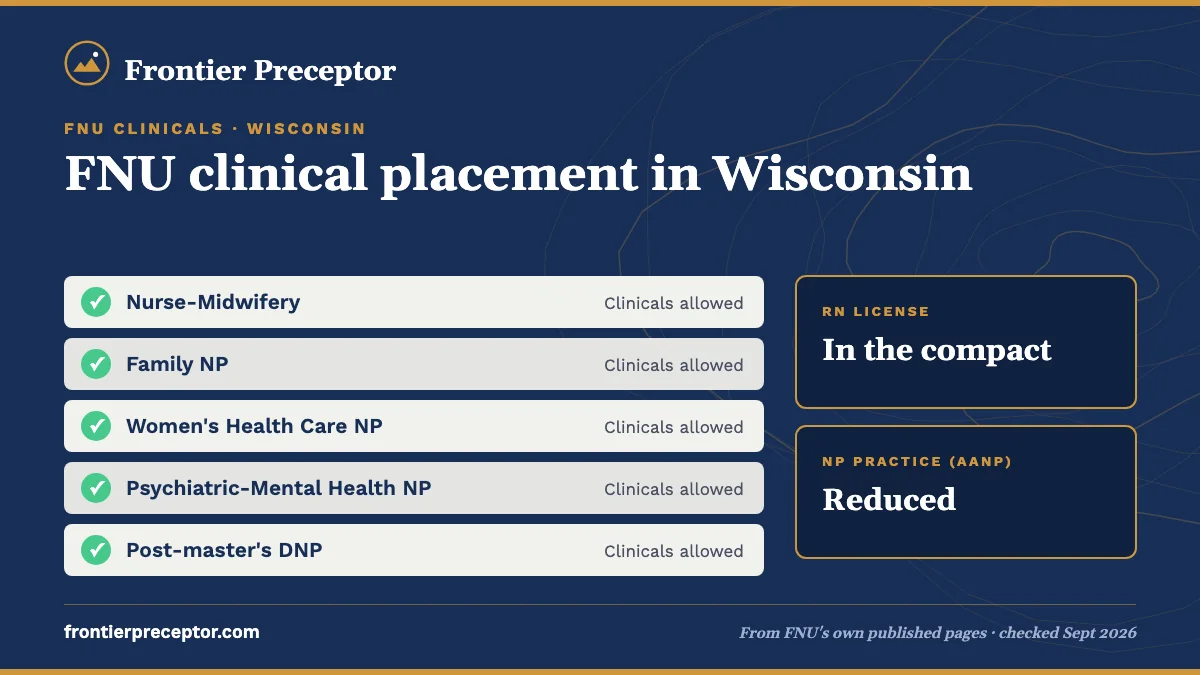
Wisconsin is a compact state, so a multistate RN license lets you train here, and FNU reports that its MSN and PGC programs satisfy Wisconsin's educational requirements. Wisconsin's Board also approves out-of-state schools of nursing, graduate programs included. Confirm how FNU stands with that rule before you lock in a site.
Planning Wisconsin clinicals?
Tell us your track, your nearest city and your projected Clinical Bound term.
Wisconsin's approval rule for out-of-state schools
DSPS Form 3067-OEE (revised 04/13/2026) says Wis. Admin. Code N 1.06 sets approval requirements for out-of-state schools of nursing, which "must be approved by the Wisconsin Board of Nursing". The form covers practical nurse and RN programs at the associate, bachelor's (including post-licensure bachelor's) and graduate levels. Approved schools file a self-evaluation report, Form 3069OEE, for continued approval.
DSPS publishes an Approved Out Of State Nursing Schools list, and FNU's status on it is still to be confirmed. Ask your Clinical Advisor whether Wisconsin placements are open for your term and track before you spend weeks courting a preceptor. Meeting state board requirements for placement is part of Clinical Credentialing's job, and FNU's catalog notes that some states need advance notice.
The rule names graduate programs, so don't assume it only affects pre-licensure schools. Confirm with your Clinical Advisor first.
Before you commit to a Wisconsin site
- Ask about the state listAsk your Clinical Advisor how FNU treats Wisconsin's out-of-state school approval for your track.
- Check your RN licenseWisconsin's compact status dates to January 19, 2018, so a multistate license works. An Illinois or Minnesota license, being single-state, does not.
- Check the preceptor's licenseFaculty and preceptors for Wisconsin clinicals must hold a Wisconsin license or a privilege to practice in Wisconsin.
- Submit the CSAFOnce the preceptor commits, file the CSAF through the Community Map so your RCF can review it.
The APRN law that took effect September 1, 2026
Under 2025 Wisconsin Act 17, DSPS now issues APRN licenses in four recognized roles: NP, CRNA, CNS and CNM. Existing APNP licenses have been converted to APRN licenses. Independent practice without a collaborating physician requires a separate application and Board approval.
In AANP's data Wisconsin is still reduced practice, NPs working in a collaborative relationship with a physician, with a note on the Act's September 2026 start. Expect a mix: some preceptors practicing with a collaborating physician, some approved for independent practice, and credentials now reading APRN rather than APNP.
For midwifery students, the change matters because CNM is now named as one of the four APRN license roles. Your FNU targets don't change: 40 births, a minimum of 8 of them in hospital, and a CNM or CM preferred as your main preceptor. See our nurse-midwifery preceptor page.
Milwaukee, Madison, Green Bay and the border metros
The Milwaukee-Waukesha metro holds about 1.6 million people and Madison about 710,000, with Green Bay and Appleton next. Large systems include Aurora Health Care, Froedtert ThedaCare Health, UW Health, Ascension Wisconsin and Aspirus Health. These show where to search, not who has agreed to host FNU students.
Part of the Minneapolis-St. Paul and Duluth metros lies in Wisconsin. Taking a site on the Minnesota side raises a Minnesota license question, because Minnesota isn't in the compact; see Minnesota. No Wisconsin preceptor incentive is on record.
Our placement desk looks for Wisconsin preceptors in your track who hold the Wisconsin license or compact privilege the state requires, then assembles the CSAF details with you. FNU decides whether a Wisconsin site passes, and ours arrive with the license requirement already met.
Questions FNU students ask
Is FNU on Wisconsin's approved out-of-state nursing schools list?
FNU's status is still to be confirmed. Wisconsin requires out-of-state schools of nursing, including graduate programs, to be approved by its Board, and DSPS publishes the approved list. Your Clinical Advisor or Clinical Credentialing can tell you how FNU handles Wisconsin placements before you commit to a site.
Does my multistate RN license cover FNU clinicals in Wisconsin?
Yes, if it's an active, unencumbered multistate license. Wisconsin's compact membership took effect January 19, 2018. FNU verifies licenses through Nursys Quick Confirm. Nurses whose only license is a single-state one from Illinois, Minnesota or another non-member need a Wisconsin RN license.
What changed for Wisconsin nurse practitioners in 2026?
2025 Wisconsin Act 17 took effect September 1, 2026. DSPS now licenses APRNs in four roles, converted APNP licenses to APRN, and lets APRNs apply separately for independent practice without a collaborating physician. For your search, a preceptor's license may now read APRN, and their practice arrangement may vary.
I live on the Minnesota side of the Twin Cities. Can I see Wisconsin patients by telehealth?
Only with a license valid in Wisconsin, because FNU applies the licensing rules of the state where the patient lives, and a Minnesota single-state license stops at the border. Once licensed, those visits count up to your track's telehealth cap, for example 20% of hours for midwifery and WHNP.
Related pages
Last checked 2026-09-23
We check these pages against FNU's own published sources. Your Clinical Advisor, your RCF and FNU's current guidelines have the final word.
Your site submitted before Clinical Bound.
Tell us your FNU track, your county and your Clinical Bound date. We look for a preceptor and site that fit FNU's rules for your track, and help you get the CSAF and credentialing details right.
- Matched to your track: CNM/CM, NP, or the right mix FNU allows
- Ready for the CSAF, the RCF and Clinical Credentialing
- In person near you, or telehealth within FNU's caps
Start your placement plan
A placement advisor replies with what an FNU-ready preceptor and site look like for you.