Florida clinicals for Frontier Nursing University students
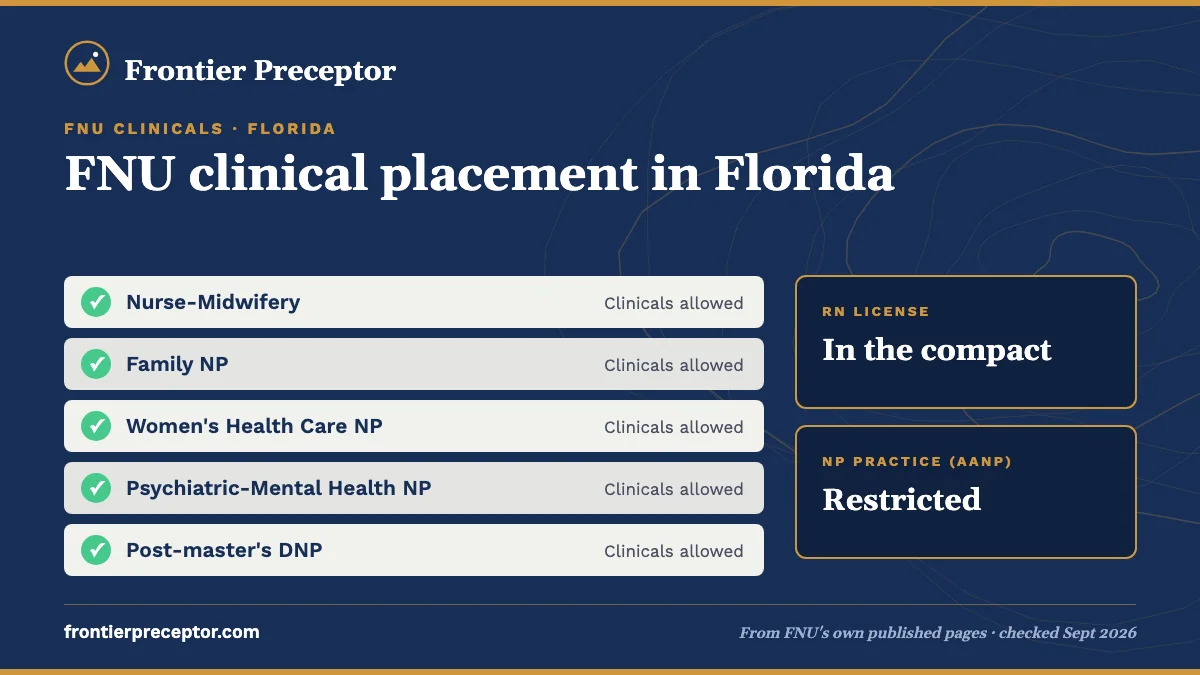
Florida is open to every FNU track and sits in the Nurse Licensure Compact, and no provision was found requiring out-of-state graduate programs to get Board of Nursing approval first. What's specific here is the physician protocol many NPs work under, and a clinical funding program that leaves out schools based elsewhere.
Searching for a Florida preceptor?
Share your track, county and Clinical Bound term. A placement advisor will reply.
What Florida looks like for an FNU practicum
Nurse-midwifery, FNP, WHNP and PMHNP students, MSN or PGC, can all do clinicals in Florida. According to FNU's state license page, its programs satisfy Florida's education requirements for licensure as a CNM, FNP, PMHNP or WHNP. Licensing sits with the Florida Board of Nursing, and the state's compact membership dates to January 19, 2018.
The search is still yours. FNU expects you to secure a preceptor and a site, submit the CSAF through the Community Map, and let your Regional Clinical Faculty member and Clinical Credentialing approve it; the affiliation agreement is Credentialing's job and can take several months. Across your sites you'll need 750 hours and your track's visit counts.
Protocol agreements and your Florida preceptor
AANP lists Florida as restricted. Its fact sheet says select Florida NPs must keep a career-long protocol agreement with a physician, and that exemptions may apply. So the NPs you approach won't all be set up the same way. Ask how a practice is organized, because the answer tells you which physicians are connected to it.
FNU judges the preceptor, not the protocol: an unencumbered US license and one year of advanced practice experience. A protocol physician can help, too. FNP students may log up to 40% of hours with an MD, DO or PA, and midwifery and WHNP students may add MD or DO preceptors alongside a primary CNM, CM or WHNP. The preceptor requirements page lists each track's rules.
No Board filing found for graduate programs
Florida's program-approval law, section 464.019, applies to an institution that wishes to conduct a program in the state for the pre-licensure education of nurses, and the Board describes its role as approving pre-licensure programs. Nothing in Florida's rules that turned up requires out-of-state graduate or APRN programs to seek Board approval or give the Board notice before placing students in the state.
That keeps the state side light, but FNU's own steps don't shrink: the affiliation agreement, the insurance exchange and preceptor credentialing all still happen. Because FNU warns that certain states expect advance notice, check with your Clinical Advisor before assuming a Florida site needs nothing more.
Searching from Miami to Jacksonville
Florida's biggest metros in the 2025 Census estimates include Miami-Fort Lauderdale-West Palm Beach at about 6.4 million people, Tampa-St. Petersburg-Clearwater at 3.4 million, Orlando-Kissimmee-Sanford at 3.0 million and Jacksonville at 1.8 million. AdventHealth is one of the systems, as are HCA Florida Healthcare, BayCare Health System, UF Health and Baptist Health South Florida. Use them as a map of where clinicians practice, not as places that have agreed to host FNU students.
For underserved care, look at the settings Florida itself targets for clinical funding: rural health clinics, federally qualified health centers, certified community behavioral health clinics and community mental health centers. Those fit FNU's rural and underserved focus, and rural clinicals has ideas for searching beyond the big metros.
Florida's TEACH funding and FNU
AHCA runs the Training, Education, and Clinicals in Health (TEACH) Funding Program under section 409.91256; it pays qualified facilities per clinical hour for nursing students and for APRN students in primary care. It pays the facility, not the preceptor, it's subject to appropriation, and preceptors must be Florida-licensed. It only covers students in accredited programs based in Florida, so an FNU rotation doesn't qualify. The section is set to be repealed July 1, 2034.
If a Florida clinic mentions TEACH, you'll know where you stand; FNU's own honorarium, based on program and hours, is what your preceptor receives.
Licensing and midwifery points for Florida
A multistate license from your compact home state covers Florida clinicals; a single-state license from a non-compact state means applying for a Florida license first. Telehealth rotations need licensure wherever the patient lives. Florida hasn't enacted the APRN Compact. Our RN licenses for clinicals page explains the compact in more depth.
Florida's midwifery practice law is outside this page, so for nurse-midwifery rely on FNU's rules and your Clinical Advisor: a CNM or CM as primary preceptor where possible, 40 births with at least 8 in hospital, and CABC-accredited birth centers only. Midwifery births explains the counts.
Why Florida FNU students choose us
We search Florida for preceptors who match your track and region, check every detail the CSAF will ask for, and stay available if a preceptor steps back. Every site decision is made by FNU's RCF and Clinical Credentialing, and yours reaches them ready to review. Start a request.
Questions FNU students ask
Can a Florida NP with a physician protocol precept me at FNU?
FNU's published preceptor rules don't mention protocol agreements. They ask for a valid, unencumbered US license and at least a year in an advanced practice role, and a Florida NP who meets that can be proposed on your CSAF. Clinical Credentialing credentials each preceptor, and your RCF decides whether the site and preceptor fit your track.
Can I use a Florida birth center for FNU midwifery births?
Only a CABC-accredited one, which FNU requires of every birth center. Out-of-hospital births are recommended but optional, and at least 8 of your 40 births must happen in a hospital, so a plan built around a birth center still needs a hospital site. Home-birth sites get extra review before approval.
Can I split FNU clinicals between Florida and Georgia?
Yes. FNU has no home-state rule, and both states are in the Nurse Licensure Compact, so one multistate license covers both. Each site needs its own CSAF, RCF acceptance and credentialing, and FNU caps sites: four for most tracks, three for WHNP in the catalog. Georgia has its own licensing rules for preceptors; see our Georgia page.
Do I need Florida licensure for telehealth with Florida patients?
Yes. FNU's rule looks at where the patient lives, not where you sit, so Florida patients mean meeting Florida licensing requirements, which a compact multistate license can satisfy. Telehealth is capped too: 20% of hours for midwifery and WHNP, 10% for FNP, and 450 hours for PMHNP students starting clinical in 2025 or later.
Related pages
Last checked 2026-09-23
We check these pages against FNU's own published sources. Your Clinical Advisor, your RCF and FNU's current guidelines have the final word.
Your site submitted before Clinical Bound.
Tell us your FNU track, your county and your Clinical Bound date. We look for a preceptor and site that fit FNU's rules for your track, and help you get the CSAF and credentialing details right.
- Matched to your track: CNM/CM, NP, or the right mix FNU allows
- Ready for the CSAF, the RCF and Clinical Credentialing
- In person near you, or telehealth within FNU's caps
Start your placement plan
A placement advisor replies with what an FNU-ready preceptor and site look like for you.