FNU clinicals in South Carolina
A compact RN license covers South Carolina clinicals for every FNU track. The state details to know are physician practice agreements with controlled-substance limits for NPs, a Board rule for out-of-state programs that is written for initial-licensure schools, and a preceptor tax credit that only reaches students at South Carolina institutions.
Want help finding a South Carolina preceptor?
Tell us your track, region and Clinical Bound term. A placement advisor will reply.
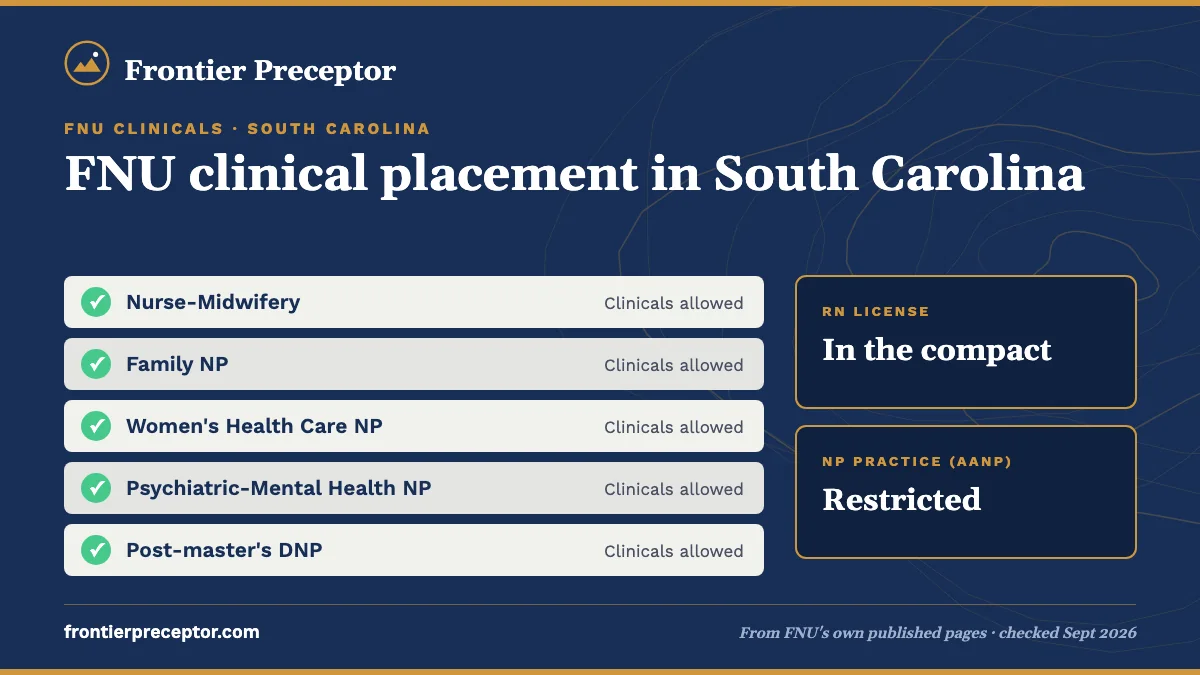
The short version for South Carolina
South Carolina appears on FNU's state license page as a state where the MSN and PGC programs meet licensure education requirements for all four specialties, so nurse-midwifery, FNP, WHNP and PMHNP students can all place here. The South Carolina Board of Nursing licenses nurses. The state has used the Nurse Licensure Compact since January 19, 2018, and AANP classes it as restricted.
As an FNU student you secure the preceptor and the site, submit the CSAF through the Community Map, and wait for RCF acceptance and Clinical Credentialing, which can take several months. Once cleared, you work toward 750 hours plus visit counts, or 40 births with 8 in hospital for midwifery. The placement process sets out the order.
Practice agreements and controlled-substance limits
AANP's South Carolina fact sheet says NPs need a practice agreement with a physician to perform delegated acts, plus controlled-substance supply limits. Your preceptor's delegated acts come from that agreement, and what you do in the rotation sits within them. If you're in PMHNP, where 300 medication-management visits are required, ask early how controlled-substance prescribing works at the practice.
FNU's rules for the preceptor stay put: a year's experience in the advanced practice role and a US license with no encumbrance. Because a physician is tied to every South Carolina NP's practice agreement, it's worth asking whether that physician would help. Physicians and NCCPA-certified PAs can cover up to 40% of an FNP student's hours, and psychiatrists can precept PMHNP students without a time cap. See PMHNP preceptors.
What Regulation 91-6 covers
South Carolina's rule for out-of-state programs, S.C. Code Regs. 91-6, applies to a nursing program based in another state that conducts clinical experiences preparing students for initial licensure. Such a program needs Board approval before those clinicals, full approval in its home state, on-site, on-shift direct supervision by a nursing faculty member licensed in South Carolina or another compact state, a written clinical affiliation agreement, and precepted experiences run under South Carolina rules.
The regulation does not address RN-to-BSN or APRN programs, which is where FNU's MSN and PGC tracks sit. Silence isn't the same as a written exemption, and FNU cautions that certain states expect notice, so get your Clinical Advisor's word that the site needs nothing further.
Greenville, Charleston, Columbia and the Charlotte edge
The Greenville-Anderson-Greer metro had about 1.01 million people in the 2025 Census estimates, Charleston-North Charleston about 889,000 and Columbia about 880,000, and the Charlotte metro reaches about 454,000 people on the South Carolina side. Prisma Health, MUSC Health, McLeod Health, Roper St. Francis Healthcare and Lexington Health are among the large systems. Use them as signposts for where clinicians work; FNU approves every site, and no system is committed to FNU students.
Outside those metros, community practices and rural clinics are where FNU's rural and underserved focus points; rural clinicals covers that search. Statewide public health sits with the South Carolina Department of Public Health. Near Charlotte, a North Carolina site may also be within reach.
The preceptor tax credit stops at the state's schools
South Carolina's preceptor tax credit and deduction (S.C. Code 12-6-3800) rewards uncompensated physician, APRN and PA preceptors who precept at least two qualifying rotations a year and meet Medicaid participation conditions. Rotations must run at least 160 hours in listed settings and be for students enrolled at a South Carolina public or independent institution, which rules out FNU rotations. A 2024 act extended the credit through tax year 2029. FNU's honorarium is what your preceptor receives.
License, telehealth, midwifery and why students choose us
Your compact home state's multistate license covers South Carolina clinicals; without one, get a South Carolina license first. Telehealth needs each patient's state as well, and the APRN Compact isn't enacted here. South Carolina's CNM practice rules aren't set out here, so midwifery students should build around FNU's, with a CNM or CM ideally as primary preceptor. RN licenses for clinicals goes deeper on the compact.
Our search covers South Carolina practices that suit your track and region, and we pull the CSAF details together with you. FNU gives the site approval and sets the start date, and your file reaches it complete. Reach the placement desk.
Questions FNU students ask
Can a South Carolina NP with a practice agreement precept FNU students?
FNU's rules don't turn on the practice agreement. A South Carolina NP with a clean license record and a year or more as an advanced practice clinician can go on your CSAF. What the agreement shapes is the delegated acts you'll see. Your RCF approves the site, and Clinical Credentialing credentials the preceptor.
Do I need a South Carolina license if I live in Georgia?
Not if your Georgia license is multistate, since Georgia and South Carolina are compact partners and FNU accepts compact eligibility. A license valid only in one non-compact state wouldn't reach South Carolina. The Augusta metro spans both states, so if you're weighing sites on each side of the line, see our Georgia page for its preceptor licensing rules.
Can I get my FNU midwifery births in South Carolina?
Yes, South Carolina is open to FNU midwifery students. FNU needs 40 births, 40 labor management experiences and 40 newborn assessments, with at least 8 births in hospital; birth centers must be CABC-accredited, and home-birth sites get extra review. See midwifery births, and take local questions to your Clinical Advisor.
How long does it take to get a South Carolina site approved?
There's no published fixed period. Site credentialing can take several months, and FNU staff describe the RCF approving the clinical plan about four to six months before Clinical Bound. No South Carolina filing for graduate programs is recorded, but confirm that with your Clinical Advisor. The placement timeline shows how to work backward.
Related pages
Last checked 2026-09-23
We check these pages against FNU's own published sources. Your Clinical Advisor, your RCF and FNU's current guidelines have the final word.
Your site submitted before Clinical Bound.
Tell us your FNU track, your county and your Clinical Bound date. We look for a preceptor and site that fit FNU's rules for your track, and help you get the CSAF and credentialing details right.
- Matched to your track: CNM/CM, NP, or the right mix FNU allows
- Ready for the CSAF, the RCF and Clinical Credentialing
- In person near you, or telehealth within FNU's caps
Start your placement plan
A placement advisor replies with what an FNU-ready preceptor and site look like for you.